
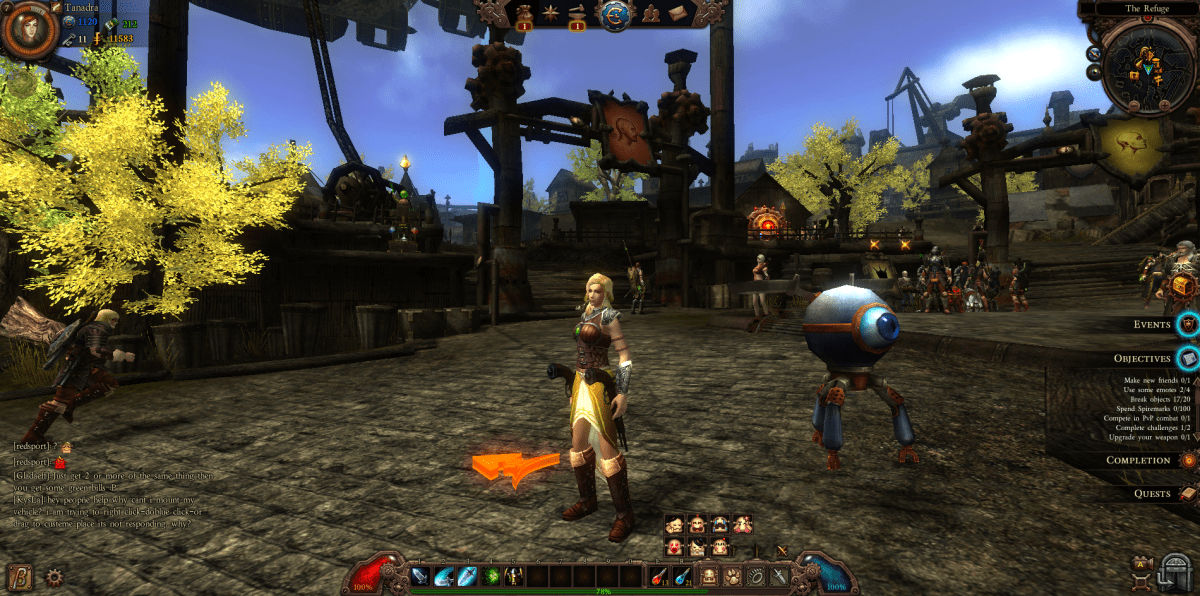

I’ve previewed City of Steam several times in the past, and I am very happy to see that the game is in a state of “soft launch,” ie: technically still in beta but the characters aren’t going to get wiped. In the past previews, I have pointed out that City of Steam isn’t breaking much ground in terms of gameplay: You talk to NPCs, take quests, go into dungeons, and kill stuff while looting stuff. The stuff you loot is equipped if it is better than your current stuff, or you can sell it to an NPC in return for medicine to heal you while you hunt for more stuff. What it does do is package a game that is familiar to all and deliver it without a client download.
So City of Steam isn’t so much a revolution of the genre as it is a slight evolution. Still, that doesn’t stop it from being a very fun game to play, so let’s go through the good, the bad, and the steamy.
1. The Good

City of Steam is the game that the folks at Unity should be utilizing to showcase the capabilities of their platform. The game runs entirely through the browser and manages to pull off amazing graphics without the need to sacrifice client stability or pull heavily from system resources. The engine powering City of Steam manages to render large numbers of objects, NPCs, and other players on screen with little to no performance drag or lag on the system.
At its core, City of Steam is closer to an ARPG than a traditional MMO, and that means you’ll be repeating content quite a bit in the search for more loot. Each hub area you come across has a number of dungeons, each of which carries the standard level which is used for many of your traditional quests and daily offerings. Each dungeon also carries two additional challenge versions that can be completed for extra rewards and involve tasks like killing a certain number of a certain monster, destroying objects, or opening chests. Quests are what you would expect from an mmo: killing things, collecting things, and talking to NPCs.
Although City of Steam throws you a lot of items that have no purpose other than stating in their description “sell me to a vendor,” the game makes excellent use of worthless equipment. Any weapons or armor you find can be salvaged into scrap metal, which can be used to upgrade your equipped items, leading me into my second favorite thing about City of Steam: Meaningful upgrades. My pistol, for instance, was able to be upgraded three times, bringing its damage rating from 9-14 all the way up to 24-37. Unlike many other games, City of Steam gives you a reason to keep your items for a good long time, essentially using the garbage you find along the way to add to the life span of the stuff you have equipped. It seems like a small part of the game from the outside, but the idea of your gear sticking with you longer than any other game would have it forms a deeper relationship between the player and their avatar.
City of Steam’s combat is solid, responsive, and attacks pack a real satisfying punch. The abilities you gain are useful, diverse, and rarely do you come across an ability that is functionally useless in one fashion or another. One of the hit or miss systems that appears in games like City of Steam is the factor of how much your character feels like a badass bringer-of-death on the battlefield, and City of Steam delivers ass kicking like it’s on the clearance rack at 75% off. Abilities are balanced pretty well, ensuring that you get to use your more powerful attacks without being too slow to recover.
2. The Bad

City of Steam violates the Rule of Privileged NPCs, a rule I made up that stems from when game engines were too basic to support things like line of sight or barriers, so oftentimes the developers wouldn’t properly code NPCs to not be able to do things like see through walls or shoot through them. The mobs in City of Steam break both of these barriers. I have had times where an NPC is standing right next to me and attacking me with melee, yet my gunner was unable to attack back until I re-positioned her. Other times I have seen NPCs shooting through closed doors. It is obnoxious, and also a pain when you’re running down a corridor and npcs in nearby hallways are activated because their aggro is based on proximity without regard to line of sight.
This leads me to my second and last major engine complaint, about the game’s geography and pathfinding which I have complained about before. This doesn’t happen a lot, but there is an existing problem with your character either getting stuck on the geometry when using click-to-move, or having problems initiating attacks if your enemies are either near or on the other side of doorways, narrow passages, or corners. I haven’t died from it yet, but it does make some parts of the game frustrating when your avatar simply refuses to attack or falls into this bug where the character is “attacking,” yet not doing any damage.
As a fan of the closed beta period, I’m not all that happy that the game was thrown down the simplification tree and managed to hit every branch along the way. Challenge dungeons have had their timers removed, along with the race-against-the-clock feel that made the more difficult dungeons so enjoyably frustrating. The leveling system has also seen a severe oversimplification, with talent upgrades consisting of choices like putting 200 points into steam, health, or dividing equally between the two. The ability system is equally simplified into one of three choices at level intervals.
What is worse is that, like an apartment built over an ancient Indian burial ground, there are still spirits roaming around to haunt and confuse new players. Dungeon challenges still feature challenge “ranks” even though they are just about meaningless and in many cases are impossible to achieve anything other than the highest rank (boss challenges have the same objective for all three ranks). You still gain ability points, even though once you choose an ability for the corresponding rank set, you don’t have any choice but to put it into that skill.
The cash shop is also going to be a pin in many player’s sides. The “cosmetic” aspect of the equipment sold in the shop is a flat out lie. The cosmetic equipment from the shop increases experience gain, shilling gain, and also increases your base damage to the tune of $17-25 depending on what you purchase. In order to revive yourself on the spot, you need to pay electrum (cash shop currency), there are unused weapon slots on the cash shop, and the game regularly harasses you to increase your inventory size via electrum.
3. The Conclusion
Like a can of soda left out in the sun, City of Steam tastes like it has flattened since we last saw it. There is little doubt that the leveling system has been drastically reduced in complexity, and that the game has been reshaped primarily around the expanded and rather expensive cash shop. And it’s obvious where these sudden changes are coming from: R2Games, a publisher well known for its pay to win systems. Now, Mechanist Games continues to claim (as they have told us) that they have final say on anything that goes into the game, kind of like how a man with a gun pointed up to his head will tell the neighbor who knocked on his front door “no, I’m perfectly fine and home alone, no need to call the police.”
How do I know R2 is calling the shots? Simply, that is is the case in virtually every publisher relationship, it just comes with the business. Otherwise, you could look into the City of Steam FAQ and see that not only is it filled with spelling errors and Engrish, the section was so lazily written that half of the questions have absolutely nothing to do with City of Steam.
I recognize that City of Steam is in open beta, which is why I have not made a single comment about bugs (apart from issues I see being engine-related and therefore unlikely to be 100% fixed) and the fact that there are races and . Those of you who have read MMO Fallout in the past know that I love City of Steam, it is one of my favorite games to come out in 2013, and I liked it enough that I partnered with Mechanist Games to hand out keys during the closed beta. I am still having a lot of fun with the current incarnation of City of Steam, even though I question some of the decisions that Mechanist Games made, City of Steam remains a solid game with a solid foundation and it is something I can see myself playing for a long time.
Those of you who read MMO Fallout know that I refuse to traffic in “prospects.” Every game has the promise of eventually being something better, and I refuse to advocate for a game based on the perceived quality that it may speculatively reach some day. What I will say is that this is a testament to how awesome City of Steam was in the closed beta, that I can sit here and , and then turn around and say that regardless of some of the elements that were changed for the worse, City of Steam is still looking toward launch as an awesome game.
 MMO Fallout