Less Massive: Valve Bans CSGO Servers That Falsify Inventories


globaloffensive

Valve has issued a warning to server owners in Counter Strike: Global Offensive that modifications that falsify player inventories are not allowed and must be removed before “further action is taken.” Since Valve’s games are heavily modifiable, players in the community quickly figured out methods to alter servers in order to provide players with weapon skins, items, and other goodies normally only accessible through random drops, lockboxes, and through the paid campaign modes.


  • Allowing players to claim temporary ownership of CS:GO items that are not in their inventory (Weapon skins, knives, etc.).
  • Providing a falsified competitive skill group and/or profile rank status or scoreboard coin (e.g., Operation Challenge Coins).
  • Interfering with systems that allow players to correctly access their own CS:GO inventories, items, or profile.
    [To clarify: it is also not acceptable to provide players with custom models and/or weapon skins that do not exist in the CS:GO ecosystem]

The blog post warns that further action will be taken to servers that do not comply with these rules.

We will continue to monitor the players experience on community servers, and may reevaluate if further actions need to be taken to ensure that server operators comply with the request above.

A few servers are already reporting bans via their Game Server Login Token with lengths of two decades. For the unaware, Counter Strike requires game servers to register a GSLT via a persistent account in order to accept players that aren’t on the same network. A new Steam account with a new qualifying phone number is required to open a new GSLT account.

(Source: Counter Strike: GO)

Less Massive Review: Tales From The Borderlands Episode 1


rhys-smash-card

(Note: This review contains spoilers for Borderlands 2.)

Telltale Games is easily one of my favorite game developers, proving the viability of AAA point and click adventure games in a world that had long since left the genre behind. The company spearheaded and successfully proved the viability of monthly episodic games, allowing players to buy the entire season with the added bonus of getting it all on dvd at the end for simply paying the shipping cost.

The idea of an episodic, intelligent, narrative take on the Borderlands universe is one that excited me greatly when it was announced earlier this year. I have a fondness for the Borderlands series, and while the series has progressed quite a bit since the first title, the games have never delved deep into the world in which your vault hunters live. All Borderlands needs to bring out its underbelly is a capable set of hands.

fiona-smash-card

Tales From The Borderlands is set after the events of Borderlands 2. Handsome Jack is dead and the Hyperion Corporation is going through a bit of a power vacuum. Vault Hunters are on the prowl looking for the newly discovered vaults, and Hyperion wants a piece of the pie. The story is told by two narrators. Rhys, a Hyperion employee, finds himself demoted to janitor and heads down to Pandora in an effort to screw over his boss and secure a vault key (and hopefully cement his real promotion). Fiona, a con artist, works on Pandora with her sister and adoptive mentor who absolutely won’t betray them, Felix.

As far as narrators go, you won’t find a pair less reliable than Rhys and Fiona, a factor that the game makes readily apparent from the start. The story shifts between perspectives, often going back and retelling the same story from the other character’s point of view, with both sides regularly contradicting each other. Who is telling the truth? Did Rhys really stand up to that group of psychos or did he wet himself and cry while the machine gun wielding robot did all of the work? That’s up to you to decide.

the-stranger

In their travels, the characters meet a variety of insane locals including my current favorite: Shade. The characters in this version are a lot more tame than their Borderlands counterparts, a more subtle comedy to match the slower pace of the game. As with previous games in Telltale’s lineup, Tales From The Borderlands has more in common with an interactive movie than a full-fledged action title. There are a few actiony moments here and there, mostly fed through quick time events, but anyone familiar with the Telltale Games series knows that these games are all about strong characters, powerful dialogue, and (more recently) giving the player choice to shape their game.

The best part is that the episodic nature allows Telltale to shape future episodes based on features players didn’t like or suggest. I can’t wait for episode 2 of Tales From The Borderlands, not to mention the upcoming Game of Thrones. Check it out on just about any device. Episode one is available now, with new episodes coming in the next few months.

vasquez

Less Massive: Afterfall Insanity Is Free, And Still Costs Too Much


2014-10-15_00001

If you follow MMO Fallout on Twitter, or even if you don’t and simply catch my tweets on the sidebar of this website, you might have followed a link yesterday to redeem a free copy of Afterfall Insanity. Well, after putting about six hours into the game, I can honestly say that I got out of this exactly what I paid in: Absolutely nothing. The simple fact that I knew what the twist ending was going to be not even five minutes into the story should have been the first sign, and probably the only one I needed.

Afterfall Insanity is a third person game from Intoxicate Studios. The game takes place in a fictional timeline where nuclear war breaks out and most of the world is destroyed. Thankfully, a small portion of humanity managed to survive by living in underground Fallout© shelters. You play as Albert Tokaj, a psychiatrist specializing in confinement syndrome who notices that the mental and physical status of those in his shelter is growing increasingly unstable. Is everyone going insane around Tokaj, or is he the one who is truly crazy? Spoiler: It’s him.

2014-10-16_00001

In the world of “survival horror” games, Afterfall Insanity is on the level of Syfy original movie. Like many other low-budget horror flicks before it, Afterfall Insanity sets out to tell a serious story and, in the process, unintentionally creates something so schlocky that the horror element is replaced by bad comedy. Tokaj flips from “I’m a doctor, I have to help these people” to beating insane people to death so fast, the player is bound to get whiplash from the experience. There is less than a minute between Tokaj punching his guard for abusing an insane person and him wielding a fire axe and chopping off limbs.

It’s hard to get motivated for the horror aspect of Afterfall when the voice actor playing Albert has the emotional range of stale roadkill. Just about all of the voice actors provide the kind of enthusiasm you’d expect from a high school student being picked to read a passage from Shakespeare. It’s the kind of voice acting that makes you suddenly appreciate the works of Tommy Wiseau, or the dramatic chops of Nicolas Cage. Throw that voice acting in with copious amounts of broken cutscenes that clip through actors and the environment, and shake in some mediocre animation, and you have a recipe for gaming’s Asylum Film company with none of the self-awareness.

I have to assume that Intoxicate Games developed Afterfall by looking at popular survival and horror games and plucking concepts to use, albeit half-cocked and unfinished. The melee combat system, by which you’ll find all sorts of pipes and axes lying around, is clearly taken from Condemned, minus the unique feel of each weapon that set Condemned apart. Melee combat in Afterfall is clunky, Albert will often take another swing or two after you’ve stopped clicking. Enemies get in cheap shots often, hit detection is poor at best, and blocking seems mostly useless since it doesn’t do much to mitigate damage.
2014-10-17_00003

Afterfall grabs fear aspects from various other titles, and implements them in a manner that is just as woody and inauthentic as the acting. Albert will get spooked when scary things happen around him, leading to the picture going fuzzy and aiming a gun becomes difficult, effectively meaningless if you’re using the melee weapons. There are puzzles in the game, most of which consist of repeatedly hitting the same button, or hitting the directional arrows in a random order based on trial and error.

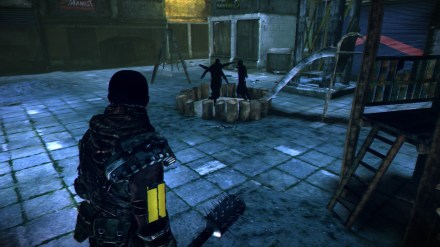
Which isn’t to say that the game falls completely flat. Afterfall is at its best when the developers aren’t trying as much. During the first half of the game, when your biggest adversary is the darkness and your limited flashlight, the game genuinely gets creepy. It is blatantly obvious from the beginning how the game is going to end, anyone who has played Spec Ops: The Line knows this tale back to front, but in that time where Albert loses his two bodyguards and must travel through the dark and creepy passageways alone, that is where the game hits its high points. Parts like silhouette children dancing in a circle are not scary.

There are so many better horror games on the market, and a lot of them come from indie developers like the Penumbra games and Amnesia: The Dark Descent. Instead of going for a game that picks random elements from other games, why not just play those games directly? Amnesia, Dead Space, Eternal Darkness, etc.