


I have to admit: When I saw that Richard Garriot’s new game was a Facebook social title, my heart sank. And then when I found out he was partnering with Zynga, the force of sudden massive compression caused my heart to tear itself inside out. Luckily, through the magic of modern science and a genetics laboratory hidden under my storage room, I have plenty of spares in case I need to set up another long winded joke that goes nowhere.
Richard Garriot’s Ultimate Collector (currently in beta) was a difficult game for me to convince myself to start playing, let alone write a quick look of. If there is one faction of the gaming industry that manages to boil my blood, it is the thousands of Facebook ad-driven, nickel and dime, pay-now-or-annoy-your-friends, energy driven games, that pass themselves off as enjoyable to anyone other than the most casual of gamers, housewives, and people with a lot of expendable money and not a lot of sense in how to spend it. Unfortunately for Ultimate Collector, it is not not one of those games. But hear me out.
Ultimate Collector was quite possibly conceived by a hoarder, and as someone whose habits border somewhere between pack rat and hoarder, I can’t honestly comment. But what struck me once I got to playing after a while was that every item in this game is a real, living, object. Apart from the trinkets which serve as quick cash, every serious sale you make is a real, true to life, branded toy. It could be a Gameboy Color, a copy of Paula Dean’s 1000 Ways to Fry Butter cookbook, Beanie Babies, pull toys from the 50’s, and more. In fact, someone who enjoys nostalgia may find the sheer number of items available in Ultimate Collector to make the game worth playing.
You might even be able to find Richard Garriot’s Ultima games. Oh and Tabula Rasa (never heard of it, personally).
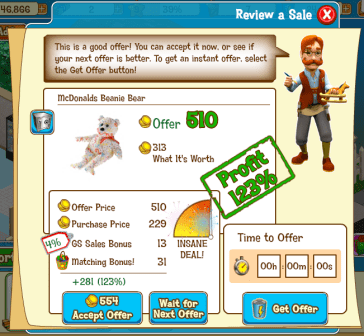
As you play, you’ll find that Ultimate Collector can be viewed in virtually brain dead mode, or you can play with a bit of strategy and foresight and really rake in the dough. When you buy an item, you lower the asking price by finding flaws, while raising your profit on resale by finding virtues. By recycling your less profitable goods rather than selling them, you retrieve parts that can be used to fix the more profitable items, making them even more profitable. So the game is about finding the balance in what is worth spending your energy in appraising, what is worth buying for spare parts, and what you should just leave in the bin.
But now we have to get to the part about the cash shop. Ultimate Collector is, after all, an energy based Facebook game, and that means every action has a cost. Each time you rummage through a bin, that’s an energy. Every time you appraise an item (five times per item), that’s an energy. Don’t want to wait for the auction to finish? That’s a Portcash (cash shop money). Don’t want to wait until tomorrow to gain your energy back? You can also spend Portcash on that. Although you gain an energy every few minutes, so the wait to refill your bar is just a few hours if not less.
And for what it’s worth, Ultimate Collector does try to throw a bone by increasing your maximum energy with leveling, and throwing Portcash at the player every now and then. Additionally, buying and selling goods raises your experience in that particular field, which in turn results in more free appraisals saving the user more energy. So there is the feeling that, while corporate won out in the end, the folks on the development side at least tried to give the user a break.

And if you are playing casually, you likely won’t spend a dime on Ultimate Collector anyway. With the way I play, I log in once or twice a day to salvage someone’s garage sale, bring the goods back to my house and see how much money I’ve made from the previous day’s sales, and then put the new stuff up for sale. For me, however, Ultimate Collector is more than just a Facebook game. It is a sign that Richard Garriot has gone back to the man I once knew and always anticipated his next announcement with held breath. The guy who made games that were basic yet filled with depth, were created with an obsessive amount of attention to detail, and occasionally make you wonder if the creator was insane from the start. Ultimate Collector has renewed the faith in Richard Garriot that I lost when Tabula Rasa went down in flames as its development team struggled to keep it alive.
I am really looking forward to seeing Ultimate RPG.

 MMO Fallout