Bigpoint Lays Off 120, Halts Development in United States


Bigpoint has abandoned development in the United States, according to a news piece by Gamasutra released today. The bad news comes alongside even worse: 120 employees have been laid off from the free to play publisher, over a third if whom are from the San Francisco studio. The layoffs are due to the cost of labor in San Francisco, as well as competing with other studios in the area for skilled work.

Founder and CEO Henrik Hubertz has stepped down from his role, citing unrelated reasons. Speaking to Gamasutra, Hubertz gave his own insight into Bigpoint.

The games that we have developed in the last two years haven’t been that successful, and the San Francisco area and Bay Area is quite a competitive market,

The other 80 layoffs came from Bigpoint’s office in Hamburg, mostly in administration. None of Bigpoint’s current projects have been affected by these layoffs.

(Source: Gamasutra)

Drakensang Relates To Diablo III and Torchlight 2


Bigpoint’s dungeon crawler Drakensang Online doesn’t just have the big mouth of its developer to back it up, it drives around in its Lamborghini waving around the wad of dosh to anyone willing to take a glance. I took a look at the game back in February and found it to be an enjoyable game despite its focused reliance on the cash shop and regular sales.

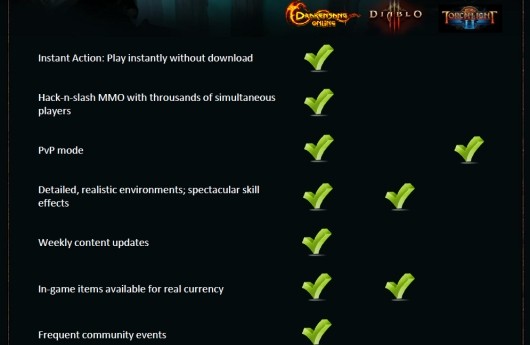
But Bigpoint went even further in its latest press email, detailing everything that Drakensang Online is that Diablo III and Torchlight II are not. It might be a bit unfair to throw in comparisons of “weekly content updates” and “frequent community events” in relation to two games that haven’t even been released yet, but then again Bigpoint isn’t known to be subtle in their advertising.

We’ll see if Bigpoint is writing a check its tush can cash when Diablo III launches in a few weeks, with Torchlight following hopefully this year.

Why Aren’t You Playing: Drakensang Online


[Addendum: I mistakenly stated that Drakensang Online was built on the Unity Platform. This was incorrect, it is built off of Bigpoint’s Nebula3 engine.]

Drakensang Online is a straight up isometric dungeon crawler, ala Diablo, and for me that is enough of a reason to at least pick the game up and give it a play through. For fans of dungeon crawlers, Drakensang does not disappoint. Otherwise, the game doesn’t have much to offer outside of the wholesale slaughter of minions and collecting of gear with incrementally higher stats.

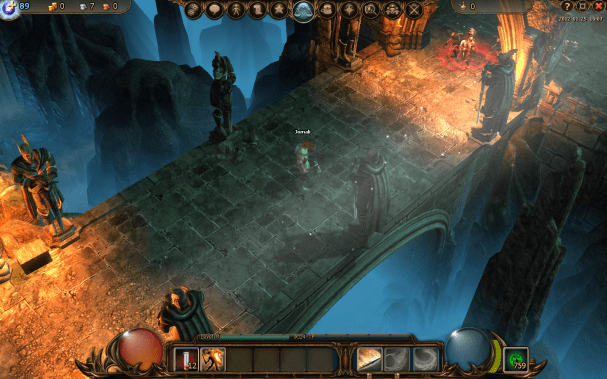
The first thing you’ll notice about Drakensang is that the game looks and sounds great. Not great as in comparable to your full client games, but the Nebula3 engine does an excellent job of cramming as much visual quality as it can into the tiny browser package.

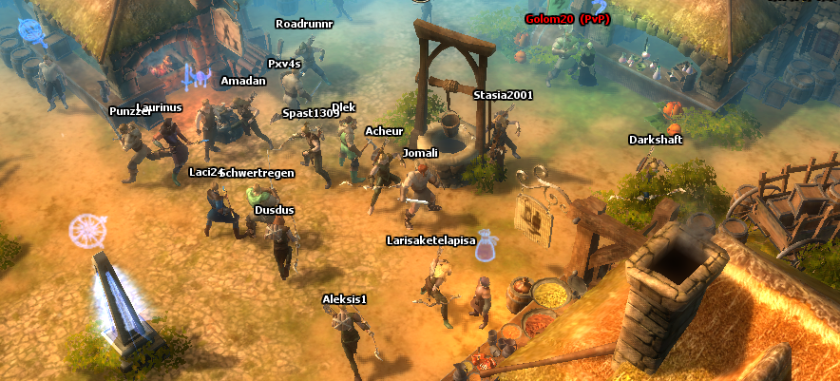
Combat handles fluidly with very minor targeting issues. Most of your game time will consist of walking around city hubs with other players, upgrading your equipment, selling your vast quantity of loot, and taking on quests. The quests are the usual fashion of “kill ten rats,” “kill rats until they drop ten buckets” and “use items on nodes.” PvP takes place either through consensual open world or through team battlegrounds.

Following the lead of Diablo3, Drakensang employs a mechanic of health orbs that drop during battle that can be picked up to restore health. Bosses drop these at regular intervals as their health is whittled away, and they replace the necessity of carrying and sucking down large quantities of potions. In addition, while your list of abilities is rather small in comparison to most MMOs, you’re likely to find a proper use for each ability granted to you.

The cash shop in Drakensang is powered by Andermant, a currency that can be slowly obtained through normal gameplay via quest rewards and random drops, or via real money at a base rate of $2 for 1,600 up to 246,700 (odd number) for $200 (a 35% saving!). Andermant can be used to purchase temporary buffs in experience and strength/defense. To expand your inventory to its maximum storage (49 extra spaces) would cost you over $200, or 249,600 Andermant.

For what it is worth, I manage to accumulate at least forty Andermant in each play period (around an hour, sometimes less), most of which I put into upgrading my weapons and armor. You’ll come across chests in dungeons that require keys that can only be purchased with Andermant, to which I can only say give them a pass. I haven’t had a single chest open that was worth the hundreds of Andermant that the keys cost.

If you were one of those people who passed up on Torchlight because it didn’t have any multiplayer (and thus no PvP) and played Diablo and Diablo II primarily for the PvP, you will likely be put off by the presence of the pay-for-advantage system. Otherwise, I can’t see PvE focused players getting angry that somewhere, someone is killing bosses in one or two less hits. And even if you get bored with Drakensang, you can always return. It isn’t going anywhere, not with Bigpoint’s profit margins.

Drakensang Online isn’t exactly a deep game, but then again fans of the genre are likely here for the same reason people enjoy Serious Sam, for the hacking, slashing, spell flinging, and masses of limbs and entrails flying every which way. It is popular, open world PvP is consensual, and the cash shop is generous (to an extent) if you’d rather not throw real money in. Everyone of the same class looks virtually the same, but that factor quickly moves aside to the actual meat of the game: Gremlin genocide.

Why Aren't You Playing: Drakensang Online


[Addendum: I mistakenly stated that Drakensang Online was built on the Unity Platform. This was incorrect, it is built off of Bigpoint’s Nebula3 engine.]

Drakensang Online is a straight up isometric dungeon crawler, ala Diablo, and for me that is enough of a reason to at least pick the game up and give it a play through. For fans of dungeon crawlers, Drakensang does not disappoint. Otherwise, the game doesn’t have much to offer outside of the wholesale slaughter of minions and collecting of gear with incrementally higher stats.

The first thing you’ll notice about Drakensang is that the game looks and sounds great. Not great as in comparable to your full client games, but the Nebula3 engine does an excellent job of cramming as much visual quality as it can into the tiny browser package.

Combat handles fluidly with very minor targeting issues. Most of your game time will consist of walking around city hubs with other players, upgrading your equipment, selling your vast quantity of loot, and taking on quests. The quests are the usual fashion of “kill ten rats,” “kill rats until they drop ten buckets” and “use items on nodes.” PvP takes place either through consensual open world or through team battlegrounds.

Following the lead of Diablo3, Drakensang employs a mechanic of health orbs that drop during battle that can be picked up to restore health. Bosses drop these at regular intervals as their health is whittled away, and they replace the necessity of carrying and sucking down large quantities of potions. In addition, while your list of abilities is rather small in comparison to most MMOs, you’re likely to find a proper use for each ability granted to you.

The cash shop in Drakensang is powered by Andermant, a currency that can be slowly obtained through normal gameplay via quest rewards and random drops, or via real money at a base rate of $2 for 1,600 up to 246,700 (odd number) for $200 (a 35% saving!). Andermant can be used to purchase temporary buffs in experience and strength/defense. To expand your inventory to its maximum storage (49 extra spaces) would cost you over $200, or 249,600 Andermant.

For what it is worth, I manage to accumulate at least forty Andermant in each play period (around an hour, sometimes less), most of which I put into upgrading my weapons and armor. You’ll come across chests in dungeons that require keys that can only be purchased with Andermant, to which I can only say give them a pass. I haven’t had a single chest open that was worth the hundreds of Andermant that the keys cost.

If you were one of those people who passed up on Torchlight because it didn’t have any multiplayer (and thus no PvP) and played Diablo and Diablo II primarily for the PvP, you will likely be put off by the presence of the pay-for-advantage system. Otherwise, I can’t see PvE focused players getting angry that somewhere, someone is killing bosses in one or two less hits. And even if you get bored with Drakensang, you can always return. It isn’t going anywhere, not with Bigpoint’s profit margins.

Drakensang Online isn’t exactly a deep game, but then again fans of the genre are likely here for the same reason people enjoy Serious Sam, for the hacking, slashing, spell flinging, and masses of limbs and entrails flying every which way. It is popular, open world PvP is consensual, and the cash shop is generous (to an extent) if you’d rather not throw real money in. Everyone of the same class looks virtually the same, but that factor quickly moves aside to the actual meat of the game: Gremlin genocide.

Bigpoint: 250 Million Registered Accounts


Bigpoint Games notoriously has a big mouth when it comes to pointing out their accomplishments, and despite the objections of some of the gaming community over the publisher’s very blatant and self-noted pay-for-advantage model, the company continues to post major profits and major user numbers. Today, the publisher announced that their portfolio of over 60 games has brought in more than 250 million registered accounts. That’s enough accounts for around 3% of the world’s population to have an account.

As I’ve said before, Bigpoint has been consistently up front about selling power in their games, and very successfully at that. The developer raked in revenues of $200 million in 2010, and that number continues to grow as they add more titles to their lineup.

(Source: Bigpoint press release)