Who is in first place? Le me (not me).
Continue reading “RuneScape: 125 Players Hit 99 Archaeology In Week One”

Who is in first place? Le me (not me).
Continue reading “RuneScape: 125 Players Hit 99 Archaeology In Week One”

Mining & Smithing are widely regarded as extremely antiquated skills in RuneScape, as Jagex essentially filled out the skill without much future proofing. Both skills were released in 2001 and have received sporadic updates throughout the years to boost their usefulness, but it can hardly be argued that either skill has been left behind as the game has progressed. Requiring 85 mining (of the 99 skill cap) to mine Rune and 85-99 smithing to create its equipment made a lot more sense in 2001 when rune was the best armor in the game (which it still is for non-members) and rune was incredibly rare with two very slowly spawning nodes deep in the player-vs-player wilderness.
One thing that’s obvious about this planned update is that both skills are see a slowdown in production,
Mining appears to be going for predictability and ease of access. In current RuneScape, mining is essentially handled by dice roll, with every strike giving the chance to collect an ore based on your mining level, the level of the rock, and your quality of pickaxe. For most ores in the game, the rock depletes after one strike and you have to wait for it to refresh before it can be struck again.
Under the new system, instead of offering a chance with each strike, Jagex is going for predictability by introducing a timed slider which grants an ore once it fills up, its speed decided by your level, quality of pickaxe, and quality of ore. In addition, it looks like all of the ore will be moved over to a community, non-competitive style with ore nodes that do not deplete. While this does mean that it’ll be more possible to mine while not paying full attention, you’ll still want to check in every so often and click the ore to restore your stamina bar, which will slow down gathering as it depletes.

Smithing on the other hand appears to be going for slower production but more returns per creation, so you won’t be pumping out hundreds of swords per hour but the experience you receive per sword will be better than the system that currently exists. Right now smithing is a simple operation of clicking on an anvil with the ore in your inventory, selecting what you want to create, and pressing a button. The new system appears to be promoting creating less items by putting more emphasis on re-smithing what you’ve already created. Items can be upgraded six times up to “decorated,” at which the item can no longer be equipped but can be traded in for a lump sum of experience. According to Jagex staff’s in-game comments, upgrading is intended to be the fast, expensive method of training with leveling by creating items from scratch being the slow, cheap method.
Smithing anvils will be situated next to forges, and now you have to keep your metal heated in order to work it into shape (for realism). This translates into a heat meter that depletes as your creation meter progresses, meaning you’ll occasionally need to stop and reheat the metal before continuing. Right now this process is incredibly slow, but there are planned changes to make your heat last longer as you level up. Coal has also been replaced with a new luminite ore as an ingredient to smith adamant and rune armor, and the existing equipment has been condensed down to level 50 with new ores/armor filling in the remaining levels.
Finally, there is an idea of convenience that has been sorely missing from mining and smithing since its inception. Since both skills are built around the idea of mass production, a lot of the time is currently spent running with limited inventory (28 spaces plus some limited options for holding coal) running to and from the bank. With this rework, players will be given an ore bag which can drastically increase the amount of time you spend mining before having to go bank. The numbers will most likely change before launch, however during the beta I could fit about 200 tin ore (level 1) and 100 living ore (top level) into the bag. On the smithing side, you’ll be able to fill a universal hopper with ore and bars that can be accessed from any anvil, removing the need to go to and from the bank with a sack full of ore.

Looking at some of Jagex’s available design documents, the company is taking into account all of the potential issues that this rework will create, including possible threats toward the value of existing, non-craftable equipment.
I’m looking forward to how this new system will shake up a system that has more or less stayed the same for the last seventeen years.

Old School RuneScape isn’t simply about allowing disgruntled players to relive the golden days of the past, since its introduction earlier this year the offshoot has gone in a rather separate direction from its New School counterpart. Thanks to a content system where updates are suggested and then voted on by the community, with nothing making its way in unless the majority say yes, Old School RuneScape has seen a few content updates from past its time, like optional hud improvements and even the god wars dungeon and godswords. The players even managed to vote in content that never existed back in the day, like new items and interfaces and even a new skill.
Designed by a member of the community and voted on by players, the Artisan skill is a bit like a craftsman’s take on slayer, where a slayer master gives assignments to kill certain creatures. In Artisan, an artisan master gives assignments to craft specific items in return for experience, the benefit being that you level in any related skills simultaneously. Players will be able to craft creature idols which, when burned, offer combat boosts. Players will also be able to learn how to craft special items that boost other skills, like cooking better quality food or new clothing.
You can check it all out at the dev blog below.
(Source: Old School RuneScape)

Divination is the latest skill to be released in RuneScape, and it is certainly interesting. The premise of the skill is that after the god Guthix is assassinated, the resulting fallout caused immense damage to the world in which the game takes place. Guthix’s life energy dispersed in the form of wisps, a combination of divine energy and memories. The divine energy is the force that once protected the world of Gielinor, but was shattered and sent raining down from the heavens upon Guthix’s death. By harvesting wisps for their divine energy and memories and return them to various craters located around the world, in the hope that this will heal the damaged planet.
It’s important to remember that Divination is a gathering skill, not unlike Fishing, Woodcutting, Mining, etc. With that knowledge, training Divination is a slow trudge through a seemingly endless bog of grind. You start out at level one with the basic wisps, and every ten levels you leave your current spot and make your way to the next tier of wisps. An oversimplification? Yes, but if you play RuneScape then you already know that this is generally how gathering skills work, except Divination doesn’t give you the piles of items to sell off at the end of the day.
As a gathering skill, Divination is meant to complement other skills. Fishing gives resources to cooking, mining to smithing, farming to herblore, etc. Divine energy can be weaved into portents and signs, powerful items that are carried in the inventory and activated automatically. These items offer benefits including automatic healing once your health drops below half, the ability to save more items upon death, increased gravestone timers, resurrection on the spot, automatic banking of items collected, and more.
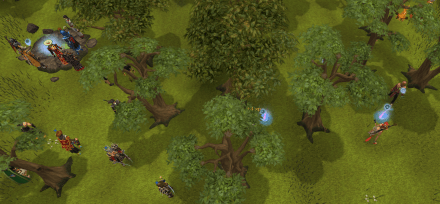
Divine Locations are one of Divination’s odder creations. Locations are essentially skill hotspots that are weaved and placed down, allowing anyone around to harvest before it disappears (generally after 30 seconds). The lesson to take home is sharing is caring, and Divination rewards plopping down your divine location in a crowded area by just handing you resources as other players harvest them. The downside to divine locations is that only one can be put down per day, and you can only harvest a limited amount of those created by other players.
And finally, players have access as they level up to abilities that allow them to “upgrade” resources of lower level to those of higher level. While it sounds cool to convert three coal into a mithril ore, or two trout into a tuna, the RuneScape Wiki shows that you’d be better off just selling the resources and buying the higher material at a profit.
Ultimately, Divination is a means to an end. Divine energy can be traded to other players at the benefit/cost of experience gain. Many signs and portents can be traded, but odds are most of your divine energy is better spent boosting your experience gain towards the next tier of wisps.

 MMO Fallout