Bigpoint: 250 Million Registered Accounts


Bigpoint Games notoriously has a big mouth when it comes to pointing out their accomplishments, and despite the objections of some of the gaming community over the publisher’s very blatant and self-noted pay-for-advantage model, the company continues to post major profits and major user numbers. Today, the publisher announced that their portfolio of over 60 games has brought in more than 250 million registered accounts. That’s enough accounts for around 3% of the world’s population to have an account.

As I’ve said before, Bigpoint has been consistently up front about selling power in their games, and very successfully at that. The developer raked in revenues of $200 million in 2010, and that number continues to grow as they add more titles to their lineup.

(Source: Bigpoint press release)

Perpetuum: When One Person Can Ruin Everyone's Fun


I’ve talked about disgruntled customers in the past, and once or twice about how occasionally those people happen to have access to say intimate knowledge of SQL database exploits or how to launch denial of service attacks, not that the latter requires much technical prowess. To make matters worse, while large businesses require denial of service attacks on an equally large scale, for smaller developers it often doesn’t take much to knock the website/game offline or to at least put a dent in the service’s stability.

Here at MMO Fallout, we love Perpetuum Online and most indie MMOs for that matter. So when an alleged disgruntled ex-player allegedly starts a denial of service attack against the game servers, we take notice. Dev Gargaj posted the following on Perpetuum’s forums:

Now, I’ll say this first that I’m not a network expert so my conclusions might be wrong but here’s how I saw the situation: Every now and then the login-server would get a huge (sometimes up to 80MB/s, though I suppose this includes TCP/IP overhead) burst of external traffic for about 15 minutes or so, and then it would go back to normal. I did some testing with a variety of network tools, and found out that the traffic is mostly aimed at port 139 (NetBIOS) which we have firewalled out, but still it would cause such a network congestion that it’d cause some connections to time out. This traffic came from thousands of endpoints all over the world, including countries where we have no (awareness of) players from (Peru, Egypt, etc.).

In short, from what I can deduce with my fairly modest knowledge about networks, we just got DDOS’d. Because our cluster works with a login server (which is a single point of failure), we were sitting ducks. Our firewall, on inspection (and contrary what I may have been saying earlier) was configured just fine, but the network itself became a bottleneck for the incoming traffic, something we couldn’t do anything about.

The announcement was posted on the 19th of January, but reportedly the attacks have been ongoing since then. Again, it’s worth noting that there isn’t any hard evidence that this is the work of a disgruntled player, but that the theory is merely speculation considering how targeted the attacks are (attacking specifically the login server rather than the cluster as a whole). Players are reporting instances of not being able to log in, and several Perpetuum traffic tracking services have been disabled without explanation (that I have found).

Still, one of the benefits of a game like Perpetuum is the community’s ability to stand together and draw swords against a common threat, against the attacker rather than the victim. Take for instance from another thread on the Perpetuum forums, Lupus Aurelius.

Also, if indeed this is due to a disgruntled player/explayer, we also need to send a clear message that no matter what they do, we will not waiver in support of Perpetuum and the DEVs, and that NO EXTERNAL ACTION BY ANYONE WILL CAUSE US TO EITHER CEASE PLAYING OR CAUSE US NOT TO RESUB! 

NO ONE, WHATEVER THEIR GRIEVANCE, HAS THE RIGHT TO DENY US OUR RIGHT TO CONTINUE TO ENJOY PERPETUUM!

They may take our bandwidth, but they’ll never take our freedom! As Lupus points out in the thread, any information regarding who might be behind these attacks should be reported directly to the development team at Perpetuum Online.

Perpetuum: When One Person Can Ruin Everyone’s Fun


I’ve talked about disgruntled customers in the past, and once or twice about how occasionally those people happen to have access to say intimate knowledge of SQL database exploits or how to launch denial of service attacks, not that the latter requires much technical prowess. To make matters worse, while large businesses require denial of service attacks on an equally large scale, for smaller developers it often doesn’t take much to knock the website/game offline or to at least put a dent in the service’s stability.

Here at MMO Fallout, we love Perpetuum Online and most indie MMOs for that matter. So when an alleged disgruntled ex-player allegedly starts a denial of service attack against the game servers, we take notice. Dev Gargaj posted the following on Perpetuum’s forums:

Now, I’ll say this first that I’m not a network expert so my conclusions might be wrong but here’s how I saw the situation: Every now and then the login-server would get a huge (sometimes up to 80MB/s, though I suppose this includes TCP/IP overhead) burst of external traffic for about 15 minutes or so, and then it would go back to normal. I did some testing with a variety of network tools, and found out that the traffic is mostly aimed at port 139 (NetBIOS) which we have firewalled out, but still it would cause such a network congestion that it’d cause some connections to time out. This traffic came from thousands of endpoints all over the world, including countries where we have no (awareness of) players from (Peru, Egypt, etc.).

In short, from what I can deduce with my fairly modest knowledge about networks, we just got DDOS’d. Because our cluster works with a login server (which is a single point of failure), we were sitting ducks. Our firewall, on inspection (and contrary what I may have been saying earlier) was configured just fine, but the network itself became a bottleneck for the incoming traffic, something we couldn’t do anything about.

The announcement was posted on the 19th of January, but reportedly the attacks have been ongoing since then. Again, it’s worth noting that there isn’t any hard evidence that this is the work of a disgruntled player, but that the theory is merely speculation considering how targeted the attacks are (attacking specifically the login server rather than the cluster as a whole). Players are reporting instances of not being able to log in, and several Perpetuum traffic tracking services have been disabled without explanation (that I have found).

Still, one of the benefits of a game like Perpetuum is the community’s ability to stand together and draw swords against a common threat, against the attacker rather than the victim. Take for instance from another thread on the Perpetuum forums, Lupus Aurelius.

Also, if indeed this is due to a disgruntled player/explayer, we also need to send a clear message that no matter what they do, we will not waiver in support of Perpetuum and the DEVs, and that NO EXTERNAL ACTION BY ANYONE WILL CAUSE US TO EITHER CEASE PLAYING OR CAUSE US NOT TO RESUB! 

NO ONE, WHATEVER THEIR GRIEVANCE, HAS THE RIGHT TO DENY US OUR RIGHT TO CONTINUE TO ENJOY PERPETUUM!

They may take our bandwidth, but they’ll never take our freedom! As Lupus points out in the thread, any information regarding who might be behind these attacks should be reported directly to the development team at Perpetuum Online.

Sony Shuttering Everquest On Mac


Everquest on Mac is interesting, to say the least. Almost like Everquest Online Adventures, Everquest Macintosh is a rather different game than Everquest on Windows. Released in 2003, EQMac lost pace with Everquest’s development a long time ago, leaving it very far behind in terms of development. But even without the same level of support as standard Everquest, the servers have gathered a rather close community of players, not to mention regular events with Sony staff. So, naturally, more than a few hearts will be broken with the announcement that Everquest Mac will be shutting down in March.

On Thursday, March 29, 2012, the Al’Kabor server and the EverQuest: Macintosh Edition will be closing. EverQuest: Macintosh Edition has had a wonderful run, seeing an incredible tightly-knit community band together to accomplish feats of heroism that remain unsurpassed in the annals of MMORPGs. Overcoming the challenges of the Planes of Power in their near original form is not a task for those who are not dedicated to victory, and we here at SOE are in awe of your dedication and commitment.

As far as compensation goes, Sony is going as far as sending a check by mail if you paid far in advance via SOE game cards or other retail cards.

We will stop all billing for EverQuest: Macintosh Edition on January 31, 2012. For players who have purchased prepaid time via a membership/subscription plan, SOE Game Card or other retail game card that extends the subscription period past January 30, 2012, SOE will provide a pro-rated refund for the time left on the subscription after that date. If a valid credit card is active on your account, any refund will be applied to such credit card. If your account is paid via an SOE Game Card or other retail game card, we will send a check in the refund amount to your current billing address within 90 days after the game ends. Please be sure to update your email and mailing address in your Station Account as this may be critical to the refund process.

It’s always disappointing to see a game shut down, especially in cases like this where only a specific section of the community is being cut off.

(Source: Everquest Forums)

TERA Can't Escape Licencing, IP Blocks Coming


Back when Bluehole announced that TERA would have no region restrictions whatsoever, I was admittedly skeptical. An MMO without regional restrictions generally spawns from one of a few circumstances: The same company is publishing it in all regions ala City of Heroes, or there is only one worldwide server ala Eve Online and Mortal Online. In the case of TERA, back in 2010 Bluehole announced that while the clients are region specific, there was nothing stopping someone in Europe from purchasing a North American client and playing on those servers.

Not the case. If Bluehole truly wanted cross-oceanic play, this idea was met with a dead “negative” by the game’s publishers. Bluehole did make this statement to Massively:

We had to change our stance on IP restrictions due to licensing and security issues. While we can’t go into the reasons in detail, we would like to say that although these restrictions are not a panacea for preventing hacking, they are highly effective, and produce more positive results than might be expected.

So licencing reasons. Restricting IP addresses will not accomplish much in preventing gold farmers in Russia or China from accessing North American and European services or stolen accounts, considering ease of use in a proxy. Unfortunately, these IP restrictions also mean that certain regions aren’t able to play the game until a publisher picks up the title in that region. In many cases, the game just never releases in those regions.

Still, this is another example of what happens when you let the developers make announcements about decisions that should be handled by corporate. If TERA had announced from the start that there would be region restrictions (or had they not waited a year and change to go back on that statement) than this wouldn’t even be an issue (save for the regions that can’t play at all).

TERA launches in May for North America and Europe and is being published by En Masse Entertainment (North America) and Frogster Interactive (Europe). Read up on Bluehole Studios’ lawsuit with NCSoft here.

TERA Can’t Escape Licencing, IP Blocks Coming


Back when Bluehole announced that TERA would have no region restrictions whatsoever, I was admittedly skeptical. An MMO without regional restrictions generally spawns from one of a few circumstances: The same company is publishing it in all regions ala City of Heroes, or there is only one worldwide server ala Eve Online and Mortal Online. In the case of TERA, back in 2010 Bluehole announced that while the clients are region specific, there was nothing stopping someone in Europe from purchasing a North American client and playing on those servers.

Not the case. If Bluehole truly wanted cross-oceanic play, this idea was met with a dead “negative” by the game’s publishers. Bluehole did make this statement to Massively:

We had to change our stance on IP restrictions due to licensing and security issues. While we can’t go into the reasons in detail, we would like to say that although these restrictions are not a panacea for preventing hacking, they are highly effective, and produce more positive results than might be expected.

So licencing reasons. Restricting IP addresses will not accomplish much in preventing gold farmers in Russia or China from accessing North American and European services or stolen accounts, considering ease of use in a proxy. Unfortunately, these IP restrictions also mean that certain regions aren’t able to play the game until a publisher picks up the title in that region. In many cases, the game just never releases in those regions.

Still, this is another example of what happens when you let the developers make announcements about decisions that should be handled by corporate. If TERA had announced from the start that there would be region restrictions (or had they not waited a year and change to go back on that statement) than this wouldn’t even be an issue (save for the regions that can’t play at all).

TERA launches in May for North America and Europe and is being published by En Masse Entertainment (North America) and Frogster Interactive (Europe). Read up on Bluehole Studios’ lawsuit with NCSoft here.

Everquest Officially Free to Play in March


Someone call my doctor, nutritionist, and accountant, and find me enough provisions to last until I die. With Sony’s multitude of announcements over free to play, the titles have been falling like dominos. Everquest 2, Planetside 2, DC Universe, Pirates of the Burning Sea, and the possibility of Vanguard at some point, the idea that Everquest might go free to play is both exciting and unsurprising at the same time. So, behold! Everquest is moving free to play in March.

So what can I expect for free, you ask patiently. Everything, well mostly. Everquest is following a similar tier of payment to its predecessors. Tiers are divided between free, silver (past subscribers and gold subscribers. Free players have access to all content up to the seventeenth expansion (House of Thule) with Veil of Alaris purchasable. Free players are restricted to Human, Erudite, Barbarian, and Gnome races, as well as warrior, cleric, wizard, and rogue classes, with the rest purchasable. Free and silver members are also restricted to rank 1 spells, among a few other restrictions you might expect. Bag slots, mail and chat, guild, coin purse, quest limit, etc.

you can find the whole matrix here, there is really too much to discuss here.

More on the transition as it appears.

Jagex Unveils 'Optimus' Anti-Bot Technology


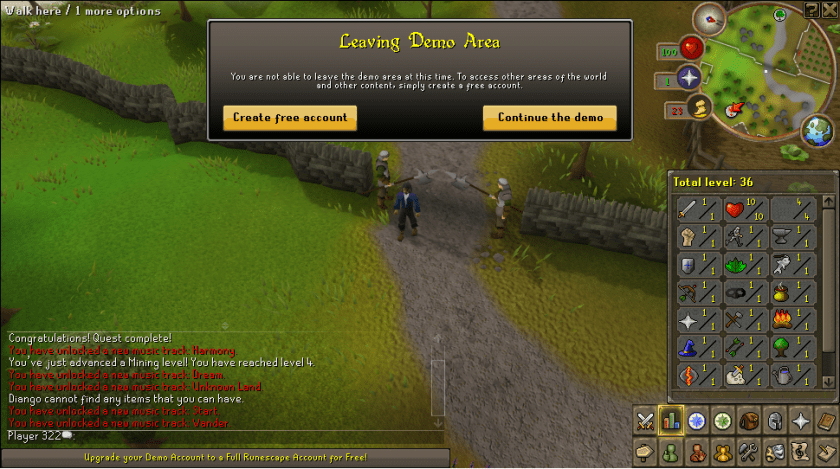
I don’t think I’ve used that screenshot in almost two years. Last October, Jagex accomplished what many of us had thought to be impossible: busted a grand majority of the bots in RuneScape in one single move known today as Bot Nuke Day, or Project Clusterfutterer. The update demolished reflection and injection bots, or 98% of the bot community according to Jagex’s estimations, and has proven to be successful enough that 40% of the player base was banned within the following month.

On the main RuneScape website, Jagex is enjoying their recent major victory over a major bot writer in a recently settled case, and they announced plans for even more bot eradication, this time focusing on the more basic bots that auto-click or search the screen for specific colors.

We remain committed to our ongoing work to ensure that the successes of Bot Nuke Day are never undone by staying a few steps ahead in the arms race with the remaining bot developers and gold farmers. We’re already well underway with our next generation of anti-botting software called Optimus, which is going to be released shortly, and we’re also currently developing ways to remove the remaining screen-scraper bots from the game. We’ll also be continuing to fight gold-farmers on every front.

Jagex has done quite a bit over the past months to completely rid their game of cheaters and scam artists, from the bot nuke back in October to the removal of popular gambling tools. With the upcoming Stellar Dawn and Transformers Online, Jagex losing their reputation as saturated with cheaters can only boost the game’s receptions.

Jagex Unveils ‘Optimus’ Anti-Bot Technology


I don’t think I’ve used that screenshot in almost two years. Last October, Jagex accomplished what many of us had thought to be impossible: busted a grand majority of the bots in RuneScape in one single move known today as Bot Nuke Day, or Project Clusterfutterer. The update demolished reflection and injection bots, or 98% of the bot community according to Jagex’s estimations, and has proven to be successful enough that 40% of the player base was banned within the following month.

On the main RuneScape website, Jagex is enjoying their recent major victory over a major bot writer in a recently settled case, and they announced plans for even more bot eradication, this time focusing on the more basic bots that auto-click or search the screen for specific colors.

We remain committed to our ongoing work to ensure that the successes of Bot Nuke Day are never undone by staying a few steps ahead in the arms race with the remaining bot developers and gold farmers. We’re already well underway with our next generation of anti-botting software called Optimus, which is going to be released shortly, and we’re also currently developing ways to remove the remaining screen-scraper bots from the game. We’ll also be continuing to fight gold-farmers on every front.

Jagex has done quite a bit over the past months to completely rid their game of cheaters and scam artists, from the bot nuke back in October to the removal of popular gambling tools. With the upcoming Stellar Dawn and Transformers Online, Jagex losing their reputation as saturated with cheaters can only boost the game’s receptions.