
You’ve got the whole universe in your hands.
Tag: browser
Eve Anywhere Brings Excel To Browsers
Play your favorite space spreadsheet simulator anywhere.
Online Text RPG Torn Coming To Android In May

You just don’t hear about large-scale text based games these days, but Torn has been rather quietly seeing massive success on desktop PCs. Launched 14 years ago, Torn bills itself as the game that Mafia Wars was built on. It lets players build a life in the city as a business owner, mob boss, or somewhere in between. You can take part in robberies, invest in the stock market, race cars, manage properties, the sky is the limit.
Continuing its success on PC, which has seen more than 2 million players worldwide and 20 thousand daily active users, Torn will be coming to Android devices on May 8. Alternately you can play right now by visiting the link down below.
MMO Fallout should be running some preview coverage of the mobile version at some point in the future.
(Source: Torn)
Heroes & Generals Rewards Team Play In Hallowes Update

Heroes & Generals is bringing in team rewards and phasing out its browser version. In an update dubbed Hallowes – XP for Friends, players will now find that acting as a team has its own rewards. The game now rewards experience for kill assists, protecting the team’s tank, and when other players use your vehicle’s weapons. The list of patch notes is massive, with tweaks to maps, guns, and more.
“As part of the update all maps have been improved to ensure a better gameflow and allow for more intense battles. Tweaks have been made to the animation system resulting in a smoother visual experience. And we have added more bicycles to the game.” -Jacob Anderson, Game Director Reto Moto
In addition to these tweaks, the browser version of Heroes & Generals is being retired in favor of the stand-alone client and Steam. The Reto-Moto team revealed that this decision is due to decreasing support from browsers for plugins.
(Source: Patch notes)
Wild Terra Now Playable In Browsers

Developer Juvty Worlds has announced that their open world sandbox game Wild Terra is now playable in your browser. Anyone who owns the game can log in to one of the game’s two servers (international and Russian), and start playing without having to download the full client. For those who haven’t purchased the game, they can do so at a reduced price as the game is presently on sale.
(Source: Juvty Worlds Press Release)
Lord of Ultima Shutting Down
No, not that Ultima. Lord of Ultima is the browser-based kingdom building game that loosely shared the Ultima franchise name and if you’ve never heard of it, well you can understand why it is shutting down. EA Games announced today that the Lord of Ultima servers will shut down May 12th at 0700 UTC. Until then, registration of new accounts will be closed and the ability to purchase play4free funds for the game will also be suspended.
It is always hard when we are met with such choices and the decision to retire older games is never an easy one. We cannot thank those who have supported us enough, and throughout the years of Lord of Ultima’s existence it has been the pleasure of both past and present developers to have been on this journey with you.
Lord of Ultima went into open beta in mid 2011.
(Source: Lord of Ultima)
Eldevin Impressions: A Touch of Nostalgia
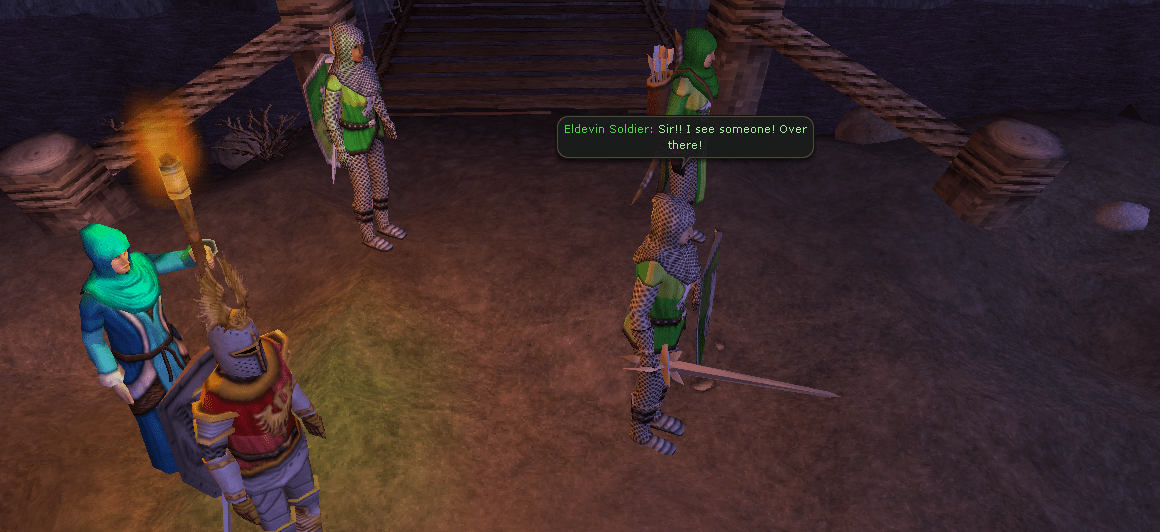

I suppose it’s a good thing that I murdered every single prisoner in the prison, considering the dead guards and smashed doors, this place probably isn’t suitable for holding any of them for the foreseeable future. The prison will also find itself lacking in a warden, seeing as how I killed the traitorous bastard on the roof of his own building. Since we’re on the topic, you might want to renovate the exterior, I don’t know how but there are a few escaped prisoners hiding out in the house across the street. Maybe send someone to clean that up, or let me do it.

Games like Eldevin and RuneScape have an odd ability to convince us to power our way through what is probably the same kind of grind that we would reject had it been foisted upon us in any other MMO. The lure of vast riches and a growing pile of resources to turn into finished products or dump at a nearby vendor in return for cash to spend on creating more stuff and stabbing more powerful beings in the face is exactly the carrot that hangs just a few inches out of reach on the grind treadmill, but close enough that we think we’ll get it if we just keep running. It is the charming world, beautiful soundtrack, living environment filled with other players all meandering about with their own tasks that make such a grind not just bearable, but actually enjoyable.
Giving my impressions on a game like Eldevin is difficult as breaking the game down into its individual mechanics would provide an inaccurate detailing the overall experience. Eldevin’s saving grace is in the sense that while the game does require a great deal of grind, it perhaps doesn’t feel as pointless as other games where the reward is often just seeing your experience bar tick up. Nearly every action in Eldevin has a purpose, from killing creatures to level up your skinning for resources to use for cooking and making armor, to finding equipment useful for vendoring to afford the catalyst items needed in the second stage of crafting.

The world of Eldevin is one that is brimming with life. Granted, once you give the world a deeper look, you see a bunch of NPCs following pre-scripted paths and animations. Still, it’s a nice touch to walk through town and see people hauling boxes around, city guards going down their paths, guards coming off duty and changing after their shift, etc. It is pretty basic at its core, but a sad reminder as to how little effort other games put into making their world feel more alive rather than a gallery for lifeless quest vendors and merchants.
Crafting is centered primarily around harvesting nodes and turning said products into goods at a station. If crafting is supposed to be a gold sink, Eldevin does it well. Most, if not all, recipes require an item that can only be purchased from vendors at a cost of anywhere from ten copper to five silver (five hundred copper). The slow process of gaining crafting experience can be alleviated slightly through a number of daily quests available for each profession. Players are able to level any skill to its maximum level (40), but you might want to focus on just one or two.
Combat, on the other hand, is where Eldevin meets standard MMO fare. The player has access to melee, range, and magic no matter what class you choose at the start, and combat is dealt through auto attack and specials. Health and mana can be replenished in combat with potions or out of combat with the various food items you can cook or buy. Combat is rather smooth and responsive, although the camera is restrictive and can get in the way, and special attacks have a habit of cancelling out your auto-attack.
Eldevin’s cash shop may be an issue, and not in the sense of pay to win. For a game focused on collecting mass amounts of resources, the fact that Eldevin sells extra inventory slots and bags will be a cause for concern for some. Alternatively, you could criticize the cash shop for selling certain items like health potions for in-game gold because the game delivers them directly to your inventory. There are multiple currencies on the cash shop, not all of which I fully understand at the time of writing and all but one are obtainable in-game.
Alternatively you can subscribe to Eldevin for $7 a month and receive experience boosts as well as a stipend of cash shop currency. I used mine on buying sacks that can be filled with gathered items, and filled them with wheat, meat, hides, and basil. Still, I find Eldevin oddly charming in the same way that RuneScape caught my attention years ago, and considering that I’m still playing the latter a decade later, I have a feeling that I’ll be sticking around in Eldevin for a long time to come.
MMOments: Akaneiro Demon Hunting

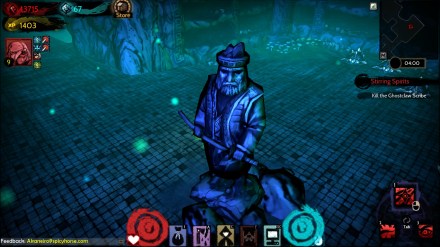
(Editor’s Note: This is not a review of Akaneiro)American McGee is the patron saint of MMO Fallout, an interesting turn of events when you consider that the man has never been involved in an MMO. What I love about American McGee is that his companies have remained one of the few developers willing to take real risks, knowing full well that not everything they do is going to be a winner. For every brilliant title like Alice there is a Bad Day LA, but it is not without the mistakes made in the latter that the former could be fully realized. Akaneiro: Demon Hunters certainly doesn’t disappoint in the category of unexpected mashups: A Diablo-esque hack and slash set to a an adaptation of Little Red Riding Hood which takes place in Feudal Japan and features Okami-style calligraphy graphics.
For all of you Diablo/Torchlight fans out there, you already know how this works: You have a central hub where the trading and leveling takes place, and the game mostly revolves around repeating dungeons where the objective is to beat the crap out of vast armies of enemies in order to obtain the randomly generated loot which can either be equipped or sold to a vendor. As you level up, you gain access to better loot with which to kill bigger and tougher bad guys to get even better loot. Each area contains multiple difficulties that must be completed in order and each level increases the power of mobs in the area as well as the types of mini-bosses, their placement, and difficulty. Shops sell equipment (which is typically overpriced and underwhelming in quality, as is the case in most ARPGs) as well as boosts which increase your base stats, exp gain, and quality of drops.
Akaneiro is still in development, meaning features like crafting and cooperative play are still unavailable. With that in mind, let’s talk about the worst aspect of Akaneiro: The cash shop. Had there been no cash shop, Akaneiro might be considered something of a hardcore title: The game completely removes the potion system, meaning instead of relying on chugging vials you have to kill enemies for their delicious karma shards, as well as gaining health via abilities that sap foes. You don’t level up as you move through a dungeon, instead the experience all goes into a pool that is awarded once you complete your designated task and head back into town. If you have to abandon the mission for any reason (including death), you forfeit your xp pool.
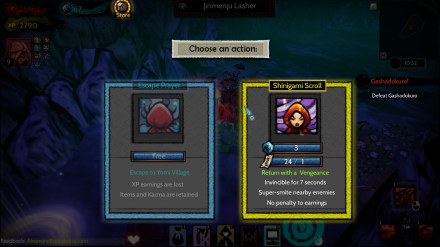
The system isn’t to make the game more hardcore, unfortunately, but to monetize death, and this is no more apparent than once you get further into the game and Akaneiro starts throwing not just larger swarms of tougher mobs, but creatures that can stun you for ridiculous lengths of time while their friends club you to death. As a mechanic, Akaneiro is a callback to the days of coin-gobbling arcade machines where life was cheap, death was often unfair, and the game was geared the nickel and dime the player, or I should say quarter and quarter. I probably wouldn’t even be as annoyed if the game forced you to forfeit the xp gain, but the fact that death is just seen as a funneling mechanic to the cash shop is both obnoxious and, in a way, sleazy on Spicy Horse’s part.
And I could be wrong on some of this, not that there is any way of finding out since any and all of Akaneiro’s help tools either don’t exist at all or are “coming soon.”
Overall, Akaneiro is shaping up to be a solid game that will probably be killed by its disappointing monetization scheme in the form of what they call “pay to revive,” which Spicy Horse finds to be agreeable on the grounds that “players are not forced to revive.” I agree with this statement one hundred percent as fact, and judging by the statistics supplied to us by Raptr where players have played an average of 24 minutes (3,623 players and 1,501 hours played as of this writing) it looks like they aren’t forced to play at all. It takes a whole five hours of tracked game time to reach the top 10% of players in Raptr.
City of Steam: The Good, The Bad, And The Steamy
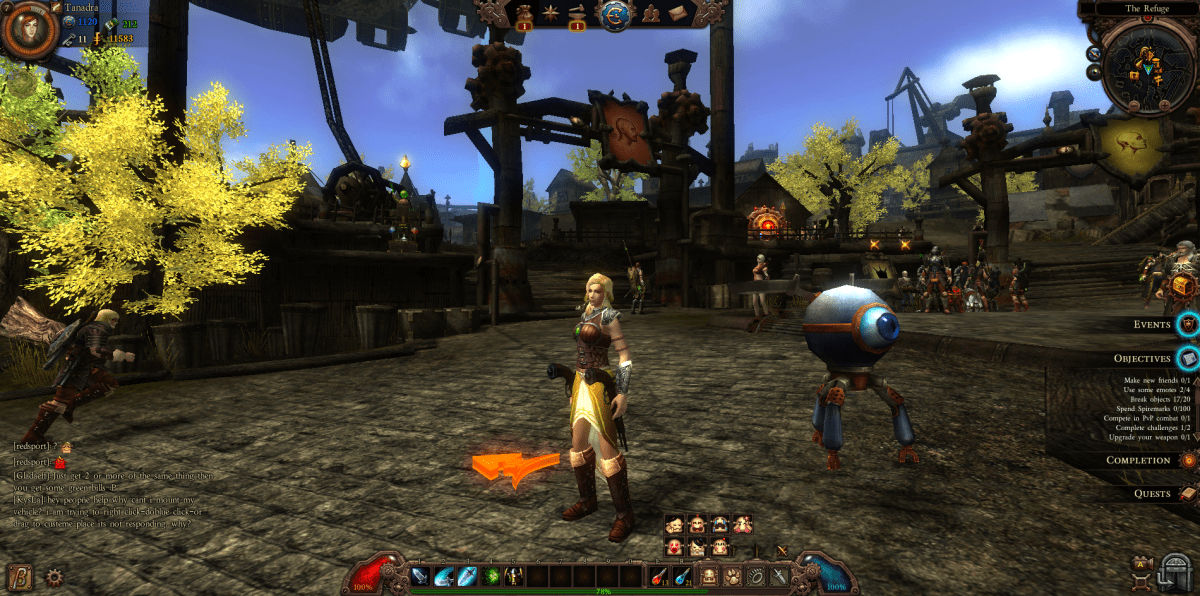

I’ve previewed City of Steam several times in the past, and I am very happy to see that the game is in a state of “soft launch,” ie: technically still in beta but the characters aren’t going to get wiped. In the past previews, I have pointed out that City of Steam isn’t breaking much ground in terms of gameplay: You talk to NPCs, take quests, go into dungeons, and kill stuff while looting stuff. The stuff you loot is equipped if it is better than your current stuff, or you can sell it to an NPC in return for medicine to heal you while you hunt for more stuff. What it does do is package a game that is familiar to all and deliver it without a client download.
So City of Steam isn’t so much a revolution of the genre as it is a slight evolution. Still, that doesn’t stop it from being a very fun game to play, so let’s go through the good, the bad, and the steamy.
1. The Good
City of Steam is the game that the folks at Unity should be utilizing to showcase the capabilities of their platform. The game runs entirely through the browser and manages to pull off amazing graphics without the need to sacrifice client stability or pull heavily from system resources. The engine powering City of Steam manages to render large numbers of objects, NPCs, and other players on screen with little to no performance drag or lag on the system.
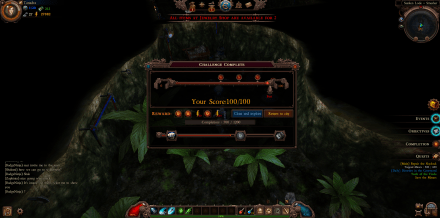
At its core, City of Steam is closer to an ARPG than a traditional MMO, and that means you’ll be repeating content quite a bit in the search for more loot. Each hub area you come across has a number of dungeons, each of which carries the standard level which is used for many of your traditional quests and daily offerings. Each dungeon also carries two additional challenge versions that can be completed for extra rewards and involve tasks like killing a certain number of a certain monster, destroying objects, or opening chests. Quests are what you would expect from an mmo: killing things, collecting things, and talking to NPCs.
Although City of Steam throws you a lot of items that have no purpose other than stating in their description “sell me to a vendor,” the game makes excellent use of worthless equipment. Any weapons or armor you find can be salvaged into scrap metal, which can be used to upgrade your equipped items, leading me into my second favorite thing about City of Steam: Meaningful upgrades. My pistol, for instance, was able to be upgraded three times, bringing its damage rating from 9-14 all the way up to 24-37. Unlike many other games, City of Steam gives you a reason to keep your items for a good long time, essentially using the garbage you find along the way to add to the life span of the stuff you have equipped. It seems like a small part of the game from the outside, but the idea of your gear sticking with you longer than any other game would have it forms a deeper relationship between the player and their avatar.
City of Steam’s combat is solid, responsive, and attacks pack a real satisfying punch. The abilities you gain are useful, diverse, and rarely do you come across an ability that is functionally useless in one fashion or another. One of the hit or miss systems that appears in games like City of Steam is the factor of how much your character feels like a badass bringer-of-death on the battlefield, and City of Steam delivers ass kicking like it’s on the clearance rack at 75% off. Abilities are balanced pretty well, ensuring that you get to use your more powerful attacks without being too slow to recover.
2. The Bad

City of Steam violates the Rule of Privileged NPCs, a rule I made up that stems from when game engines were too basic to support things like line of sight or barriers, so oftentimes the developers wouldn’t properly code NPCs to not be able to do things like see through walls or shoot through them. The mobs in City of Steam break both of these barriers. I have had times where an NPC is standing right next to me and attacking me with melee, yet my gunner was unable to attack back until I re-positioned her. Other times I have seen NPCs shooting through closed doors. It is obnoxious, and also a pain when you’re running down a corridor and npcs in nearby hallways are activated because their aggro is based on proximity without regard to line of sight.
This leads me to my second and last major engine complaint, about the game’s geography and pathfinding which I have complained about before. This doesn’t happen a lot, but there is an existing problem with your character either getting stuck on the geometry when using click-to-move, or having problems initiating attacks if your enemies are either near or on the other side of doorways, narrow passages, or corners. I haven’t died from it yet, but it does make some parts of the game frustrating when your avatar simply refuses to attack or falls into this bug where the character is “attacking,” yet not doing any damage.
As a fan of the closed beta period, I’m not all that happy that the game was thrown down the simplification tree and managed to hit every branch along the way. Challenge dungeons have had their timers removed, along with the race-against-the-clock feel that made the more difficult dungeons so enjoyably frustrating. The leveling system has also seen a severe oversimplification, with talent upgrades consisting of choices like putting 200 points into steam, health, or dividing equally between the two. The ability system is equally simplified into one of three choices at level intervals.
What is worse is that, like an apartment built over an ancient Indian burial ground, there are still spirits roaming around to haunt and confuse new players. Dungeon challenges still feature challenge “ranks” even though they are just about meaningless and in many cases are impossible to achieve anything other than the highest rank (boss challenges have the same objective for all three ranks). You still gain ability points, even though once you choose an ability for the corresponding rank set, you don’t have any choice but to put it into that skill.
The cash shop is also going to be a pin in many player’s sides. The “cosmetic” aspect of the equipment sold in the shop is a flat out lie. The cosmetic equipment from the shop increases experience gain, shilling gain, and also increases your base damage to the tune of $17-25 depending on what you purchase. In order to revive yourself on the spot, you need to pay electrum (cash shop currency), there are unused weapon slots on the cash shop, and the game regularly harasses you to increase your inventory size via electrum.
3. The Conclusion
Like a can of soda left out in the sun, City of Steam tastes like it has flattened since we last saw it. There is little doubt that the leveling system has been drastically reduced in complexity, and that the game has been reshaped primarily around the expanded and rather expensive cash shop. And it’s obvious where these sudden changes are coming from: R2Games, a publisher well known for its pay to win systems. Now, Mechanist Games continues to claim (as they have told us) that they have final say on anything that goes into the game, kind of like how a man with a gun pointed up to his head will tell the neighbor who knocked on his front door “no, I’m perfectly fine and home alone, no need to call the police.”
How do I know R2 is calling the shots? Simply, that is is the case in virtually every publisher relationship, it just comes with the business. Otherwise, you could look into the City of Steam FAQ and see that not only is it filled with spelling errors and Engrish, the section was so lazily written that half of the questions have absolutely nothing to do with City of Steam.
I recognize that City of Steam is in open beta, which is why I have not made a single comment about bugs (apart from issues I see being engine-related and therefore unlikely to be 100% fixed) and the fact that there are races and . Those of you who have read MMO Fallout in the past know that I love City of Steam, it is one of my favorite games to come out in 2013, and I liked it enough that I partnered with Mechanist Games to hand out keys during the closed beta. I am still having a lot of fun with the current incarnation of City of Steam, even though I question some of the decisions that Mechanist Games made, City of Steam remains a solid game with a solid foundation and it is something I can see myself playing for a long time.
Those of you who read MMO Fallout know that I refuse to traffic in “prospects.” Every game has the promise of eventually being something better, and I refuse to advocate for a game based on the perceived quality that it may speculatively reach some day. What I will say is that this is a testament to how awesome City of Steam was in the closed beta, that I can sit here and , and then turn around and say that regardless of some of the elements that were changed for the worse, City of Steam is still looking toward launch as an awesome game.
MMOrning Shots:

Today’s MMOrning Shot comes from a viewer named Omali and is a screenshot of a previous City of Steam beta weekend. Each dungeon in City of Steam offers an array of challenges, from killing specific monsters to collecting items all within a time limit. The challenges aren’t all that great for picking up loot, since you are constantly racing against the clock, but the points gained toward your challenge score make up for the loss of free stuff.
MMOrning Shots is a (somewhat) daily line of screenshots from various MMOs. Most are taken in-house or come to us in press releases, but if you would like your screenshot featured, send it over to contact[at]mmofallout[dot]com with the subject “MMorning Shots.”
 MMO Fallout