IPE News: VIolating A Terms of Service Is Still Not A Crime


Good news, internet-goers, violating a website’s terms of service isn’t a crime. It hasn’t been for years, but a recent decision by the Ninth Circuit Court of Appeals has gone to solidify and embolden that ruling.

In this case, Oracle USA sued Rimini Street Inc in Nevada District Court over allegations of misuse of their website violating established terms of service. Rimini was brought into court over their use of automated programs downloading support materials from Oracle’s website, which is against the company’s terms of service. Oracle sent a cease and desist, but did not restrict access to said files, and eventually filed suit. The judge ruled in favor of Oracle, stating that violating the terms of service constituted a breach of state computer crime statues.

Rimini appealed the ruling to the Ninth Circuit who overturned the lower judge’s decision, noting that Oracle prohibiting certain methods of collecting material does not constitute a violation if the material is already readily available. In short, it’s not illegal just because the website owner doesn’t like your methods.

More analysis can be found on the Electronic Frontier Foundation website piece linked below.

(Source: EFF.org)

Another Epic Games Lawsuit Settled With Permanent Injunction


Another Epic Games Fortnite lawsuit has been settled this month. Back in October, Epic Games filed lawsuits against a number of people creating and disseminating cheats for Fortnite in California and North Carolina state courts. A couple of those cases have already been settled and it looks like most of these cases will end with the defendants permanently barred from (possibly) playing and definitely from creating, using, or distributing cheats for Fortnite or any of Epic’s other titles.

Epic alleges that Yakovenko created, developed, and/or wrote a purported software cheat for Fortnite’s Battle Royale game mode; Yakovenko then created and posted several videos on YouTube to advertise, demonstrate, and distribute his cheat; Yakovenko’s videos feature Epic’s FORTNITE mark and full screen gameplay using the purported cheat; and while Yakovenko’s “cheat” does not appear to be a functional Fortnite cheat, it functions as a bitcoin miner that infects the user’s computer with a virus that causes the user’s computer to mine bitcoin for the benefit of an unknown third party.

The terms of the judgement permanently bar Yakovenko from creating or using cheat software in any current or future game owned by Epic Games, or even assisting anyone with creating or using a cheat for one of Epic’s games. Both parties will be paying their own legal fees, and it looks like no monetary penalty will be taken against Yakovenko.

In other news, it looks like Epic Games may have sued another minor. Last year we talked about the lawsuit against 14 year old Caleb Rogers, whose case has not seen any progression since we last discussed it. Epic’s lawsuit in North Carolina court mirrors that of its lawsuit against Rogers, noting that the minor was posting videos on Youtube showing how to cheat and where to get said cheats, with the lawsuit essentially following up on a DMCA takedown notice that Epic had filed. The defendant, M.F., filed a counter-notice under the penalty of perjury that his videos were fair use. In cases where counter-claims are issued, the only option going forward for a copyright holder is to file a lawsuit.

As in the case of Rogers, it looks like Epic was not aware of the age of Moret before filing and as such a number of files have been sealed to the public regarding this case. As with the other cases, Epic appears to be pursuing a permanent injunction on cheating.

Crytek Suing Star Citizen For Copyright Infringement/Breach of Contract


Always read your fine print, folks, it’ll help you out of a lot of problems.

Crytek has officially launched a lawsuit against Cloud Imperium Games and Roberts Space Industries, alleging copyright infringement and breach of contract. The lawsuit alleges that CIG violated its contract with Crytek back in 2016 when they announced that the first person shooter spinoff Squadron 42 would be sold as a separate product. According to the lawsuit, Crytek contacted CIG to inform them that their license only covered one game, and thus Squadron 42 was not licensed for use with their engine.

Crytek has not been compensated for Defendants’ unlicensed use of Crytek technology in the Squadron 42 game, and has been substantially harmed by being deprived of that compensation, which would ordinarily include a substantial up-front payment as well as a substantial royalty on game sales.

Star Citizen has not been on the CryEngine in some time, it moved over to the Amazon Lumberyard engine which, incidentally, is based on the CryEngine. Based on the lawsuit, Chris Roberts was able to successfully negotiate a substantially reduced licensing fee as long as they promised to prominently promote both Crytek and CryEngine. In return, CIG allegedly reduced and then removed the copyright notices and trademarks completely.

Outside of copyright infringement and breach of contract, it looks like CIG may have signed a clause into their license that made CryEngine the exclusive engine, thus making their move over to Lumberyard in violation of said agreement. Outside of the obvious now-missing revenue stream, Crytek’s lawsuit also notes that CIG’s license included requirements to send bug fix and optimization reports on at least an annual basis, an obligation that the company did not meet. Crytek also alleges that the Bugsmashers video series constitutes publicizing confidential information regarding CryEngine.

On May 6, 2015, Defendants began posting a series of videos online titled “Bugsmashers.” The videos contain excerpts of information from CryEngine that were confidential, in breach of the GLA, and should not have been shown to the public. The series continues today.

Crytek is asking for damages well in excess of $75,000 (the exact number will be seen). The charges seem pretty cut and dry, if Crytek has the supporting evidence than the next step would be for the court to determine damages.

CIG has commented to several websites on the matter:

“We are aware of the Crytek complaint having been filed in the US District Court. CIG hasn’t used the CryEngine for quite some time since we switched to Amazon’s Lumberyard. This is a meritless lawsuit that we will defend vigorously against, including recovering from Crytek any costs incurred in this matter.”

(Source: Scribd)

Epic Games Settles First Lawsuit Against Fortnite Cheater


Epic Games is on a rampage against cheating in Fortnite, and the first lawsuit has officially ended with a settlement and injunction.

Defendant Charles Vraspir entered an agreement voluntarily with no ability to repeal, that permanently bars him from creating, promotion, distributing, or using any software or device that infringes on Epic’s copyright for any existing or future copyright. Vraspir is restrained from cheating in any game that Epic develops or publishes or even materially contributing or inducing others to cheat in a title that Epic develops or publishes. If Vraspir violates the terms of this agreement, he can be charged $5,000 plus other potential fines.

(Source: Torrent Freak)

In Plain English: No, Epic Games Isn’t Suing A 14 Year Old Just For Cheating


(Update 9/10: Out of respect for the courts, MMO Fallout has redacted the name of the defendant)

Epic Games has made some news this month over the announcement that they are filing lawsuits against people cheating in Fortnite. How many lawsuits? This many, so far:

One particular lawsuit has caught greater attention because it turns out that the defendant is 14 years old. Epic Games filed a complaint against C.R., or Sky Orbit as he is known on Youtube, one month ago for copyright infringement and breach of contract under North Carolina law. The lawsuit here stems from multiple DMCA stikes against the defendant’s channel by Epic Games, taking down videos showcasing and promoting cheating in the video game Fortnite. The defendant appealed said strikes, and under copyright law the only avenue going further for Epic Games is to file a lawsuit.

Further, Defendant is streaming videos of himself playing and cheating at Fortnite by using cheat software (“cheats” or “hacks”) to unlawfully modify Fortnite’s software. In the videos Defendant posts on YouTube, Defendant promotes and demonstrates a Fortnite cheat, and provides viewers with a link to a site from which they can acquire the cheat for themselves.

Epic Games also notes in the lawsuit that defendant has been banned from the game at least 14 times, and continued creating accounts and posting videos on Youtube attempting to promote the cheat program, going so far as to create a second Youtube account to circumvent the takedown notice.

Defendant has been banned from playing Fortnite for this conduct at least 14 times. He nevertheless continues to play using other accounts he created using false names. He has also continued to cheat and to publicly perform and display video of himself cheating on YouTube in an effort to induce others to buy the cheat he sells so that they too can cheat at Fortnite.

A response video by the defendant on the lawsuit can be found here where he disputes the number of bans and claims that the 14 count is exaggerated and is “more like 10 or 5.”

https://youtu.be/OSVeOQfujOQ

Epic has included the Copyright appeal sent to Youtube.

On October 17, 2017, Defendant submitted a counter-notification responding to Epic’s DMCA takedown notice for the First Video in which he stated “i did noting rong this strike is all wrong I was modding in a video game that isn’t against youtubes TOS Why was i striked ?!”

To say that Epic Games is suing a 14 year old because of cheating would be boiling down the story into its base parts and picking out the wrong piece to focus on. It’d be like me covering a burglary and the headline being “Man Arrested For Putting Some Money In His Pocket,” (Note: I’m not equating the two). There is also a misconception going around that Epic cannot sue defendant as he is 14 and therefore not an adult. This is also not true, as in the United States a child can be sued for willful or malicious damages, in which case his parents would be liable for paying said damages. Most states cap this amount, however North Carolina actually doesn’t have such a cap on damages.

In their lawsuit, Epic Games is seeking injunctive relief, barring the defendant from cheating or sharing further videos of cheating in Fortnite, as well as statutory damages due to the defendant distributing said cheats and advertising them on his Youtube channel. One spot where Epic Games may have lost the mark is in their belief that C.R. had a financial investment in the cheat itself. Unless Epic has access to some information that we don’t, the defendant has expressly denied that he is involved in any way with the creation of said cheat program.

On information and belief, Defendant engages in such conduct to promote the cheat via his Sky Orbit and Sky Orbit V2 YouTube channels because Defendant obtains some financial benefit or value in consideration for his video postings and/or the sale of the cheat he promotes and demonstrates in the First and Third Videos.

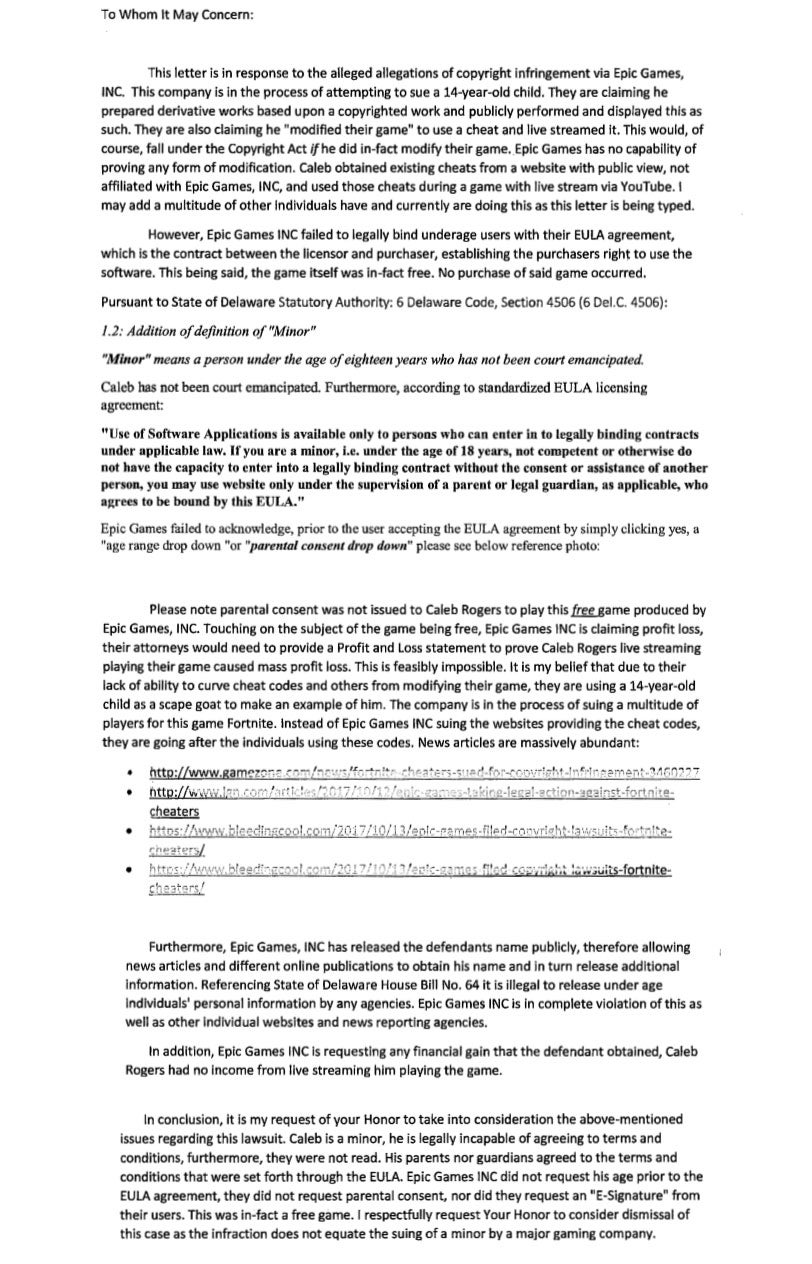
The defendant’s mother submitted a letter to the court which may or may not have been a bad idea, as it shows a glaring lack of understanding of both the situation as well as what exactly her son is being sued over, and likely divulges more than any lawyer would advise her to say.

Regardless, it is likely that Epic Games did not know the age of the defendant prior to filing said lawsuit, so whether or not they will pursue the case further will have to be seen. This is just one of at least six lawsuits currently pending from Epic toward cheat makers and promoters.

In Plain English: Epic Sues Two Fortnite Cheat Creators


I’m not entirely happy with the press coverage of Epic Games’ lawsuit. If you’ve been reading the news this week, you may be under the impression that Epic Games was so angry about two particular players cheating in Fortnite that the game developer decided to take these two individuals to court. This isn’t exactly the case.

Epic Games has filed complaints against Charles Vraspir and Brandon Boom in separate cases in North Carolina district court. Unsurprisingly, Epic has chosen to go with the Digital Millennium Copyright Act for their main point of attack, alleging that the cheats involve illegally modifying the game code. By going for copyright infringement, Epic is looking to slap both defendants with some potentially hefty fines (up to $150,000 each) plus damages and any additional profits that the defendants made from the sale of said cheats. In the interim, Epic is seeking an injunction preventing the defendants from continuing to use and advertise said cheat programs.

One interesting note in this lawsuit that may help their case is intent. The lawsuit docket makes several notes of both Vraspir and Boom stating that their goal is to ruin the business viability of Fortnite by making the game as unbearable to play as possible.

In an effort to adversely impact as many people as possible while playing and cheating at Fortnite, Defendant specifically targets streamers. He has declared that it is his objective to prevent streamers from winning the game and has boasted in online cheating discussion channels that his goal is to “stream snipe,” i.e., kill streamers as they stream. Defendant has said that making streamers hate Fortnite is Defendant “in a nutshell.”

Epic also alleges that Vraspir’s conduct may be related to the fact that he was banned from Fortnite PvE for cheating:


Defendant’s unlawful conduct may be the result of a misplaced antipathy towards Epic because he was banned from Epic for cheating.

This is known in court as the famous “u mad” strategy.

Now those of you who read In Plain English know that the legality of cheating has come up in the past. The court ruled that the use of bot software in World of Warcraft did not constitute copyright infringement because the software itself was found to not violate Blizzard’s copyright. If the software is found to be violating Epic’s copyright by making illegal modifications or by violating DMCA rules in circumventing protections, it could spell trouble.

This is a copyright infringement and breach of contract case in which the Defendant is infringing Epic’s copyrights by injecting unauthorized computer code into the copyright protected code of Epic’s popular Fortnite® video game. In so doing, Defendant is creating unauthorized derivative works of Fortnite by modifying the game code and, thus, materially altering the game that the code creates and the experience of those who play it.

The Fortnite cheat in question has been discontinued on the cheat maker’s website, along with a Paragon cheat that was similarly discontinued over legal disputes from Epic.

In Plain English: Imagos Softworks v Alex Mauer


(Editor’s Note: All information presented in this article is sourced from court dockets. As always, nothing in the column should be regarded as legal advice. In Plain English does not attempt to draw conclusions, and all parties are innocent until proven guilty in the court of law. I’ve fulfilled my legal obligation. Thank you.)

The Alex Mauer case is one that MMO Fallout has stepped away from covering, due mostly in part to the fact that every major Youtuber from SidAlpha to John Bain and Jim Sterling have more than thoroughly kept up with coverage, as well as that for a while now the story has been moving at such an incredible pace with fact mixing with hearsay that I didn’t feel that I’d be able to keep up with my morning and evening schedule freedom. I’ve always been one to avoid covering controversies until they turn into something genuine, an individual and a company shouting at one another generally leads nowhere, someone gets paid or agrees to stop shooting their mouth off, and we all go home disappointed.

But Alex Mauer’s lawsuit is different, because I think this is the first video game lawsuit in which the defendant has been ordered by a judge to stop sending death threats to the plaintiff. Here is the order:

Defendant shall refrain from making threats of harm and physical violence against Plaintiffs or Plaintiffs’ lawyer

The case of Alex Mauer really came to a head in June when she began submitting frivolous DMCA takedown notices for game footage of a property that she has no ownership of, but the drama goes further back than that. Mauer was hired by Imagos Softworks in March 2015 by Don Thacker to work on the soundtrack for Starr Mazer, a side scrolling shoot-em-up. At some point during this timeline, Alex Mauer asked for time off for medical reasons, at which she eventually left the team entirely. According to the lawsuit, Mauer came back and began claiming that Imagos owed her money, and claiming rights to Starr Mazer and Imagos’ other properties.

Mauer issued a DMCA notice against Starr Mazer DSP on Steam, forcing Valve to take the game down while the dispute was resolved, over a property that Alex Mauer allegedly doesn’t own. According to the lawsuit, which includes the contract with Mauer’s signature, Imagos Softworks retained all rights to Mauer’s work. Here is the snippet from the contract that discusses ownership:

WORK FOR HIRE: Contractor’s services will be performed as a specifically ordered or commissioned work made-for-hire, and Production Company shall own all results and proceeds of Contractor’s services rendered hereunder in perpetuity to use for all purposes, including without limitation to the exploitation of the Picture or otherwise. This agreement may be assigned to any entity by Producer provided such entity assumes all executor obligations. Contractor may not assign this agreement. Contractor agrees to maintain the secrecy of all Producer’s confidential information which comes into Contractor’s possession by virtue ,of Contractor’s participation in the Production.

Imagos is suing in the Eastern District of Pennsylvania and has hired Leonard French as their attorney. Alex Mauer, in the short time that this case has been running, has hired and subsequently fired Frank A. Mazzeo. On June 26, Mauer allegedly began sending threatening messages of murder, arson, and vandalism toward Thacker and French, causing Mauer to be taken into involuntary custody while a mental health evaluation was performed. Mauer was released.

Mauer is being charged with Copyright Misrepresentation, breach of contract, defamation per se in regards to the claims of ownership, allegations of misconduct, and damage to Imagos Softworks through said allegations, as well as extortion/blackmail, following Mauer’s comments that the DMCA takedowns were to provoke content creators into contacting Imagos on her behalf.

In their lawsuit, Imagos Softworks hopes to place a permanent injunction preventing Mauer from filing additional claims, a delcatory judgement that Imagos owns its properties, unspecified damages, and any relief the court may deem necessary. The court will be conducting a hearing in regards to the application for a temporary restraining order on July 19 at 9:30 a.m.

[Column] Mobile Legends Threatens The Press, Good Luck With That


Riot Games is currently suing Moonton over alleged copyright infringement in regards to their game Mobile Legends. I’m going to reiterate that last statement because Moonton apparently doesn’t want me to tell you this: Moonton is currently being sued in court over alleged copyright infringement regarding Mobile Legends allegedly ripping off League of Legends. Those of you who are interested in reading up on the lawsuit, filed in California, can do so here. If you don’t feel like sifting through 44 pages of legal documents, I’ll be running an In Plain English article summarizing the charges. There are plenty of photos comparing the two games to gawk at, so I recommend taking a look.

The part of this lawsuit that caught my eye is that Moonton needs to read up on the free press and the definition of slander, because the company has posted a threat to the media reporting on this lawsuit: Stop, or potentially face intimidation through legal threats. Moonton posted the below statement on their Facebook page calling the stories “unreal,” and “rumors,” albeit refusing to go into detail on either aspect. For their part, Moonton has explicitly denied all claims of infringement, which can also be read in the statement below. The lawsuit is real, for a case that will occur in a real court in the real state of California.

The lawsuit notes that Riot Games had initially gone through Google and Apple to remove the app from both stores, alleging that Moonton simply changed its name, made minor changes, and put the game back on the store.

Most notably, after Riot discovered Mobile Legends: 5v5 MOBA and notified Google that the game was infringing, Moonton purported to remove the game from the Google Play store. But that was simply a subterfuge. Immediately after removing Mobile Legends: 5v5 MOBA, Moonton (without notifying Riot or Google) released a “new” game, Mobile Legends: Bang bang. However, Mobile Legends: Bang bang was not a new game at all, but in fact was the exact same game as Mobile Legends: 5v5 MOBA, with some modest changes. This ploy of “hide the ball” was part of Moonton’s deliberate business strategy, designed to hamper Riot’s ability to protect its intellectual property.

Winning a defamation lawsuit in the United States would be incredibly difficult. It requires that the plaintiff prove that the allegations are false (a nonstarter in this case, as the lawsuit is very real) and that the author knew that the statements were false and can prove material damage related to said statements. In cases of lawsuits, the press can’t be sued for writing about a lawsuit, provided the author isn’t making their own conclusions, and represents the allegations as just that (charges, not convictions). Moonton can’t sue the press for reporting on the allegations made by Riot Games and win, not in the states anyway.

More on this lawsuit to come.

[NM] Payday 2 Announces Ethan & Hila Content Pack


Overkill Software announced this week that they will be consolidating Payday 2’s DLC into one Ultimate Edition package, consolidating dozens of heists, characters, weapons, and more into one purchase. As part of the update, Overkill also announced the release of an Ethan and Hila character pack, incorporating two popular Youtubers from the channel H3H3 Productions. H3H3 currently boasts over 3.8 million subscribers and creates content mostly around Youtube drama.

According to the official website, all sales from the character pack will go to Ethan and Hila.

The only DLC that will be available separately is the Ethan and Hila Character Pack. The subsequent revenue from the Ethan and Hila Character Pack is going straight to Ethan and Hila. We are doing this because we appreciate them and wanted to find a way to help them out financially so they can continue to do what they do best.

While Hollywood partnerships are somewhat common in the video game industry, this type of deal is surprisingly rare. Overkill Software previously struck a deal to include content from Scarface, John Wick, and Goat Simulator, to name three properties. The announcement also comes alongside the news that support for Payday 2 has been extended through October 2018.

H3H3 Productions has been embroiled in a lawsuit by Youtuber Matt Hoss for copyright infringement over their use of his footage in reaction videos.

(Source: Payday 2)

In Plain English: KLM Starfall Education Foundation v. Trion Worlds, Inc.


Today’s In Plain English covers the very short lawsuit between Starfall Education Foundation and Trion Worlds regarding the Rift expansion Starfall Prophecy. You may be aware that Trion Worlds recently changed the name of the expansion to the Prophecy of Ahnket and wanted to know why. The explanation lies in a recent lawsuit filed by a children’s charity foundation over its ownership of the trademark “Starfall.”

If you don’t know what Starfall is, I’ll let the charity’s website explain itself:

Starfall Education Foundation is a publicly supported charity, 501(c)(3). We create free and low-cost experiences whereby children can successfully learn through exploration. On the Starfall website and in Starfall classrooms, children have fun while learning in an environment of collaboration, wonderment, and play. We teach through positive reinforcement to ensure children become confident, intrinsically motivated, and successful.

Donors to the Starfall Education Foundation can sleep soundly knowing that your contributions went to fund the Bardacke Allison LLP, Melkonian & Co, and Purvis Gray Thompson, LLP law firms for the purposes of filing a dispute over a video game expansion title. For what might otherwise seem to be a pretty minor issue, Starfall decided to bring a team of three lawyers on board, an ultimately pointless move since Trion Worlds didn’t put up much of a fight or make much in the way of arguments on their own behalf.

Still, a $400 filing fee is a big lump of money when your 2015 revenue looks like this (via Citizen Audit):

Unlike certain other cases covered here on In Plain English, this story is fast and has a simple ending. Rather than fight what could become a lengthy and costly legal battle over something rather trivial, Trion Worlds decided to settle. Those of you who play Rift, or read about it, will know that Trion Worlds has changed the name of the expansion to Prophecy of Ahnket, a decision that might be confusing if you don’t understand this underlying context.

Trademark ownership is only as strong as the owner’s protection, although MMO Fallout has doubts that the case would hold up given a company willing to lawyer up and take a stance. The numerous Starfall video games and video game related websites that we were able to find over the course of a half hour, many of which predate the Starfall 2002 founding date, and thus its 2004 trademark registration date, could make a solid case against Starfall’s claim to the term. Still, I’m not a lawyer, so don’t take any of this as legal advice.