Crowfall Upgrades To UNITY 5


crows

ArtCraft Entertainment has announced that Crowfall has been upgraded to run on the latest version of UNITY. The engine upgrade brings in new physics integration as well as the .NET platform along with a whole host of middleware.

UNITY 5 was released this week as a fully featured free engine.

(Source: Backer email)

Less Massive: Ubisoft Offers Unity Compensation


5d4f2ac5b313068d9b28ff73174ae4f0

Assassin’s Creed Unity launched on November 11th, and since then has proven itself to be quite problematic for Ubisoft. The seventh major installment in the series of the same name launched with heavy technical issues, from performance problems to humorous graphical glitches (as seen above). Since the game launched, Ubisoft has launched at least two major patches with the third coming this week, and has been busy cleaning up the public relations end of dealing with dissatisfied customers.

As compensation, Ubisoft has discontinued the season pass, making the upcoming Dead Kings DLC free for everyone. Owners of the season pass or gold edition are eligible for one free Ubisoft game, including very recent releases like Far Cry 4 and The Crew. You can find more details at the link below.

(Source: Developer blog)

City of Steam: The Good, The Bad, And The Steamy


chrome 2013-05-12 01-09-08-47

I’ve previewed City of Steam several times in the past, and I am very happy to see that the game is in a state of “soft launch,” ie: technically still in beta but the characters aren’t going to get wiped. In the past previews, I have pointed out that City of Steam isn’t breaking much ground in terms of gameplay: You talk to NPCs, take quests, go into dungeons, and kill stuff while looting stuff. The stuff you loot is equipped if it is better than your current stuff, or you can sell it to an NPC in return for medicine to heal you while you hunt for more stuff. What it does do is package a game that is familiar to all and deliver it without a client download.

So City of Steam isn’t so much a revolution of the genre as it is a slight evolution. Still, that doesn’t stop it from being a very fun game to play, so let’s go through the good, the bad, and the steamy.

1. The Good
chrome 2013-05-12 10-36-55-76

City of Steam is the game that the folks at Unity should be utilizing to showcase the capabilities of their platform. The game runs entirely through the browser and manages to pull off amazing graphics without the need to sacrifice client stability or pull heavily from system resources. The engine powering City of Steam manages to render large numbers of objects, NPCs, and other players on screen with little to no performance drag or lag on the system.

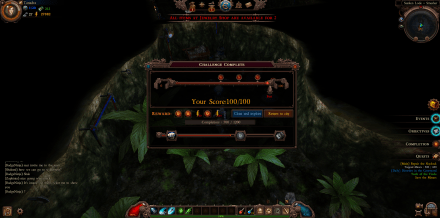
At its core, City of Steam is closer to an ARPG than a traditional MMO, and that means you’ll be repeating content quite a bit in the search for more loot. Each hub area you come across has a number of dungeons, each of which carries the standard level which is used for many of your traditional quests and daily offerings. Each dungeon also carries two additional challenge versions that can be completed for extra rewards and involve tasks like killing a certain number of a certain monster, destroying objects, or opening chests. Quests are what you would expect from an mmo: killing things, collecting things, and talking to NPCs.

Although City of Steam throws you a lot of items that have no purpose other than stating in their description “sell me to a vendor,” the game makes excellent use of worthless equipment. Any weapons or armor you find can be salvaged into scrap metal, which can be used to upgrade your equipped items, leading me into my second favorite thing about City of Steam: Meaningful upgrades. My pistol, for instance, was able to be upgraded three times, bringing its damage rating from 9-14 all the way up to 24-37. Unlike many other games, City of Steam gives you a reason to keep your items for a good long time, essentially using the garbage you find along the way to add to the life span of the stuff you have equipped. It seems like a small part of the game from the outside, but the idea of your gear sticking with you longer than any other game would have it forms a deeper relationship between the player and their avatar.

City of Steam’s combat is solid, responsive, and attacks pack a real satisfying punch. The abilities you gain are useful, diverse, and rarely do you come across an ability that is functionally useless in one fashion or another. One of the hit or miss systems that appears in games like City of Steam is the factor of how much your character feels like a badass bringer-of-death on the battlefield, and City of Steam delivers ass kicking like it’s on the clearance rack at 75% off. Abilities are balanced pretty well, ensuring that you get to use your more powerful attacks without being too slow to recover.

2. The Bad

chrome 2013-05-11 00-50-17-99

City of Steam violates the Rule of Privileged NPCs, a rule I made up that stems from when game engines were too basic to support things like line of sight or barriers, so oftentimes the developers wouldn’t properly code NPCs to not be able to do things like see through walls or shoot through them. The mobs in City of Steam break both of these barriers. I have had times where an NPC is standing right next to me and attacking me with melee, yet my gunner was unable to attack back until I re-positioned her. Other times I have seen NPCs shooting through closed doors. It is obnoxious, and also a pain when you’re running down a corridor and npcs in nearby hallways are activated because their aggro is based on proximity without regard to line of sight.

This leads me to my second and last major engine complaint, about the game’s geography and pathfinding which I have complained about before. This doesn’t happen a lot, but there is an existing problem with your character either getting stuck on the geometry when using click-to-move, or having problems initiating attacks if your enemies are either near or on the other side of doorways, narrow passages, or corners. I haven’t died from it yet, but it does make some parts of the game frustrating when your avatar simply refuses to attack or falls into this bug where the character is “attacking,” yet not doing any damage.

As a fan of the closed beta period, I’m not all that happy that the game was thrown down the simplification tree and managed to hit every branch along the way. Challenge dungeons have had their timers removed, along with the race-against-the-clock feel that made the more difficult dungeons so enjoyably frustrating. The leveling system has also seen a severe oversimplification, with talent upgrades consisting of choices like putting 200 points into steam, health, or dividing equally between the two. The ability system is equally simplified into one of three choices at level intervals.

What is worse is that, like an apartment built over an ancient Indian burial ground, there are still spirits roaming around to haunt and confuse new players. Dungeon challenges still feature challenge “ranks” even though they are just about meaningless and in many cases are impossible to achieve anything other than the highest rank (boss challenges have the same objective for all three ranks). You still gain ability points, even though once you choose an ability for the corresponding rank set, you don’t have any choice but to put it into that skill.

The cash shop is also going to be a pin in many player’s sides. The “cosmetic” aspect of the equipment sold in the shop is a flat out lie. The cosmetic equipment from the shop increases experience gain, shilling gain, and also increases your base damage to the tune of $17-25 depending on what you purchase. In order to revive yourself on the spot, you need to pay electrum (cash shop currency), there are unused weapon slots on the cash shop, and the game regularly harasses you to increase your inventory size via electrum.

3. The Conclusion

Like a can of soda left out in the sun, City of Steam tastes like it has flattened since we last saw it. There is little doubt that the leveling system has been drastically reduced in complexity, and that the game has been reshaped primarily around the expanded and rather expensive cash shop. And it’s obvious where these sudden changes are coming from: R2Games, a publisher well known for its pay to win systems. Now, Mechanist Games continues to claim (as they have told us) that they have final say on anything that goes into the game, kind of like how a man with a gun pointed up to his head will tell the neighbor who knocked on his front door “no, I’m perfectly fine and home alone, no need to call the police.”

How do I know R2 is calling the shots? Simply, that is is the case in virtually every publisher relationship, it just comes with the business. Otherwise, you could look into the City of Steam FAQ and see that not only is it filled with spelling errors and Engrish, the section was so lazily written that half of the questions have absolutely nothing to do with City of Steam.

I recognize that City of Steam is in open beta, which is why I have not made a single comment about bugs (apart from issues I see being engine-related and therefore unlikely to be 100% fixed) and the fact that there are races and . Those of you who have read MMO Fallout in the past know that I love City of Steam, it is one of my favorite games to come out in 2013, and I liked it enough that I partnered with Mechanist Games to hand out keys during the closed beta. I am still having a lot of fun with the current incarnation of City of Steam, even though I question some of the decisions that Mechanist Games made, City of Steam remains a solid game with a solid foundation and it is something I can see myself playing for a long time.

Those of you who read MMO Fallout know that I refuse to traffic in “prospects.” Every game has the promise of eventually being something better, and I refuse to advocate for a game based on the perceived quality that it may speculatively reach some day. What I will say is that this is a testament to how awesome City of Steam was in the closed beta, that I can sit here and , and then turn around and say that regardless of some of the elements that were changed for the worse, City of Steam is still looking toward launch as an awesome game.

Greed Monger Is Back On UNITY


GM_Dragonwm1

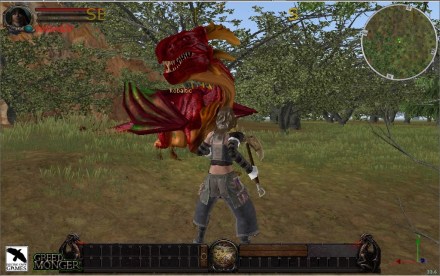
Greed Monger is the upcoming sandbox MMO being created by Electric Crow Games and the subject of a very successful Kickstarter project just a few months ago. Originally set on the UNITY engine, at some point the folks at Electric Crow Games decided to switch over to the HERO engine, which many of you will recognize as the same engine used in Star Wars: The Old Republic. Well that didn’t last long, as the Easter announcement confirms that Greed Monger has indeed changed back to UNITY.

We had some issues that caused us to step away from Unity and head into the world of the Hero Engine. It was a major decision considering all that we had done already and without being 100% certain how much of our already existing assets could be migrated into Hero. Well, the truth is, we switched back to Unity not long after we switched to Hero. Aside from the issues of the revenue model, no cross-platform support and other things the player base has been expecting, the engine just wasn’t a fit for us.

You can follow the link below to see the full explanation as to why Greed Monger was moved to HERO and subsequently moved back.

(Source: Greed Monger)

Bigpoint Gives Faith in UNITY, Jagex Should Use It


My first, and for a long time only, experience with MMOs on the UNITY engine was Cartoon Network’s Fusionfall, and for all the criticizing I throw at Bigpoint Games for their public comments, I’m very happy that they had more faith in the engine than I did. I say this because I was playing the open beta for KULTAN today, Bigpoint’s upcoming answer to the sea-faring MMOs, and the game looks great to the point where the screenshots (even the one I presented) really don’t do it justice. And the game ran great, apart from a few issues I had with the controls and some problems with targeting, but that can be ironed out in development.

Of course this isn’t the first Bigpoint MMO built on the UNITY engine. Battlestar Galactica Online also does the engine justice. It is a system that is mind-blowing more in the sense of what a browser-based engine can do, rather than expecting Crysis-level graphics. Even in the short period between Battlestar Galactica and KULTAN, the amount of progress tells me that in just a few years the UNITY engine has the potential to evolve the next base platform for MMOs, in a similar way that the Unreal engine became the base for most video games you play today.

Almost immediately I thought “I’d like to see Runescape transition to Runescape 3, released on the UNITY engine.” Java is a great tool, but it is falling behind on the times. For an MMO, especially one growing at the rate Runescape is, the technology has become so old and lacks optimization that Jagex will only be able to stack so much on top before they are forced to switch over. The Java engine doesn’t lend itself well to “real time” on a mass scale, which you can see in Runescape’s mini-games and FunOrb’s mini-games that have some sort of fast-paced measure to them.

Moving to the UNITY engine would allow for keyboard movement rather than relying on point and click pathfinding, fighting would become far more engrossing than standing next to someone taking turns swiping a whip, and while Jagex could get the engine for free, porting the game over to mobile devices would be far easier than on Java. I’m not an expert on the engine, but I get the feeling that removing the point and click aspect of Runescape would also see a heavy decrease in botters, not to mention better support for anti-cheat utilities. Also, UI improvements! I’d no longer have to go through the game seeing every button for every interface I might ever need to use!

And for the people who can’t play Runescape 3, keep Runescape 2 open for five more years (blocking new accounts) and allow people to transition their characters to the new game. No, not everyone has a powerhouse computer, but UNITY engine doesn’t require one and holding back upgrades to accommodate little Timmy on the library’s computer just allows for Chris in Florida to run that many more clients on his gold farming…farm.

How did this article turn into Runescape? Anyway, I think I’ve made my point. The UNITY engine is the base platform for browser MMOs, and something about Jagex not stopping cheaters.

Poop Talk: Battlestar Galactica Vs The Old Republic


Stargate Resistance.

Over here at MMO Fallout, we follow the mantra of publishing and forwarding ego-driven banter, and generally for the sole purpose of its comedic value. Much like how most humorous situations begin with a simple “hey, look what I can do,” the MMO world is no exception to events that begin with high self esteem and end with someone face planting into a stop sign.

When tasked with finding an analogy to describe Battlestar Galactica to Star Wars, the only thing I could come up with was to look at each franchise’s latest foray into media. Caprica, a prequel series to Battlestar Galactica, was cancelled at season one due to low ratings, before the season had even finished. On the other hand, Star Wars: Clone Wars grossed almost $70 million worldwide in theaters, and another $20 million in DVD sales, despite low scores from critics.

So when Bigpoint, the developer behind Battlestar Galactica Online, comes out at the London Games Conference and says that The Old Republic will never be profitable, I can only assume he means to imply that Battlestar Galactica will either perform better, or at the very least become profitable. Given that Battlestar Galactica is being developed on the UNITY engine (Cartoon Network’s Fusionfall as another example) as a browser based MMO, I like to think it can be said that it won’t take much to cover the development costs of this venture into the MMOG realm.

With Turbine taking Lord of the Rings and Dungeons and Dragons Online free to play and doing greatly by it, there is an air of elitism coming from the less popular of the free to play ilk toward the companies that maintain subscriptions, like the Grover Dill to the Scut Farkus, the loud annoying toadies who hide behind the guy who can actually put up a fight. What companies like Bigpoint don’t realize when they preach Turbine is that Turbine has infiltrated the free to play cash shop from within and has set the stage into motion that will utterly demolish the existing standard, all the while the very people they are trashing are holding them up like dopes.

What Lord of the Rings has done is they have taken the best of the free to play cash shop idea, namely no up front fees and no in-your-face costs until you’ve leveled up a bit, with a cash shop that sells things people will actually want to buy. But Turbine introduced what can be formally called a price ceiling to the model, where once a player goes over $15 a month, they can choose the flat rate subscription, and get the same content another cash shop grinder might cost up to and over a hundred dollars a month for, for the same flat rate. Not only will they get the same flat rate, but Turbine gives free cash shop points for extras each month.

Bigpoint invoking Turbine is like Justin Beiber invoking Keith Urban. Yes, you are using a popular example to bring up the rest of the genre, almost none of which who can attest to the same success that Turbine has had with Lord of the Rings Online and Dungeons and Dragons Online. That would be like me invoking Blizzard by saying that none of the free to play ventures hold a candle to twelve million paying players (regardless of whether or not they pay a subscription or hourly rate, they are paying).

But people will tell me not to publish this, as it gives Bigpoint exactly what they want: Publicity, and I say give them more publicity, because publicity exponentially emphasizes the response, and when Battlestar Galactica eventually does take its leap off of the development branch, Bigpoint is either going to make a grand entrance or fall flat on its face.

Bigpoint may think itself cool trash talking a company that could literally drown them in a sea of development money, but as George Carlin once said:

“You ain’t cool, you’re chilly. And chilly ain’t never been cool.”