
NaturalMotion Games announces sunset.
Continue reading “Star Wars: Hunters Dead After Nine Months”

Development will continue at the publisher.
Continue reading “Echtra Hands Torchlight III To Perfect World”

Zynga’s stock has recovered most of its value following the announcement that CEO Don Mattrick would step down with Mark Pincus taking his place. Zynga’s stock fell heavily with Pincus’ return, down to a low of $2.38 from its $2.90.
Investors are responding well to Zynga’s latest quarterly results, in which the company announced severe downsizing. As part of proposed cuts, Zynga will shut down its $100 million dollar data centers and switch over to Amazon. In addition, the company will lay off 364 employees, nearly 20% of its workforce,
We need to be more resourceful in how we manage our costs in order to fund our investments in new games, people and data and analytics. We’ve overburdened our game teams with complexity and centralized expenditure.
The cuts are expected to save $100 million annually.
For the first quarter of 2015, Zynga’s daily active users remained flat (25 million) while monthly active users fell (100 from 108 million) and monthly unique users grew (73 million from 71 million). Revenue fell further, however earnings were higher than expected.
(Source: Zynga)

Zynga’s stock continued shedding value today, just a day after the developer revealed that CEO Don Mattrick would step down and be replaced by founder and ex-CEO Mark Pincus. Zynga’s stock ended the day at $2.90, at which they lost about 10% in after-hours trading. Starting the day at $2.6, the stock fell another twenty two cents to end the day at $2.38, an 18% overall drop over the past day.
Mattrick’s departure comes after Zynga posted a $226 million loss for 2014, coinciding with the company closing shop in China. Despite the previous year’s performance, investors are not excited to see Pincus return to power. 2012 under Pincus proved to be disastrous as the company closed offices, laid off employees, shut down over a dozen games, posted a $200 million loss, lost much of its stock value, and saw blowback from its decision to purchase OMGPop to the tune of $180 million before shutting the studio down one year later.
Zynga’s value has so far not moved in after-hours trading.

In a letter posted to employees earlier today, Zynga founder and chairman of the board of directors Mark Pincus announced that CEO Don Mattrick would be stepping down from his post, with Pincus taking his place effective immediately. Mattrick steps down after less than two years as CEO, during which he managed to grow Zynga’s mobile revenue from 27% to 60% of Zynga’s bookings.
I am returning to the company that I love in order to accelerate innovation in the most popular categories like Action Strategy and strengthen our focus on our core areas like Invest and Express. I look forward to partnering with our leaders to intensify our focus on social experiences for the millions of consumers who play our games.
Mattrick’s firing has been written on the wall ever since he referred to 2014 as a “year of progress.” 2014 saw Zynga post a $226 million loss compared to a $37 million loss in 2013. Due to underperforming titles in the country, Zynga also made the decision to close operations in China.
Investors have not responded well to the announcement of Mark Pincus returning to the reigns, however, as Zynga’s stock has dropped more than 10% in after hours trading. Zynga hopes to turn its problems around in 2015 with the launch of several new products.
(Source: Zynga)

Zynga has posted their second quarter figures for 2014 and the results are less than stellar, depressing even. The creator of Farmville posted a 34 percent drop in revenue compared to last year, with net income dropping down to $2.8 million from $6.1 million. The company continued its ongoing losses with a dramatic rise from $15.8 million last year to $62.5 million.
Last year was not good for Zynga, as the developer/publisher faced a revolving door of top executives resigning as well as the continued diminishing popularity of their games. Last year at this time, Zynga boasted 39 million daily active users, 187 million monthly active users, and 123 million monthly unique users. Those numbers plummeted to 29 million, 130 million, and 89 million respectively. Farmville 2 and Zynga Poker make up the bulk of Zynga’s revenue, 32% and 24% respectively.
Despite these losses, Zynga is looking to expand into two new mobile categories: Sports and endless runners. Zynga has formed a multi-year partnership with the NFL to create games for mobile devices. The company is projecting lower losses next quarter and increased revenue.
(Source: CNN Money)

Holiday Lights is an expansion farm for FarmVille introduced a few weeks ago by Zynga. Unlike other expansion farms, Holiday Lights is unique in that 100% of the Zynga’s share on in-game items is directed straight to charity. In a post on the Zynga blog, the company congratulated its players for raising one million dollars collectively for Feeding America, enough to deliver nine million meals to those in need. According to the post, sixty percent of the FarmVille population donated in some capacity.
To date, Zynga has raised $17 million for charities including Toys for Tots, children’s hospital, building schools in Haiti, and more. Thanks a million. Seventeen million, that is.
(Source: Zynga)

I have to admit: When I saw that Richard Garriot’s new game was a Facebook social title, my heart sank. And then when I found out he was partnering with Zynga, the force of sudden massive compression caused my heart to tear itself inside out. Luckily, through the magic of modern science and a genetics laboratory hidden under my storage room, I have plenty of spares in case I need to set up another long winded joke that goes nowhere.
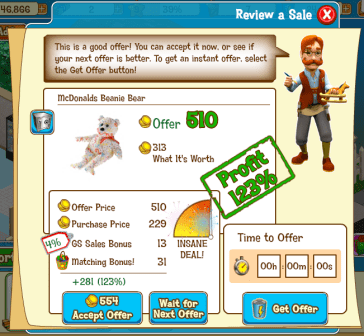
Richard Garriot’s Ultimate Collector (currently in beta) was a difficult game for me to convince myself to start playing, let alone write a quick look of. If there is one faction of the gaming industry that manages to boil my blood, it is the thousands of Facebook ad-driven, nickel and dime, pay-now-or-annoy-your-friends, energy driven games, that pass themselves off as enjoyable to anyone other than the most casual of gamers, housewives, and people with a lot of expendable money and not a lot of sense in how to spend it. Unfortunately for Ultimate Collector, it is not not one of those games. But hear me out.
Ultimate Collector was quite possibly conceived by a hoarder, and as someone whose habits border somewhere between pack rat and hoarder, I can’t honestly comment. But what struck me once I got to playing after a while was that every item in this game is a real, living, object. Apart from the trinkets which serve as quick cash, every serious sale you make is a real, true to life, branded toy. It could be a Gameboy Color, a copy of Paula Dean’s 1000 Ways to Fry Butter cookbook, Beanie Babies, pull toys from the 50’s, and more. In fact, someone who enjoys nostalgia may find the sheer number of items available in Ultimate Collector to make the game worth playing.
You might even be able to find Richard Garriot’s Ultima games. Oh and Tabula Rasa (never heard of it, personally).
As you play, you’ll find that Ultimate Collector can be viewed in virtually brain dead mode, or you can play with a bit of strategy and foresight and really rake in the dough. When you buy an item, you lower the asking price by finding flaws, while raising your profit on resale by finding virtues. By recycling your less profitable goods rather than selling them, you retrieve parts that can be used to fix the more profitable items, making them even more profitable. So the game is about finding the balance in what is worth spending your energy in appraising, what is worth buying for spare parts, and what you should just leave in the bin.
But now we have to get to the part about the cash shop. Ultimate Collector is, after all, an energy based Facebook game, and that means every action has a cost. Each time you rummage through a bin, that’s an energy. Every time you appraise an item (five times per item), that’s an energy. Don’t want to wait for the auction to finish? That’s a Portcash (cash shop money). Don’t want to wait until tomorrow to gain your energy back? You can also spend Portcash on that. Although you gain an energy every few minutes, so the wait to refill your bar is just a few hours if not less.
And for what it’s worth, Ultimate Collector does try to throw a bone by increasing your maximum energy with leveling, and throwing Portcash at the player every now and then. Additionally, buying and selling goods raises your experience in that particular field, which in turn results in more free appraisals saving the user more energy. So there is the feeling that, while corporate won out in the end, the folks on the development side at least tried to give the user a break.

And if you are playing casually, you likely won’t spend a dime on Ultimate Collector anyway. With the way I play, I log in once or twice a day to salvage someone’s garage sale, bring the goods back to my house and see how much money I’ve made from the previous day’s sales, and then put the new stuff up for sale. For me, however, Ultimate Collector is more than just a Facebook game. It is a sign that Richard Garriot has gone back to the man I once knew and always anticipated his next announcement with held breath. The guy who made games that were basic yet filled with depth, were created with an obsessive amount of attention to detail, and occasionally make you wonder if the creator was insane from the start. Ultimate Collector has renewed the faith in Richard Garriot that I lost when Tabula Rasa went down in flames as its development team struggled to keep it alive.
I am really looking forward to seeing Ultimate RPG.

 MMO Fallout