US Copyright Office: No, the Carlton Is Not Copyrightable


Alfonso Ribeiro is best known for his character Carlton from The Fresh Prince of Bel-Air. Ribeiro came back into the public spotlight after launching lawsuits against Epic Games and Take-Two Interactive over copyright claims that he owns the famous dance popularized by the TV Show, informally known as The Carlton. The lawsuit alleges that both developers used The Carlton without permission, that Ribeiro is the sole owner, and that he deserves compensation for use of his creation.

Unfortunately for Ribeiro the Copyright office has been rather explicit regarding the copyright status for simple dance routines: They can’t be copyrighted. The Carlton as it turns out is no different.

In a response to his copyright application, the US Copyright Office officially refused registration for The Dance by Alfonso Ribeiro – Variation B, and noted in no uncertain terms that the dance qualified as a simple dance routine and could not be classified as a choreographic work. Choreography is legally defined as a composition and arrangement of a related series of dance movements and patterns organized into an integrated, coherent, and expressive whole. Choreographic works do not include social dance steps and simple routines, and must contain a sufficient amount of choreographic authorship.

As The Carlton is a routine consisting of three dance steps, it is not registrable as a choreographic work. The Copyright office went further in questioning whether or not Ribeiro was even the sole author of the work.

Epic and Take Two are currently fighting legal battles against a growing number of performers and internet celebrities over the use of popular dance moves in Fortnite and NBA 2K. Now that the copyright office has spoken on Ribeiro’s ownership status, it seems likely that Epic’s next move will be a motion to dismiss.

Source: U.S. Copyright Office

[NM] Star Control On Stardock’s Website Following DMCA


Star Control Origins has returned to digital store shelves following its removal from Steam and Good Old Games just a few days ago. Star Control: Origins was removed from Steam and Good Old Games following a DMCA takedown request by Fred Ford and Paul Reiche, two individuals with whom developer Stardock is currently fighting in court over disputes regarding the Star Control franchise.

In the course of their lawsuit, Stardock requested that the court grant an injunction preventing Ford and Reiche from interfering with the release of Origins. The judge denied the request, stating that Stardock developed Origins with the full knowledge that a serious copyright dispute was likely to arise, and that any harm is of its own making.

“Plaintiff was aware of Defendants’ copyright claim to Star Control 1 and 2 since the development of Origins commenced, however, and was aware of the contours of the present copyright dispute since at least December 2017,” Armstrong writes. “Thus, whatever monies Plaintiff invested in Origins was done with the knowledge that serious copyright disputes were likely to arise or had arisen.”

Origins is currently 50% off on Stardock’s store.

Source: Stardock

[Column] PUBG’s Ridiculous Ownership Claim on the Frying Pan


PUBG Corp has finally decided to pull up its britches and sue NetEase for copying Playerunknown’s Battlegrounds, a move that will certainly make for some monumental court precedent. While I do have coverage coming for this 155 page complaint once I get done reading it, one bit that caught my eye was on PUBG Corp’s list of concepts it claims copyright ownership of, the frying pan as a weapon.

Especially the part where PUBG Corp claims that ‘previous shooter games did not include the use of a frying pan.’

“One very beloved aspect of creative expression in BATTLEGROUNDS is the game’s iconic frying pan. Previous shooter games did not include the use of a frying pan… When
so equipped, as a purely artistic and creative expression injecting humor into the game, the frying pan is the only indestructible armor in the game (i.e., armor that can absorb infinite hit points without deteriorating), providing complete protection against projectiles aimed at a character’s posterior. “

Right, except the frying pan has been a comedic weapon in literature popular media for decades, if not longer, likely longer than many of the PUBG Corp employees have been alive. If you want to keep the conversation strictly limited to video games, the frying pan as a humorous weapon has become iconic as far back as 1996 with Princess Peach and the release of Super Mario RPG but can be found in games like Earthbound (1994), Fable (2004), and Conker’s Bad Fur Day (2001). Dead Rising had a frying pan weapon and Dead Rising 2 even utilized the mechanic of having said frying pan block bullets.

Left 4 Dead 2 (2009) had a frying pan as arguably its most powerful melee weapon, which was then transplanted to Team Fortress 2 in 2010 with the sound effect of a successful hit meant to be both humiliating for the player on the receiving end and humorous for the game as a whole.

Full coverage of the lawsuit is on its way, but this is just one of a large number of concepts that PUBG Corp is claiming copyright ownership of that it had veritably no hand in creating, including the phrase “winner winner chicken dinner,” and the concept of starting with nothing and building up an arsenal, or virtually every RPG since the 80’s as well as the Unreal Tournament games, to name two examples.

In Plain English: No, Epic Games Isn’t Suing A 14 Year Old Just For Cheating


(Update 9/10: Out of respect for the courts, MMO Fallout has redacted the name of the defendant)

Epic Games has made some news this month over the announcement that they are filing lawsuits against people cheating in Fortnite. How many lawsuits? This many, so far:

One particular lawsuit has caught greater attention because it turns out that the defendant is 14 years old. Epic Games filed a complaint against C.R., or Sky Orbit as he is known on Youtube, one month ago for copyright infringement and breach of contract under North Carolina law. The lawsuit here stems from multiple DMCA stikes against the defendant’s channel by Epic Games, taking down videos showcasing and promoting cheating in the video game Fortnite. The defendant appealed said strikes, and under copyright law the only avenue going further for Epic Games is to file a lawsuit.

Further, Defendant is streaming videos of himself playing and cheating at Fortnite by using cheat software (“cheats” or “hacks”) to unlawfully modify Fortnite’s software. In the videos Defendant posts on YouTube, Defendant promotes and demonstrates a Fortnite cheat, and provides viewers with a link to a site from which they can acquire the cheat for themselves.

Epic Games also notes in the lawsuit that defendant has been banned from the game at least 14 times, and continued creating accounts and posting videos on Youtube attempting to promote the cheat program, going so far as to create a second Youtube account to circumvent the takedown notice.

Defendant has been banned from playing Fortnite for this conduct at least 14 times. He nevertheless continues to play using other accounts he created using false names. He has also continued to cheat and to publicly perform and display video of himself cheating on YouTube in an effort to induce others to buy the cheat he sells so that they too can cheat at Fortnite.

A response video by the defendant on the lawsuit can be found here where he disputes the number of bans and claims that the 14 count is exaggerated and is “more like 10 or 5.”

https://youtu.be/OSVeOQfujOQ

Epic has included the Copyright appeal sent to Youtube.

On October 17, 2017, Defendant submitted a counter-notification responding to Epic’s DMCA takedown notice for the First Video in which he stated “i did noting rong this strike is all wrong I was modding in a video game that isn’t against youtubes TOS Why was i striked ?!”

To say that Epic Games is suing a 14 year old because of cheating would be boiling down the story into its base parts and picking out the wrong piece to focus on. It’d be like me covering a burglary and the headline being “Man Arrested For Putting Some Money In His Pocket,” (Note: I’m not equating the two). There is also a misconception going around that Epic cannot sue defendant as he is 14 and therefore not an adult. This is also not true, as in the United States a child can be sued for willful or malicious damages, in which case his parents would be liable for paying said damages. Most states cap this amount, however North Carolina actually doesn’t have such a cap on damages.

In their lawsuit, Epic Games is seeking injunctive relief, barring the defendant from cheating or sharing further videos of cheating in Fortnite, as well as statutory damages due to the defendant distributing said cheats and advertising them on his Youtube channel. One spot where Epic Games may have lost the mark is in their belief that C.R. had a financial investment in the cheat itself. Unless Epic has access to some information that we don’t, the defendant has expressly denied that he is involved in any way with the creation of said cheat program.

On information and belief, Defendant engages in such conduct to promote the cheat via his Sky Orbit and Sky Orbit V2 YouTube channels because Defendant obtains some financial benefit or value in consideration for his video postings and/or the sale of the cheat he promotes and demonstrates in the First and Third Videos.

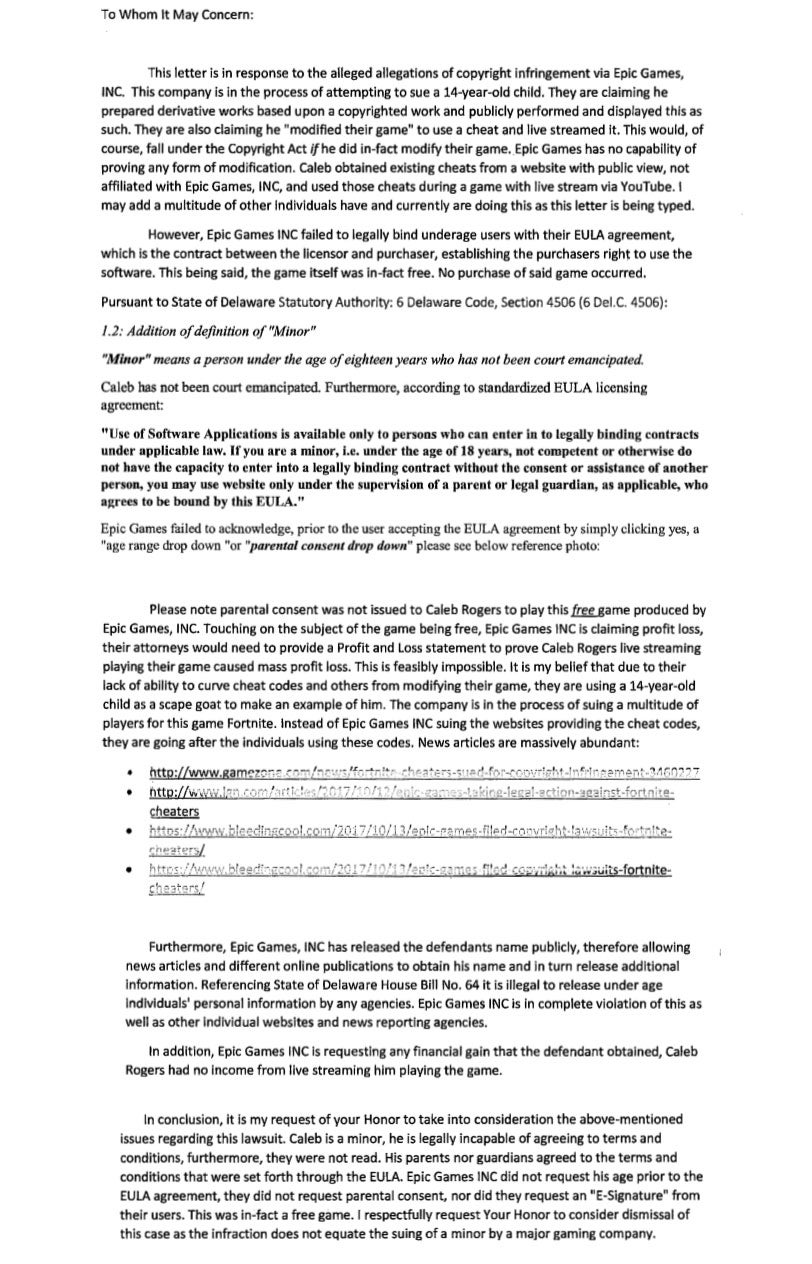
The defendant’s mother submitted a letter to the court which may or may not have been a bad idea, as it shows a glaring lack of understanding of both the situation as well as what exactly her son is being sued over, and likely divulges more than any lawyer would advise her to say.

Regardless, it is likely that Epic Games did not know the age of the defendant prior to filing said lawsuit, so whether or not they will pursue the case further will have to be seen. This is just one of at least six lawsuits currently pending from Epic toward cheat makers and promoters.

Chaturday: The Story of In Plain English and how Atlus Got Copyright Wrong


If I had to give an award for the part of MMO Fallout that fills me with equal amounts of pride and disappointment, it would be the In Plain English column. For those who haven’t been following this website long, In Plain English is one of those columns I started as a direct response to the media’s coverage of events, specifically lawsuits, particularly in the sense that it is generally impossible to find someone willing to cover a lawsuit once it has started.

What got me started on this was the complete lack of coverage regarding Turbine’s lawsuit against Atari, and subsequently Wizards of the Coast’s lawsuit against Atari, regarding the Dungeons & Dragons license, a lawsuit that could have affected every single video game based on D&D. While the lawsuit between Turbine and Atari was settled out of court, we were able to surmise some of the terms of the settlement through actions by both companies shortly thereafter, such as Cryptic (who was owned by Atari at the time) suddenly declaring that Neverwinter would not be an MMO (this was later rescinded once Perfect World Entertainment took over).

For the most part, however, covering lawsuits isn’t good press unless some major groundbreaking decision is on the line or unless one or both parties is utterly insane and is permanently filing nonsense in the court records (read: James Romine v 100 Steam Users). From my perspective, I’m dealing with a story where neither side will ever comment publicly, if they know what’s good for them, due to the potential damage that commenting on an ongoing case can cause. So I’ve tried to take a different approach, by discussing the claims, looking at precedent provided, and digging up cases not presented to use for my own analysis. I never want this column to turn into "this person claimed this, the other guy denied it, who knows what is right."

More often than not, these cases end on a disappointing (for the reader) note, being settled out of court under terms that are never released to the public, with both sides gagged from ever revealing the terms themselves. Speculation in this industry is often fruitless since, as I’ve become tired of repeating on social media, most of these cases have no precedent in court.

Which ultimately leads me to this week’s controversial developer action, and of course I am speaking of Atlus attempting to DMCA a Patreon page for a Playstation emulator because the emulator can be used to play Persona 3.

They later put up a statement which didn’t so much offer legal justification as it did make excuses barely related to copyright law while repeating how much they just want everyone to have the best time possible.

"We believe that our fans best experience our titles (like Persona 5) on the actual platforms for which they are developed. We don’t want their first experiences to be framerate drops, or crashes, or other issues that can crop up in emulation that we have not personally overseen."

While a nice sentiment, this has absolutely nothing to do with copyright law, nor would it be covered under a DMCA claim.

"Unfortunately, when our content is illegally circumvented and potentially made available for free, in a format we do not think delivers the experience and quality we intend, it undermines our ability to do so by diverting potential support from new audiences."

This next part is important because Atlus isn’t just misinformed on copyright, they are veritably wrong in their interpretation of the law. First, the creator of an emulator would not be responsible for people pirating the game. Second, and going by this and other statements, Atlus believes that its rights are infringed on because people are playing Persona on a system that they did not intend it to be played on.

It’s story time.

Back in 1999, a company called Connectix released the Virtual Game Station, a commercially available emulator for the Playstation on Mac. Yes, I said commercial, as in the thing was sold on a disc and for money. It was even shown off by Steve Jobs himself at MacWorld. Sony sued, as you would expect, and the miraculous thing about it is that they lost, the court ruled in favor of Connectix that the emulator did not diminish Sony’s brand.

But here is where it specifically connects to Atlus. The court even ruled that copyright law does not grant Sony a monopoly on devices that play Sony branded products.

"Sony understandably seeks control over the market for devices that play games Sony produces or licenses. The copyright law, however, does not confer such a monopoly."

In the lawsuit, Sony argued that the availability of the emulator would lose them sales on consoles. The court’s response was essentially "tough," declaring that the emulator was a legal market competitor, and that Sony losing sales to the competition did not affect its fair use defense.

Ultimately, Patreon refused to comply with the takedown and the group is still up and operational, likely with more funding than ever thanks to the new round of publicity. All references to Persona have been removed from the Patreon page and website as a precautionary measure.

You can be completely against emulators while also acknowledging that this is out of Atlus’ reach.

STICLI Games: Toxic Developer With Invalid EULA


STICLI Games is the developer of Airport Master on Steam, a $15 airport simulator that by all accounts seems to be a decent game that merely suffers from a bad user interface. The developer, however, seems intent on driving their reputation directly into the river by coming right off the starting line with toxic behavior, an illegitimate end user license agreement, and enforcing trademarks that it very likely does not own.

Since we live in a world where shady, toxic indie Steam developers waste no time perjuring themselves (because filing a false DMCA is committing perjury, a very real crime) by striking critical videos, banning people who post critical reviews, and threatening critics with everything from legal action to revoking their access to the game because they had the gall to complain on or off of the forums.

But STICLI Games has taken it a step further. Imagine, as a non-business owner, what you would do to stop criticism of your game. You write it into the rules, right? While rules are fine and dandy, you need a set that has implied legal backing behind it, and that leads us to our next topic: The end user license agreement. It’s a tool that, for many small business, would never hold up in court because it wasn’t drafted by a lawyer (a competent lawyer), contains bad sections that could invalidate the whole agreement, and the owner assumes that anything written is legally binding because why not, the customer agreed to it.

STICLI Games has decided to bake justification for toxic, anti-consumer practices directly into their EULA, starting with the recognition that STICLI owns the trademarks on all properties and you are not allowed to produce content without prior written permission:

The End User recognizes that all of the rights associated with the Software as well as the rights related to the trademarks, royalties and copyrights, are the property of STICLI Games and are protected by international laws and treaties. Any use of Copyright Holder’s trademarks, imagery content, videos, graphical elements, names, plot in any activity (including but not limited to: producing 3d party video content, electronic and on-paper publishing, creation of promotional content etc.) is only possible with prior written permission of Copyright Holder.

Incidentally, we can learn a lesson from Digital Homicide’s James Romine on this subject: As he stated in his lawsuit against Jim Sterling about the use of the ECC Games name, he isn’t violating any law because ECC Games doesn’t own the trademark in the United States. And after a cursory search of the US Trademark Office, it looks like STICLI Games doesn’t own a US trademark on Airport Master. Trademark, unlike copyright, does not protect works automatically. You have to file, pay the fees, and have your application approved.

But let’s go further, because the EULA just gets better from here out.

4. TRADEMARKS AND RIGHTS TO THE SOFTWARE
The End User recognizes that all of the rights associated with the Software as well as the rights related to the trademarks, royalties and copyrights, are the property of STICLI Games and are protected by international laws and treaties. Any use of Copyright Holder’s trademarks, imagery content, videos, graphical elements, names, plot in any activity (including but not limited to: producing 3d party video content, electronic and on-paper publishing, creation of promotional content etc.) is only possible with prior written permission of Copyright Holder.

A large portion of the threatening emails I receive from developers follow this pattern, people who think they the legal authority to decide who covers their products and want to know why I didn’t ask for permission before publishing my review/editorial. Here’s the thing about copyright law: You don’t have to ask for the creator’s permission in order to cover it. I don’t need STICLI’s permission to use a screenshot as part of this publishing, I don’t need their permission to write this article about how they’d want permission from me to write this article, and I don’t need permission to review their products.

EULAs don’t magically grant companies special privileges, there have boundaries you can’t go outside of when it comes to agreeing on what can and can’t be done.

9. NO REFUNDS
Except when required by law, the Licensor shall be under no obligation to issue refunds under any circumstances. The Licensor may issue refunds basing on Licensor’s own judgement and solely as a gesture of good will.

I have seen some discussion about this clause and it isn’t technically ‘illegal’ in the basic sense because the writer was smart enough to add ‘except when required by law.’ It doesn’t make sense otherwise because STICLI doesn’t get to decide who receives a refund, that’s Valve. None of STICLI’s judgement comes into effect when it comes to Valve’s refund policy.

That means you MUST obtain prior written permission from us before uploading any videos to YouTube. Otherwise, you are breaching the EULA and we can terminate your software license without refund and fire a copyright strike on YouTube.

Also, is this a challenge? Because it sounds like a challenge, and I love a good challenge. So, in testing whether Steam would enforce Airport Master’s ‘under any circumstance’ EULA, I decided to purchase Airport Master for $14.99. I quickly came across some performance issues, including the following illegible text on most menus. It made the game, in my humble opinion, impossible to play on my system and therefore a qualifying circumstance to ask for a refund, I think most will agree.

So I asked for a refund, to which Valve said “yea sure whatever” and promptly handed it over after about two hours.

Turns out that STICLI Games’ EULA isn’t so binding after all.

One more thing: The whole argument about trademark is useless as trademark and copyright are two wholly separate entities. Trademark is all about market confusion, owning a brand and identity and being able to protect it. It is what would prevent someone from, say, starting up a business called STICKLI Games and producing a game called Airport Masters and selling it on Steam, because that is confusing the market. It stops sleazy furniture stores from advertising the “Ultimate Super Bowl Couch,” because it implies official affiliation. It does not give you full control over the use of the words.

It looks like STICLI Games is in Cyprus, and doesn’t own the trademark there either.

Crowdfunding Fraudsters: Legend of Zelda On Unreal


fraudster

Fraudster:
2
a:  a person who is not what he or she pretends to be :impostor;

Gather around, students, for it is time for another Crowdfunding Fraudsters courtesy of MMO Fallout and a never ending legion of people whose motivations are, shall we say for the sake of legal liability, questionable? The reason we call this segment Crowdfunding Fraudsters, rather than say ‘Kickstarter Scam Artists,’ and put the definition right at the beginning is to forward the idea that this isn’t a witch hunt. Most of the projects covered under this segment are merely the ill-informed dreams of ignorant fans. They either lack the business knowledge, the legal understanding, or the programming experience to see their projects to completion. In short, they are impersonating someone who can run a competent crowdfunding campaign.

Today’s project is The Legend of Zelda: Ocarina of Time ported to the Unreal Engine 4 so PC gamers can play it. It sounds like an invitation for a cease & desist from Nintendo, but the campaign has been up and running for a while now so let’s give it the benefit of the doubt.

Let’s find out about the creator.

My name is Joseph I am the current lead developer and coming from Germany / Italy and i think im Well known for the Nintendo character creation in Unreal Engine 4 🙂

As a game developer, being well known as the guy who steals Nintendo assets and ports them to other engines probably isn’t something to be especially proud of, although that resume would have gotten you a job at Silicon Knights years back.

This game will never be allowed to be sold so for the project to ever be completed it must be crowd funded. You are the only ones who can help with the competition I hope to make this a three person team as you can see from the demos we have posted so far this game is coming along, and most of the main maps are complete.

Here’s the thing that people don’t seem to understand about copyright, and I won’t go into the whole idea of profit motive as a concept just yet. It is illegal to just 1:1 recreate a game on a different engine and sell it for money, I think we can all agree on that basic point. With that in mind, creators like Joseph tend to think that if they don’t charge up front for something that they can’t legally sell, but ask for donations or contributions that it’s suddenly alright in the eyes of the law.

Spoiler: It isn’t. It also doesn’t help that the campaign is going to directly sell the game, as it admits right afterward:

IT WILL BE AVAILABLE FOR ALL TO DOWNLOAD AFTER A SMALL CONTRIBUTION $1 MINIMUM

Joseph needs $2,500 to make Legend of Zelda on Unreal Engine 4 a reality, but the goal is flexible because why demand the whole pot when you can hope to lure in some hapless chap for $50? With about 20 hours left to go as of this publishing, not a single person has fallen into this campaign.

The good news is that you can be listed as a producer with nothing more than a mere $15 contribution. For $500, you can be listed as the sole executive producer.

My advice to the creator: You do more benefit to your image and portfolio by creating original works. Nintendo is not well known for its patience when it comes to unlicensed works, and asking for money is just adding gasoline to the inevitable fire.

Indiegogo

League of Angels Using Assets Lifted From Final Fantasy XIV


League

League of Angels developer Youzu Interactive Co. Ltd (or whoever is responsible for their advertising) is directly stealing video and audio assets from Final Fantasy XIV for use in promotional materials. This revelation isn’t particularly new, it’s in a footnote on the game’s Wikipedia article. Follow the link in League of Angel’s advertising and it takes you to a Start Game page that will show either a direct rip of Final Fantasy XIV’s Heavensward trailer or the End of an Era trailer alongside the Answers song.

I reached out to both GT Arcade, whose website hosts the videos, and Square Enix, and haven’t received a response from either. I’m going to assume, given Square’s protective nature of its assets, that the usage has not been approved.

Youzu Interactive and GT Arcade are both headquartered in China.

league2 league3

league4league5

[Not Massive] Criticism Mounting of Paid Mods Program


1663Gargoyle

[Update]: Tripwire Interactive has expressly forbidden the use of paid mods in its EULA for Killing Floor 2.

Your Mods must be distributed for free, period. Neither you, nor any other person or party, may sell them to anyone, commercially exploit them in any way, or charge anyone for receiving or using them without prior written consent from Tripwire Interactive.

[Original Story] About a day has passed since Valve’s announcement of paid mods on Steam, beginning with Elder Scrolls Skyrim, and the backlash is mounting against the new system. A petition on Change.org to remove the mod shop has drawn over forty thousand signatures at the time of this publishing, while a number of people are flooding paid mods with bad reviews.

Fears that Valve’s hands-off approach to curating content would result in stolen content being listed were confirmed when a fishing mod was pulled for using assets from another mod without permission. The creator of Fore’s New Idle Animations, a mod that many other Skyrim mods rely on to function, has expressed his opposition against mods being released for money.

Valve has also seen criticism over its policy of taking a 75% cut of revenue.

Creating Games Using Someone Else’s Intellectual Property


As someone who started writing by creating derivative works of existing properties, I have a special place in my heart for amateur studios who do the same. So whenever I have to deal with such a group of people, I never see them as content theives when I tell them they will probably be served a cease and desist, if not sued outright, for stealing intellectual property.

As is the case with My Little Pony Online, a testament to the internet’s demand that not even this website can refrain from mentioning the show. MLP: Online is an MMO based on the tv show dedicated to a base of adult men. Unsurprisngly, MLP: Online was the target of a cease and desist by Hasbro for all sorts of infringements. The project will continue, but without anything that would identify it as a My Little Pony game.

Still, the law sucks. It puts content owners in a rough spot since if they don’t protect their properties, they could lose them.

Perhaps the better question to ask is why Hasbro took so long to send the cease and desist, considering the game was on the radar of the mane-stream press for a good while now.

I am so sorry.