Does anyone else remember the excitement you felt when you learned that Richard Garriot was back and making MMOs? I believe it was 2005/2006 that Tabula Rasa was fully announced and confirmed to be in development, and many of us just couldn’t wait to see what Garriot’s twisted mind would come up with. Another Ultima Online, perhaps?
SecondStar Interactive is a new studio formed out of names we know well.
Darrin Hyrup: Founder of Mythic Entertainment.
Lory Hyrup: Lead Designer of Dark Age Of Camelot.
Cooper Buckingham: From Warhammer Online, Dark Age of Camelot, The Sims, and Gods & Heroes.
Tim Cotten: Ultima Online.
Eric Piccione: Art Director responsible for the look of Ultima Online and Dark Age of Camelot.
What type of MMO is SecondStar working on? I have absolutely no clue. All we know is that the game is running off the HeroEngine, the same engine you’ll find in Star Wars: The Old Republic and a few other upcoming titles.
I know what some of you are thinking (Ultima Online pre-Trammel PvP with three factions and an extensive crafting system and RvR) and I must ask to contain your drool! That being said, the wait for information shouldn’t be long, SecondStar has rounded out their announcement by claiming a late 2011 release date.
Massive Action Tactics Online Of Duty Free To Play
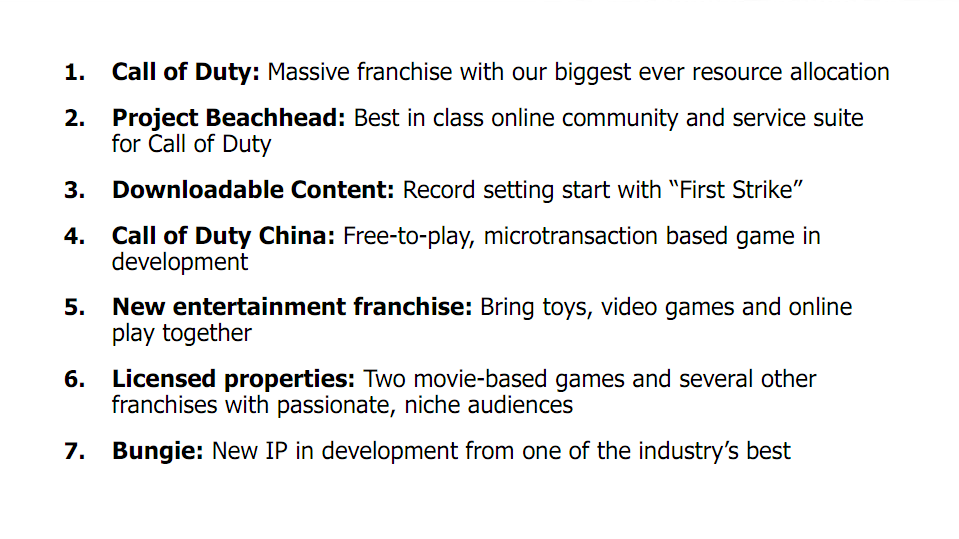
I know what you’re thinking: “Omali, this sounds like yet another free to play lobby based substandard shooter with a cash shop attached where players can pay to win,” to which I must ask that you set aside your stereotypes for five minutes and realize that you are likely 100% correct on that prediction. In Activision/Blizzard’s latest quarterly report, the company reveals plans for yet another Call of Duty developer, Beachhead Studios, to work on a Call of Duty game for the Asian markets. While the traditional Call of Duty never sold too well in Asia, thanks to the abundance of piracy, having mandatory multiplayer and self-hosted servers (not to mention the game being free) will give Activision a tighter control on those who want to play their game.
The financial report doesn’t give any information as to when we can expect the Call of Duty MMO, or if there are any plans to expand the title to the Western hemisphere. In the same financial report, Blizzard highlighted their plans for 2011, including:
Grow World of Warcraft with new content; work towards StarCraft II and Cataclysm launch in China
It is worth noting that Wrath of the Lich King was delayed two years before release in China, due to the restrictions placed on games and Blizzard’s well publicized publisher fiasco, so a 2011 launch for Cataclysm may be on the less realistic side. Still, it would be nice for the Chinese players to remain somewhere close to their Western counterparts.
This month sees the launch of DC Universe Online, with the launch dates of Rift and Xsyon confirmed for very early March, and Earthrise coming in February. Over on the MMORPG.com RIFT forums, I’ve noticed a number of posts from people who reported purchasing not only the collector’s edition of the game, but six or more months of membership in advance. As an afterthought, I decided to look through the post history of a few of these people, and found similar stories: Not much hope in the game, considering they are putting down so much money.
Granted, this phenomena isn’t new. This seems to happen every time a new MMO launches, where a small group of players who don’t have much faith in the game purchase the most expensive version, and are often the first to throw the words “fraud” or “scam” around when the game doesn’t turn out exactly as they hoped it would be, when they hoped it would be so. Take Final Fantasy XIV as a recent example. I’ve seen people post that they had purchased not only the collector’s edition of Final Fantasy XIV, but also added about a year’s subscription worth of Crysta to their account. Some of them admitted that they played the game during open beta, and didn’t like it, yet proceeded to not only purchase the most expensive version of the game, but invest a ton of cash right from the start. Why? Because they “had misguided faith.”
The example I gave above is actually mild compared to the more extreme section of players. Back when Mortal Online launched, I had quite a few people asking me why, despite a few of my articles here on MMO Fallout, I was so aggressive towards players gloating about their chargebacks from Star Vault. One player I got into a heated argument with was because he not only purchased the game one time, and reversed the charges because of the lag and how much he hated the developers, but he then proceeded to buy the game a second time, perform a chargeback, and then boast about it on third party forums. I came across a number of players who played the open beta, didn’t like certain core features (open PvP, sandbox title, stat-based) and still proceeded to purchase the full game, only to perform a chargeback because they believed they were lied to.
Obviously my writing this article isn’t going to magically change the way life works, but I just wish people would make more informed decisions about throwing their money around, or perhaps make an intelligent choice about purchasing a game you played and hate. Hell, that’s the major reason I started reporting on sales in the first place, to not only get people into the games, but to get them in at the best possible price. PC games were never able to be returned, no matter how high your buyer’s remorse, and the fact that you can call you bank and start crying like a child because you got ganked and quit doesn’t change the fact that the whole ordeal would have never happened if you thought with your mind rather than your wallet.
This month sees the launch of DC Universe Online, with the launch dates of Rift and Xsyon confirmed for very early March, and Earthrise coming in February. Over on the MMORPG.com RIFT forums, I’ve noticed a number of posts from people who reported purchasing not only the collector’s edition of the game, but six or more months of membership in advance. As an afterthought, I decided to look through the post history of a few of these people, and found similar stories: Not much hope in the game, considering they are putting down so much money.
Granted, this phenomena isn’t new. This seems to happen every time a new MMO launches, where a small group of players who don’t have much faith in the game purchase the most expensive version, and are often the first to throw the words “fraud” or “scam” around when the game doesn’t turn out exactly as they hoped it would be, when they hoped it would be so. Take Final Fantasy XIV as a recent example. I’ve seen people post that they had purchased not only the collector’s edition of Final Fantasy XIV, but also added about a year’s subscription worth of Crysta to their account. Some of them admitted that they played the game during open beta, and didn’t like it, yet proceeded to not only purchase the most expensive version of the game, but invest a ton of cash right from the start. Why? Because they “had misguided faith.”
The example I gave above is actually mild compared to the more extreme section of players. Back when Mortal Online launched, I had quite a few people asking me why, despite a few of my articles here on MMO Fallout, I was so aggressive towards players gloating about their chargebacks from Star Vault. One player I got into a heated argument with was because he not only purchased the game one time, and reversed the charges because of the lag and how much he hated the developers, but he then proceeded to buy the game a second time, perform a chargeback, and then boast about it on third party forums. I came across a number of players who played the open beta, didn’t like certain core features (open PvP, sandbox title, stat-based) and still proceeded to purchase the full game, only to perform a chargeback because they believed they were lied to.
Obviously my writing this article isn’t going to magically change the way life works, but I just wish people would make more informed decisions about throwing their money around, or perhaps make an intelligent choice about purchasing a game you played and hate. Hell, that’s the major reason I started reporting on sales in the first place, to not only get people into the games, but to get them in at the best possible price. PC games were never able to be returned, no matter how high your buyer’s remorse, and the fact that you can call you bank and start crying like a child because you got ganked and quit doesn’t change the fact that the whole ordeal would have never happened if you thought with your mind rather than your wallet.
A good man once said “there is no such thing as a free lunch.” A greater man then followed him with “luckily it’s past 3pm, so to me this is dinner,” right before tucking into his now-complimentary meal. Those of you who play Anarchy Online’s free to play offering, or really anyone who played an EA Games…game several years ago will be aware, if slightly, about the use of in-game advertising. Mostly you might see this in Madden games, street racing titles, and other names. With the way EA was utilizing in-game advertising, one might think it a lucrative business.
Turns out, it isn’t. Electronic Arts Ben Cousins said in an interview to Edge:
“We actually aren’t getting much from ad revenue at all”, the in-game advertising business hasn’t grown as fast as people expected it to.”
Cousins reminded us that the advertising system isn’t completely dead, but does need to go deeper than simple in-game billboards. Cousins suggested soda deals as part of the system.
“We did a deal with Dr Pepper for Battlefield Heroes, where if you buy a bottle and scan in the code you get an exclusive outfit. That kind of deep integration will work, I think, but I’m not convinced that we’ll have billboards in games and things like that. Maybe those days are over.”
So if in-game billboards are dead, does that mean I’ll be able to walk around in Anarchy Online without seeing the latest Lil Wayne CD? Does Lil Wayne still make CDs? Guess there’s only one way to find out.
First off, I have to give my apologies to those of you who partook in yesterday’s sale on Aion, and will no doubt be at my door ready to slit my throat over the price reductions that are coming not 24 hours later. A few of the existing titles are now on sale at an even more drastically reduced price, although previous restrictions still stand (IE: Sony’s restrictions on free time to existing accounts), and prices are still in USD.
Only a few changes today.
Sales that have not been altered are in standard colors. Prices that have been reduced are in green. New sales are in red.
Items no longer on sale are now removed.
If I accidentally trip or bump into you, generally a simple “I’m sorry” and a hand up with suffice. Then again, if I smash your mailbox with my car because I’m texting while driving, an apology won’t suffice as well. You’ll probably expect me to pay for the mailbox, and won’t be paying for the damage your mailbox caused to my car.
Such is the case with MMOs and various forms of reimbursement that come up over the course of any title’s life. Very extended maintenance, false bans, etc, can put a company in the position where they have to say “alright, now how do we calm tensions between us and the customer?” If you are Jagex, you’ll likely refuse to roll back or compensate, and simply give the middle finger to anyone who lost items or was banned unfairly due to a bug or oversight. If you are NCsoft, XP bonus items are your forte. Turbine? Break out those Turbine points.
I think we can place loss of items at the lowest end of the reimbursement spectrum, extended maintenance somewhere around the middle, and false positive bans somewhere around the top. At the lowest end, reimbursement and perhaps some free xp boosters will suffice, depending on the severity of the loss and the time it took to reimburse. As for extended maintenance, this scales with time. A few extra hours may require a couple xp boosters, but 12+ hours of downtime should generally lead to game time being extended by the respective amount of time (So one day, generally).
In the cases of false bans, however, as a developer you should be putting on your lips of +2 ass kissing, because their durability will be put to the test. By banning someone falsely, as has happened on countless occasions over virtually any game, you’ve accomplished the virtual equivalent of approaching someone, sucker punching them in the jaw, and accusing them of cheating on your wife, before saying “sorry, you looked like another guy.” At this point, you’re looking at shelling out one or more free months of game time, and hoping that the person doesn’t up and quit.
So there you have it. For those companies that do offer reimbursement, they generally do a pretty good job of scaling the compensation to match the severity of the problem. Again, unless you are Jagex and would rather your players quit than reimburse them for issues brought about by faults in your programming.
I love my 2010 MMO Calendar, so much so that I’m keeping it after 2010 is over this year. For those of you who haven’t participated in the past, the MMO Calendar is a yearly tradition that’s been happening for a few years now, and is essentially a calendar (yes) with a different MMO on each month, sold by an independent company with the proceeds going to St. Jude Children’s Research Center. The calendar put out last year also has signatures from the developers at Jagex, Sony Online Entertainment, and Frogster.
Sadly, it doesn’t seem like there’s going to be an MMO Calendar this year, as it is well past last year’s deadline to order, and there is no information on the main website that there will be a new calendar this year. I’ve tried contacting the “email us if you want information on the 2011 calendar,” but that email address is from 2009, and may not be in use anymore.
More on the MMO Calendar, and subsequent charities, as it appears. I guess for now I’ll have to just use my Nintendo Club desk calendar, right? January is Super Mario Galaxy 2 themed.
Here at MMO Fallout, I don’t think it is any surprise that Turbine is essentially my deity, and for numerous reasons. The one I’d like to get into today is what I call The Great Safety Net, not invented but popularized by Turbine. Before Dungeons and Dragons Online went free to play as a saving grace, an MMO losing its subscription was generally accompanied by an announcement that the game would be shutting down. The company couldn’t sustain the title anymore, and hell since the game was shutting down in a few months why not let everyone enjoy it while it lasts?
Dungeons and Dragons Online is a perfect example of a game that was falling down hard, and moved to what was, at the time, a fairly experimental system involving Turbine points, a VIP system, an allowance, and the contents of the item shop itself. Of course, communities saw this and immediately called the impending death of the game. After Turbine launched the free to play effort, Dungeons and Dragons increased its paying subscribers by 40%, with a 500% increase in sales over the first year.
So why do I say Turbine saved the industry? With Dungeons and Dragons Online, Turbine has proven that there is an option other than simply shuttering a title. Following Dungeons and Dragons Online, Turbine has proven that even a healthy title can become an even bigger cash cow when Lord of the Rings Online went free to play. Since Dungeons and Dragons Online, we’ve seen Everquest II move to free to play, alongside Pirates of the Burning Sea, and upcoming Champions Online, Global Agenda, Alganon, and more. Even the normal banter has changed. In many of the forums I visit, the phrase has changed from “I wonder how long until it shuts down” to “I wonder how long until they go f2p with a cash shop.”
Granted, taking the plunge into free to play cash shop is not a guarantee at success, but rather it’s like putting a cast on your horse’s broken leg in hopes that it will heal, rather than outright shooting it. In the case of Chronicles of Spellborn, well you can’t go free to play if your developer goes out of business. Perhaps if Turbine had popularized this just a year or two earlier, we might still be playing Tabula Rasa, The Matrix Online, and other titles.
More and more we can see companies experimenting with or thinking about the Turbine model. Sony is getting into the system with Pirates of the Burning Sea and Everquest II. Funcom and Mythic have discussed such moves with Age of Conan and Warhammer Online respectively, noting that the option is not off the table but not being considered at the moment. Cryptic is taking Champions Online to such a model. The option is no longer cake or death.
Of course, there are some companies that would rather shoot the horse than risk the cast, although with the popularity of Dungeons and Dragons Online, more of those companies might start seeing the light. I’m looking at you, NCsoft.
Which MMOs would you like to see go free to play? Drop us a comment below. Want MMO Fallout beamed directly to your email account? Sign up in the sidebar. Follow us on Twitter: @mmofallout.
Fun Fact: The last Project V13 article was almost five months ago (June 27th).
When I read the latest description of Fallout Online, it reminded me of Xsyon in nature. Being an MMO, the game can’t give you a simple task like finding a chip to fix the water recycling, or escaping the vault to find your father because the overseer wants to kill you. In Fallout Online, the only conceivable goals would be surviving the post-apocalyptic world and helping to rebuild it. Interplay is going for both.
I think [Bethesda] miss a lot of the humour. Our Fallout MMOG will be extremely funny. At the same time, an MMOG must be a lot deeper than a standalone game… you can shoot, but it’s a very small portion of the game. The game itself is about reconstructing the world.
Interplay is looking to follow their own brand of Fallout, rather than the latest iteration set forth by Fallout 3 and New Vegas (the latter of which attempts to reach back to Fallout 1 and 2). Eric Caen was kind about Bethesda’s shaping of Fallout 3’s world, but had his criticism:
“We appreciate some portions of [Bethesda’s work], and we’re not necessarily fans of everything. I think they miss a lot of the humour, and the fans seem to agree with that. Fallout 3 was a little bit too serious – that’s definitely not where we’re going. OurFallout MMOG will be extremely funny.”
According to Caen, president of Interplay, the Fallout Online team is 90 men strong, and the game is still on track for a 2012 beta and release (hopefully giving players enough time to gain survival tips for the real end of the world later that year).
You can check out the partial interview on Edge’s website, with the full interview appearing in the magazine.
Read more information on Fallout Online here. Want new MMO Fallout breaking stories sent directly to you? Subscribe in the top right hand corner, or follow us on Twitter @mmofallout. Leave a comment, no email address required.




 MMO Fallout