“Long term we actually have to look at servers as a whole. The nice part about it is we have doubled how many people we can put on each server since launch. The down side is that at launch, because people were upset at the long queues we aired on the side of opening up more space. What that has now done is separated our player-base into a larger group.”
When The Old Republic originally launched, servers were staggered in order to ensure that players evened out over the course of launch. Following launch, Bioware has slowly increased server capacity to allow more people into each server. The combination of increased capacity and post-launch player activity has resulted in a number of servers with a dearth of players, and Bioware is looking into server mergers in the future.
First, however, Bioware will be opting for a server transfer approach, allowing players to freely move about to the server of their desire.
“One of the problems we’re running into right now is kind of a classic MMO problem, which is that our overall population of players has not changed, but our peak concurrent users has changed”
Back when the internet was powered by Steam and everything cost a nickel NCSoft sued Bluehole Studios, a company made up of ex-Lineage III developers. There has been a bit of confusion with convictions being upheld while others were later appealed and overturned, and I hadn’t noticed that the case has made its way to the South Korean Supreme Court, who yesterday came out with their ruling.
Bluehole Studios has been found innocent of any charges of wrongdoing. However, three employees were convicted of leaking trade secrets and must both pay two billion won in restitution ($1.7 million USD, approximately). The story might be over for now for Bluehole Studios, but the three employees mentioned now face criminal charges for which sentencing will take place at a later date.
In January, NCSoft launched a lawsuit in the United States to keep TERA from releasing, and from the outside looking in this ruling does not bode well for a guilty verdict. While the case in Korea has successfully taken down those responsible for the theft, NCSoft has failed in their other objective: Shutting down TERA.
So those of you on the bench in regard to preordering TERA can probably breath a sigh of relief and grab those credit cards. TERA launches in just a few weeks.
Part of MMO Fallout deals with the harsh reality of the current market: There are too many MMOs currently competing for players, and even more hit the market each day. For every MMO that dies here at MMO Fallout, another three or four take its place! Considering that MMOs are still releasing under the $50-60 client bracket, and with the increasing amount of free to play titles on the market, there is an overwhelming demand to know whether or not an MMO is worth investing in.
That being said, life expectancy can be very difficult to measure, especially before launch. Below I have a few items that should not be taken as exact, but rather observations of past trends that generally hold true.
1. Hacking Off Limbs Before Birth
This is a very important factor. Keep an eye on your MMO of choice and see if the developer starts discussing features that were planned for launch and had to be “suspended” due to budget restraints, but will be included later on once more funding comes in in the form of boxes and subscriptions. I’m not talking about easy to implement features like Looking For Group tools or cosmetic slots. I mean features that were once major parts of the game’s advertising, like Warhammer Online where each race would have its own living, breathing city. That announcement was in 2008, would anyone like to put money on Mythic ever releasing those cities?
If you see a game being advertised as releasing bare bones with no specific details for release, you can probably expect to see the cut features sometime in the year two thousand and never. Assuming of course the game doesn’t pull a Warhammer Online and go into maintenance mode quickly after launch. If your MMO exhibits these signs before launch, you might want to keep your friends close and your wallets closer.
2. How Many Times Has It Shut Down?
Market viability is very important when determining…well, market viability, and MMOs are like psychotic murderers: Once they’ve tasted blood, they can’t stop. So ask yourself before you make a purchase: Has this game killed a company?
Let’s take a look back, shall we? Perpetual Entertainment died with Star Trek Online and Gods & Heroes still in the oven. Star Trek Online went on to become a horrendously rushed release due to a licensing agreement and Gods & Heroes went on to pull in one of the smallest launches in MMO history. Flagship Studios died after Hellgate London and Mythos, the former spending a few years touring Asia while the latter went on to be picked up by Hanbitsoft where it was shut down in Europe under Frogster and eventually launched as a global edition.
There are plenty more to bring up, including All Points Bulletin killing Realtime Worlds, or Earth Eternal being shut down more times than I can count, but you should exercise caution around any game that has previously been shut down: Especially if the prior company went bankrupt.
3. Is The Developer A Known Face?
I apologize in advance to my dear friends in the independent field who will hate me for saying this: I love indie-gaming. I hate indie-MMO developers. Don’t get me wrong, your developers have a great big vision for the future where you can not only take a chunk of sand and turn it into a sword, but you can also use that sword to commit murder and theft. Assuming that the sand is ever fully implemented.
In order to buy into an indie-MMO, you need zen-like patience. The development team might be completely new to the genre, having never developed an MMO or even a full retail game for that matter. You should expect major features to be cut and not implemented for a good year or two, and for development to be slow and sloppy. If video games are an art, buying an indie MMO is not unlike buying a sculpture before it is completed, you assume the artist doesn’t die sometime in the process.
So, although it guarantees that the MMO will be delayed further, possibly by years, I have always suggested that my indie-developer friends create a game and release it first. It gives the developer credibility in the marketplace, not to mention extra cash in the bank, not to mention a successful product makes them much more appealing to investors.
4. Time Spent Trashing the Competition
I’ve seen this marketing strategy fail time and time again, but publishers still have a habit of spending more time trashing the competition than they do talking about the benefits of their own game. Some of you may remember the Global Agenda “No Elves” campaign which focused on how people were sick of elves and magic and wanted shooting and headshots. Global Agenda was to be everything these games weren’t, which ultimately included the desire to pay a subscription for it, because Global Agenda lost its subscription not long after launch and eventually lost its cover price. This is just one example, but around 2007-2008 there were quite a few MMOs released under the “WoW killer” brand that released with major features broken or delayed.
And as far as upcoming MMOs go, I will include TERA in this with their “Are You An MMOFO?” campaign. While somewhat funny, the fact that Enmasse has started directly naming games (DC Universe, Lord of the Rings Online, World of Warcraft) as boring crap (my words, not theirs), has me worried that the developer is writing a check they have no ability to cash.
5. You Know Who Is Working On It
I’m referring to several different people, and you all know who I am talking about. For the sake of MMO Fallout, however, I cannot name them on this page as these people have a habit for threatening to sue me every time I mention them by name. But you all know who they are, the names who are either head of the pack or somewhere in the middle when everything seems to upend and your big ship suddenly goes the way of the Titanic.
This person, you may not personally know them, but they are well known to you. They seem to pop up everywhere bankruptcy and turmoil follow, the games they work on or lead are released unfinished with a priority on selling cash shop items rather than fixing the broken parts of the game, and when pressed to fix them responds with “well since it was broken no one plays that portion so we won’t work on it because not enough people play it.” To these men, hypocrisy knows no boundary, and integrity is just something you sprinkle on a nice lasagna.
One thing you can always expect out of this man is that he will flee the ship before it sinks. When he leaves, you can expect that the end approaches.
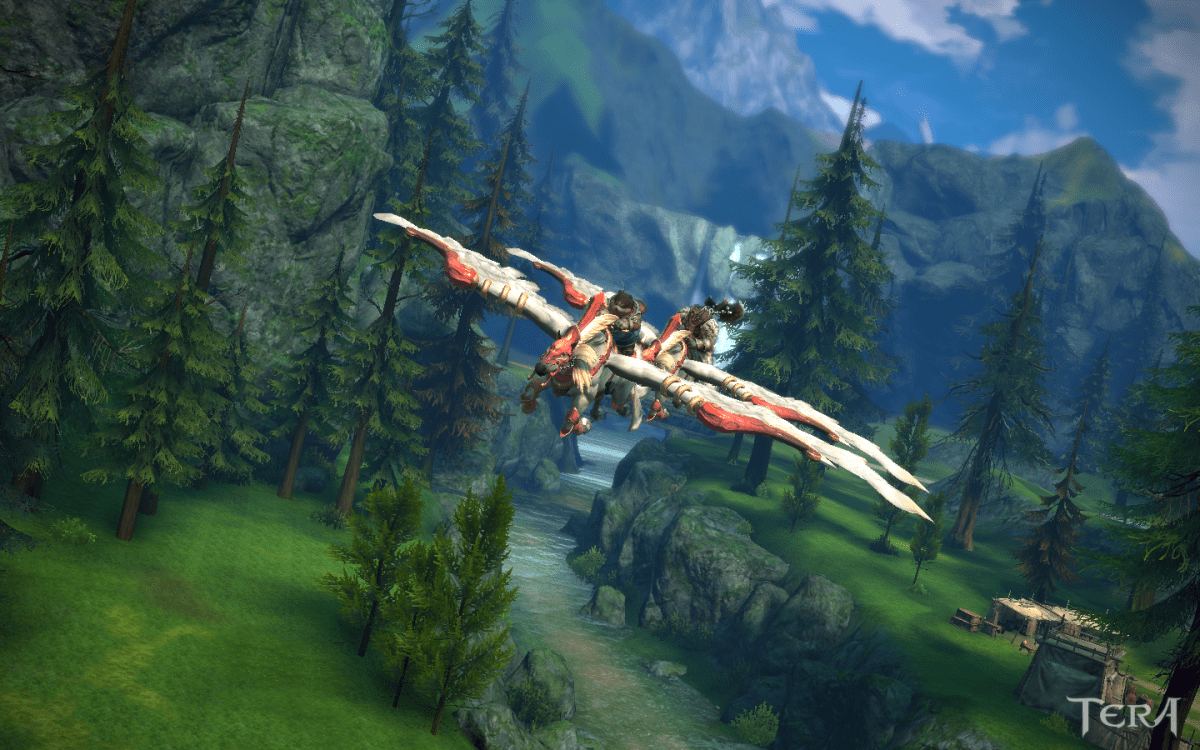
TERA is showing off its new opening cinematic, offering some backstory to the game you likely are well aware of by now. TERA launches May 2nd with the open beta starting April 19th.
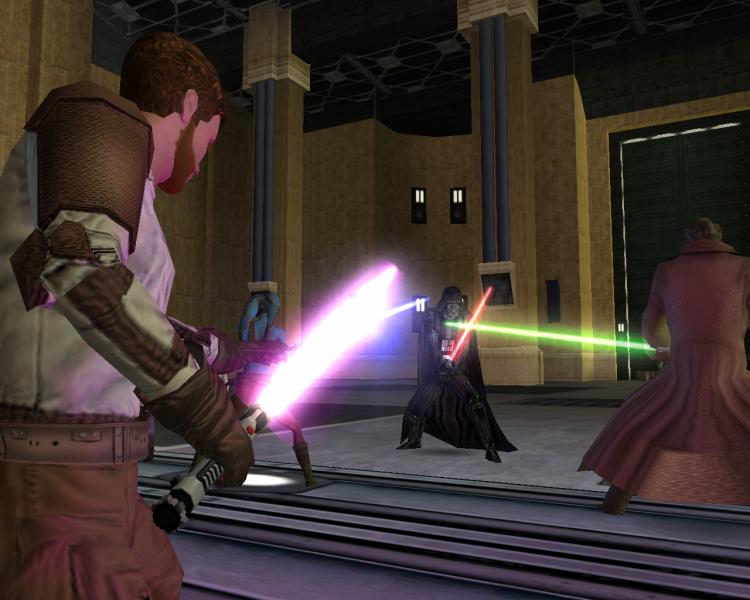
[Update] Bioware has extended the free month to anyone who also receives Legacy level 6 on their account. The time to obtain this has also been extended to April 22nd.
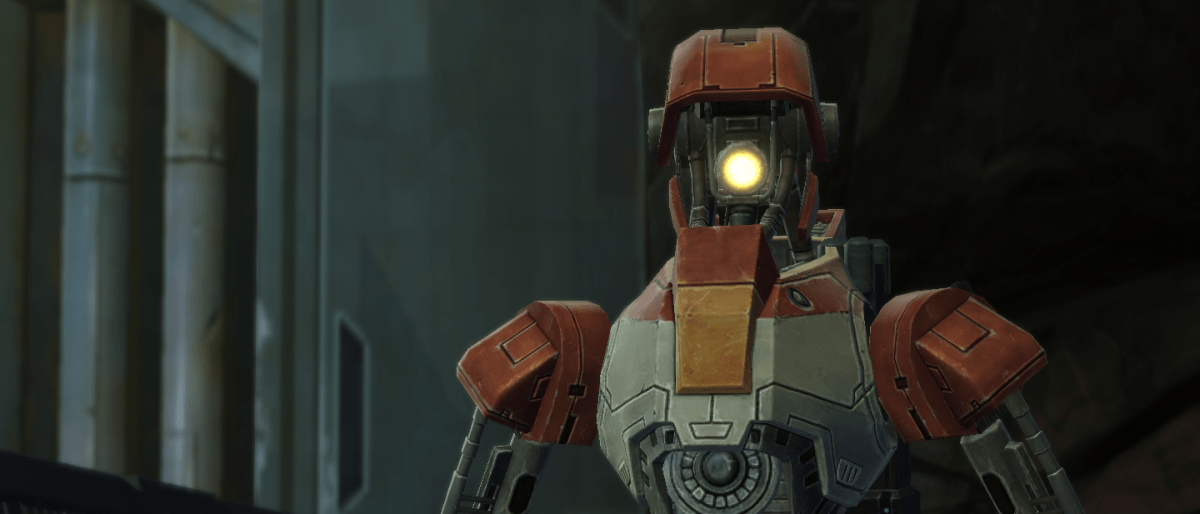
[Original Story] Bioware wants to thank its most loyal customers for sticking with the developer during these hard times. Of course, how do you factor in how loyal a player is? You could ask for a human sacrifice, but Human Resources is notorious for requiring long and redundant paperwork to be signed before any such promotion can take place.
So Bioware has decided to rate “most loyal” as anyone with at least one level 50 character. Those of you who have subscribed since launch but have not reached end game? Well, you’re loyal but they are more loyal. Perhaps you shouldn’t be such a casual gamer?
But don’t fret, all players subscribed regardless of loyalty will receive a free Tauntaun pet. in addition, previous subscribers can log in from April 13th to April 19th.
“It’s a persistent game, it has persistent player data, the character grows and gets better over time. I think most gamers expect that now anyway, but this was a design I’d done a while ago. I think it’s pretty valid.”
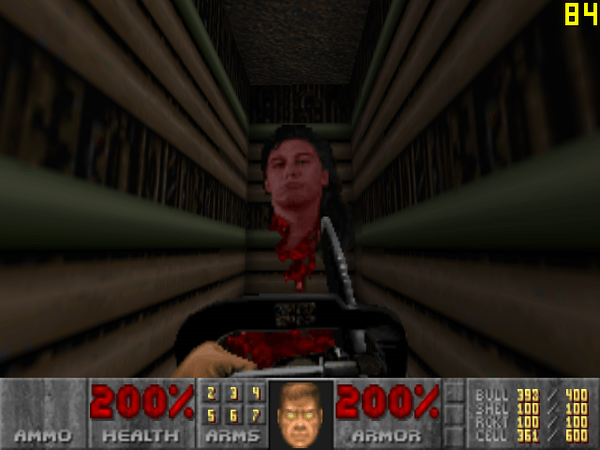
John Romero is one of the industry’s finest, even if he no longer works with John Carmack, and if the man wants to make his own MMO-ish shooter, then by God he will. In an interview with Eurogamer, Romero stated that while the game is still in pre-production stages, he has a solid vision of what he expects the title to become. Romero discusses his distaste for the current shooter genre, and mentions that his game will play faster than the Gears of War titles currently available, and won’t rely on the slower-paced cover based systems and characters who act as bullet sponges. Not to say Gears isn’t a great game, it just isn’t the type Romero would like to create.
If this makes you think of Quake Live, you probably aren’t too far from the target. Granted, very little about Romero’s game, so we will simply have to wait for more details.
Minecraft is a game that has stolen the hearts, the lives, and a whole lot of time here at the nonexistent MMO Fallout office. I’d love a reason to talk about Minecraft, but sadly the game is not an MMO. Notch’s next game, however, will give me plenty of time to talk about Minecraft. Announced just recently, the game is titled 0X10c (figure out the pronunciation yourself), which we will simply refer to as Notch’s MMO from here on out.
The game is set as a sci-fi title and is very early in development, and appears to be an Eve Online style game with a very heavy focus on engineering, mining, trading, and looting. Players have a spaceship that carries a certain fixed wattage that is consumed by additions added to the ship (very Eve-like). At its heart, each ship will operate as its own fully functioning 16-bit CPU.
You can check out the website below. Notch’s MMO will carry a singleplayer and multiplayer mode, and will likely carry a subscription fee for the multiplayer universe.
Aion free to play technically doesn’t launch until next week, but NCSoft has something all players can get into, past, present, and prospective. Starting today, inactive accounts that are in good standing will be reactivated and able to log on. When Aion Truly Free goes live, a new server Kahrun will be launched. While you cannot play on the server until it goes live, starting today players will be able to create characters and reserve names on the server.
To compensate current players with additional time on their accounts, NCSoft is crediting 40 NCcoins per day remaining on the account (or around 1200 coins for each month you had remaining). The credit may take several days to process, however.
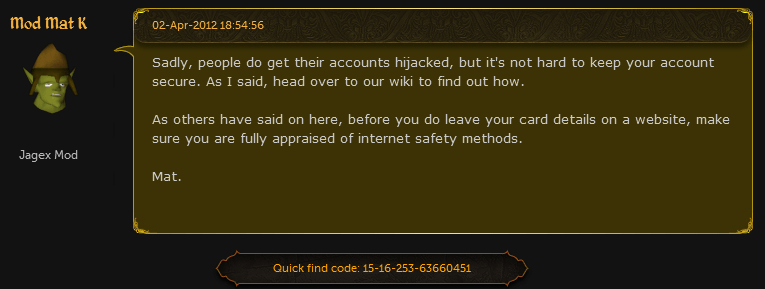
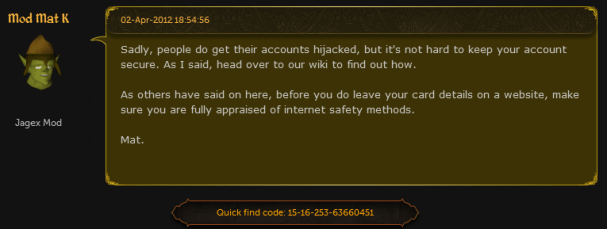
Having your account stolen in RuneScape just became a lot more dangerous. A very serious concern has arisen with regard to Squeal of Fortune, and Jagex’s method of keeping storage of user payment details. Jagex stores credit card information for recurring subscriptions, and uses that same card to purchase Squeal of Fortune spins. While the card number cannot be accessed, Jagex requires no extra information to process the purchase.
Squeal of Fortune is a grab-bag style mini-game where players can purchase spins (and receive them in-game) to have a chance at receiving rare equipment. If an account is stolen, there is nothing preventing the thief from doing very real damage by running up a massive bill through Squeal of Fortune. Why would someone do that with no real benefit to themselves, you might ask? Never question what a person might do to cause grief to another, especially over the anonymity of the internet.
The only way to remedy this for the time being is to head over to Runescape.com and remove your credit card from the account. Go to the main website, click on account settings, membership, and extend membership. You will see a list of payment sources on file, click “manage saved cards,” and there you will be able to delete the card off of the record.
Future membership purchases can be made with the option to not remember the card details. For players with the lower membership rate, there is a leeway when resubscribing where you will still receive your current rate. If the account is compromised and money is transferred, Jagex will not be refunding any money spent, legitimately or not.
With the on-screen PIN to prevent theft in the case that an account is stolen, RuneScape has more security around a player’s virtual bank than it does around the player’s actual bank.
When Jagex introduced the Squeal of Fortune, they did so with the premise that the mini-game was balanced. Powerful and expensive rewards were relegated to untradeable and extraordinarily rare chances, and each player was only offered one spin per day (two for members). Today, however, Jagex has reversed years of outspoken anti-real money trading policies by introducing an update allowing players to purchase extra spins.
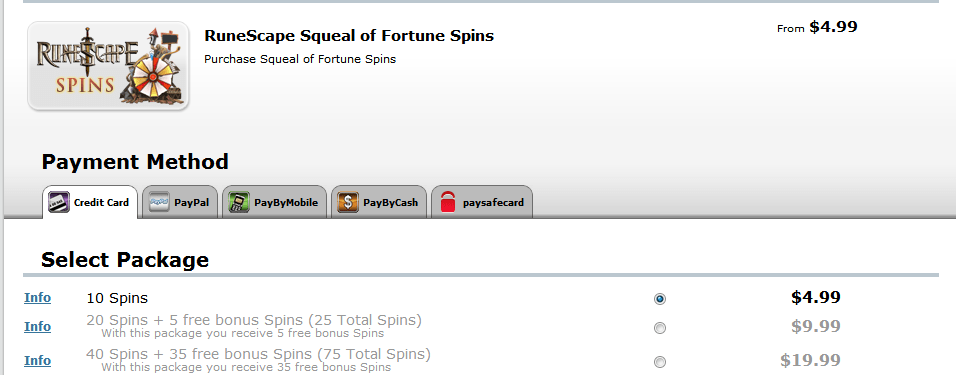
Spins can be bought in packages of 10, 20 (with 5 bonus spins), and 40 (with 35 bonus spins) for $5, $10, and $20 respectively. Jagex has denied that this constitutes paying for an advantage as players are not buying a specific item. The company has also denied that this constitutes gambling as there is no chance of “loss,” as players will always win something, even if it is a cheap 50 coin payout.
The gambling issue, however, stands to be a very important one. This update puts Squeal of Fortune in a similar bracket with lotto bags that many free to play games offer, and depending on if anyone decides to bring question, may constitute gambling and be subject to varying restrictions, laws, and even bans depending on the country.
Regardless of any potential and currently unknown legal implications, this move is sure to draw fire from the community, thanks in part to Jagex’s extreme stance over the past decade against any form of extra payment in return for advantages, and the justifications from developers (see above) as to how this does not violate the core principles is not being received well.



![[Update] The Old Republic: Free Month For Most Loyal Players](https://mmofallout.com/wp-content/uploads/2009/11/starwars.jpg?w=750)




 MMO Fallout