NCSoft Selling Off NC Interactive


ncsoft

Things are afoot over at NCSoft. According to Reuters today, the Korean publisher has announced that it will be selling off NC Interactive Inc, its online gaming branch. Is NCSoft going away in the west? Absolutely not. A follow up article on Reuters states that NCSoft has announced a wholly owned subsidiary that will handle business in the United States and Europe. The transaction will be taken care of on December 24th, to the cost of $50 million KRW. It appears that this is a simple business move by NCSoft to avoid paying some taxes in the US and Europe. Note I said avoid, not evade. One is legal, the other is not.

Otherwise, nothing major is set to come out of this, apart from a little rebranding. It occurs often in business, and as I pointed out, it is a tax trick.

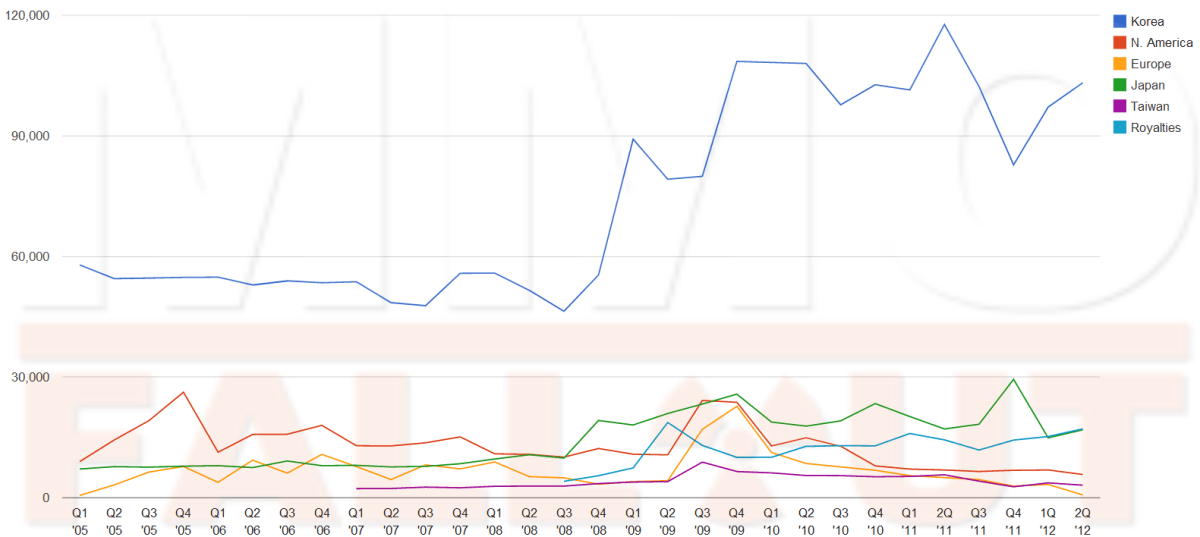
NCSoft’s Sales Per Region, Per Quarter, Mapped


Click on me to enlarge. I look much better zoomed in.

I’ve mapped out the sales per region over the entirety of NCSoft’s financial statements, dating back to the first quarter of 2005. You’ll see that Korea makes up more of NCsoft’s sales generally than every other region combined, and occasionally even doubled. Sales in North America and Europe peaked in 2009 and have been on a steady decline since, with European sales you will see becoming virtually nothing in Q2 2012 (less than 1% of total sales for the quarter). Japan has its ups and downs but is on a general incline, and Taiwan has been relatively stable since its tracking began in 2007. Royalty sales are on an incline, with a few stumbles along the way.

NCSoft may be banking on Guild Wars 2 to save its sales in North America and Europe. Guild Wars sold millions of copies and did quite well in the West. Shutting down City of Heroes will cut NCSoft’s income by a small amount, small beans compared to the sales of Guild Wars 2.

Just a few notes:

  • Units are KRW in Mn.
  • Up until Q3 2008, royalties were included in Korean sales.
  • Taiwan was not listed until Q1 2007.
  • Up until around 2006, NCSoft changed its label “US” to “North America.” For the sake of continuity, N. America has been used for the entire list.

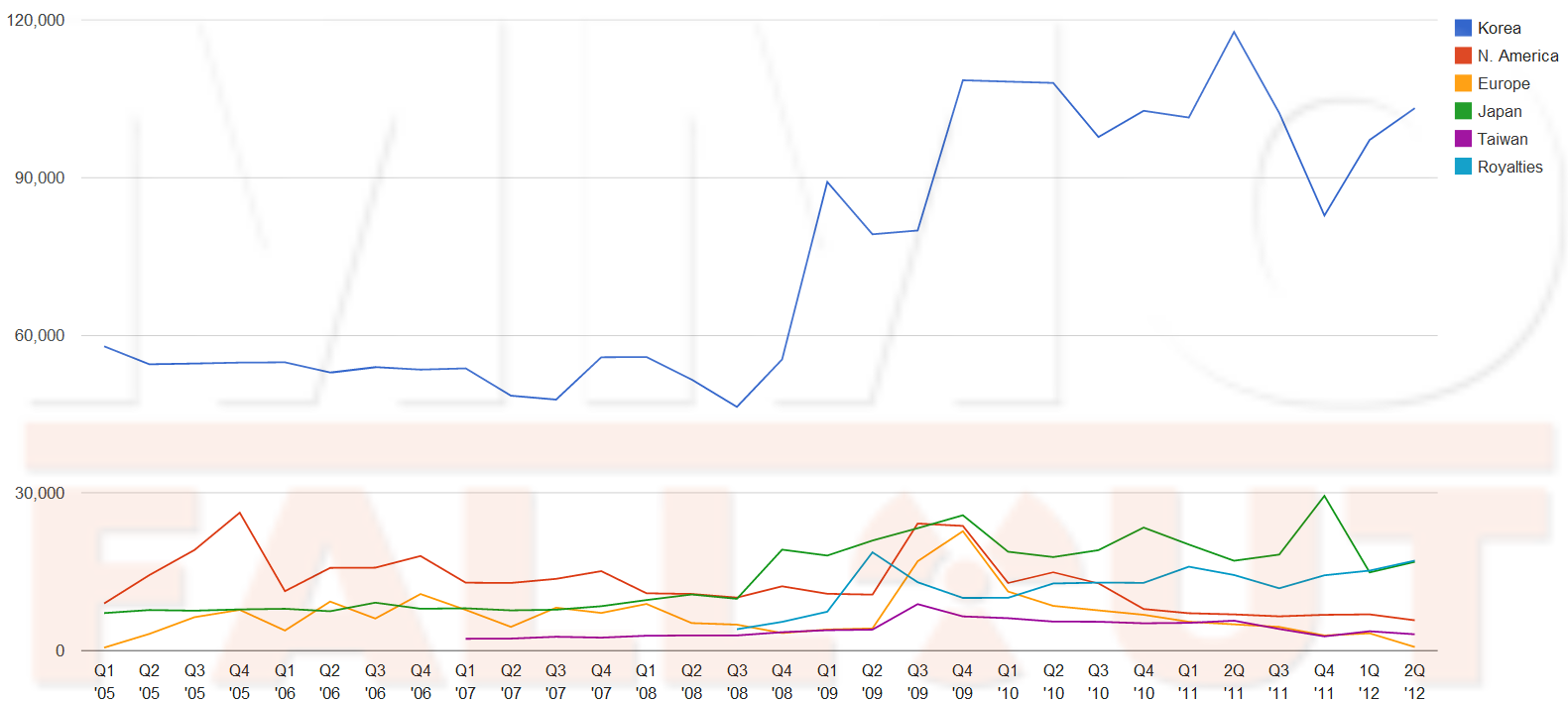
NCSoft's Sales Per Region, Per Quarter, Mapped


Click on me to enlarge. I look much better zoomed in.

I’ve mapped out the sales per region over the entirety of NCSoft’s financial statements, dating back to the first quarter of 2005. You’ll see that Korea makes up more of NCsoft’s sales generally than every other region combined, and occasionally even doubled. Sales in North America and Europe peaked in 2009 and have been on a steady decline since, with European sales you will see becoming virtually nothing in Q2 2012 (less than 1% of total sales for the quarter). Japan has its ups and downs but is on a general incline, and Taiwan has been relatively stable since its tracking began in 2007. Royalty sales are on an incline, with a few stumbles along the way.

NCSoft may be banking on Guild Wars 2 to save its sales in North America and Europe. Guild Wars sold millions of copies and did quite well in the West. Shutting down City of Heroes will cut NCSoft’s income by a small amount, small beans compared to the sales of Guild Wars 2.

Just a few notes:

  • Units are KRW in Mn.
  • Up until Q3 2008, royalties were included in Korean sales.
  • Taiwan was not listed until Q1 2007.
  • Up until around 2006, NCSoft changed its label “US” to “North America.” For the sake of continuity, N. America has been used for the entire list.

ProSiebenSat.1 Deal Altered, More Titles Heading To Europe


You may remember back in February when Sony Online Entertainment announced that they would be opening up a multi-year partnership with European ProSiebenSat.1 Games Group. The list of games affected includes DC Universe, Everquest II, Free Realms, Everquest Next, and Planetside 2. Oddly enough, and without explanation, the list did not include Everquest, Vanguard, and the upcoming Wizardry Online, leading to speculation that ProSiebenSat simply wasn’t interested in the titles.

Well, bad news bears (those of you expecting that Sony would continue hosting said titles in Europe). Today Sony announced that the deal with ProSiebenSat.1 has been expanded. The set list is to include the aforementioned Everquest, Vanguard, Wizardry Online, and the recently released Bullet Run.

“ProSiebenSat.1 is the ideal partner for us to reach an even broader audience in Europe. We are confident that the combination of the media power provided by ProSiebenSat.1 and our expertise in developing high-quality online games will appeal to players in a new and captivating way, creating the perfect prerequisite for achieving great success with our games in Europe.”

The community is once again split over this decision.

(Source: Everquest Forums)

Is FFXI Going To Start Phasing Out The PS2? No Expansion Outside Japan


The recent announcement of a new boxed expansions for Final Fantasy XI brought a swell of joy from the aging MMO’s community. Except for the Playstation 2 community, because earlier today Square Enix clarified on the announcement to point out that Seekers of Adoulin will not be releasing on the Playstation 2 outside of Japan, hence the ominous absence of the PS2 on the trailer we posted.

Is Square Enix greasing the wheels to start phasing out support for the Playstation 2? It is absolutely possible, as Sony Online Entertainment did with Everquest Online Adventures earlier this year. It is absolutely possible, considering the ripe old age of the Playstation. The full statement is below:

“I’d like to take a moment to clarify which platform Seekers of Adoulin will be available on for those that have been asking. We will continue to support North American FINAL FANTASY XI players on the PlayStation 2, Xbox 360 and PC (Windows) platforms. However, FINAL FANTASY XI: Seekers of Adoulin will only be available on the Xbox 360 and Windows platforms in North America when it is released in 2013.”

The Old Republic Launches In More Countries


Good news, Star Wars fans in Croatia! Bioware has announced today that The Old Republic is available for purchase in a whole host of countries previously unavailable. The entire list includes thirty eight countries over Europe and the Middle East, although only a select number of countries in the list will actually have The Old Republic appear on retail shelves. The rest will have to buy through Origin.

Check the list below to see if your country is listed. Unfortunately, if you don’t speak English, French, or German, you are out of luck. Bioware has no plans on adding any additional languages or launching servers for the new territories, so you will have to use the existing European servers.

(Source: The Old Republic)

[Europe] TERA Custom Guild Emblems Temporarily Removed


I’ve always said that developers/publishers should not punish the entire community for the actions of a small group. Now, I hadn’t taken a full look at the TERA guild emblems I posted (which were essentially dumped from a folder on my hard drive) until I started writing this article, but lo and behold I found a penis in the pile. Unsurprising in the highest order. In Europe, however, TERA publisher Frogster has taken upon itself to disable the feature entirely for everyone for the time being.

We had to remove the possibility to use custom guild emblems, as there were cases of inappropriate pictures.

The emblems aren’t gone forever, just until Frogster is able to filter them.

We haven’t just removed the guild emblems without contacting Bluehole Studios. We’re working together with them on this problem, and try our best to find a way to censure/filter inappropriate images.

Community Representative Sealath also explained that the publisher also has an issue with the logos being saved to the local hard drive.

(Source: TERA forums)

Cleanup In Aisle 5! SOE Community Explodes In Response To Europe Deal


In the land of MMOs, few have ginned up more controversy than Sony Online Entertainment. Sony announced that they would be partnering with Alaplaya, gaming division of ProSiebenSat.1 to publish most of Sony’s MMOs in Europe, transitioning European players off of Sony’s account system and on to PSS. The deal has an astounding laundry list of negative impacts on both the North American and European communities which you can read here at EQ2Wire, and the drama only increased when allegations arose that PSS once had a policy of publishing personal details of its customers, and how Alaplaya’s current library is mostly filled with cheap free to play Korean grinders with pay-to-win cash shops, servers riddled with exploits and gold farmers, and mostly absent GMs.

The community has exploded over this news, and the forums were set ablaze by angry customers resulting in numerous posts deleted and users banned for “excessive negativity,” including Morgan Feldon of EQ2Wire. Sony has been mostly silent, saying little more than that the deal is not a done deal and nothing is set in stone yet, while ProSiebenSat has set up a forum and has been talking to users about specific complaints.

There will surely be more information on this as it appears.

TERA Can't Escape Licencing, IP Blocks Coming


Back when Bluehole announced that TERA would have no region restrictions whatsoever, I was admittedly skeptical. An MMO without regional restrictions generally spawns from one of a few circumstances: The same company is publishing it in all regions ala City of Heroes, or there is only one worldwide server ala Eve Online and Mortal Online. In the case of TERA, back in 2010 Bluehole announced that while the clients are region specific, there was nothing stopping someone in Europe from purchasing a North American client and playing on those servers.

Not the case. If Bluehole truly wanted cross-oceanic play, this idea was met with a dead “negative” by the game’s publishers. Bluehole did make this statement to Massively:

We had to change our stance on IP restrictions due to licensing and security issues. While we can’t go into the reasons in detail, we would like to say that although these restrictions are not a panacea for preventing hacking, they are highly effective, and produce more positive results than might be expected.

So licencing reasons. Restricting IP addresses will not accomplish much in preventing gold farmers in Russia or China from accessing North American and European services or stolen accounts, considering ease of use in a proxy. Unfortunately, these IP restrictions also mean that certain regions aren’t able to play the game until a publisher picks up the title in that region. In many cases, the game just never releases in those regions.

Still, this is another example of what happens when you let the developers make announcements about decisions that should be handled by corporate. If TERA had announced from the start that there would be region restrictions (or had they not waited a year and change to go back on that statement) than this wouldn’t even be an issue (save for the regions that can’t play at all).

TERA launches in May for North America and Europe and is being published by En Masse Entertainment (North America) and Frogster Interactive (Europe). Read up on Bluehole Studios’ lawsuit with NCSoft here.

TERA Can’t Escape Licencing, IP Blocks Coming


Back when Bluehole announced that TERA would have no region restrictions whatsoever, I was admittedly skeptical. An MMO without regional restrictions generally spawns from one of a few circumstances: The same company is publishing it in all regions ala City of Heroes, or there is only one worldwide server ala Eve Online and Mortal Online. In the case of TERA, back in 2010 Bluehole announced that while the clients are region specific, there was nothing stopping someone in Europe from purchasing a North American client and playing on those servers.

Not the case. If Bluehole truly wanted cross-oceanic play, this idea was met with a dead “negative” by the game’s publishers. Bluehole did make this statement to Massively:

We had to change our stance on IP restrictions due to licensing and security issues. While we can’t go into the reasons in detail, we would like to say that although these restrictions are not a panacea for preventing hacking, they are highly effective, and produce more positive results than might be expected.

So licencing reasons. Restricting IP addresses will not accomplish much in preventing gold farmers in Russia or China from accessing North American and European services or stolen accounts, considering ease of use in a proxy. Unfortunately, these IP restrictions also mean that certain regions aren’t able to play the game until a publisher picks up the title in that region. In many cases, the game just never releases in those regions.

Still, this is another example of what happens when you let the developers make announcements about decisions that should be handled by corporate. If TERA had announced from the start that there would be region restrictions (or had they not waited a year and change to go back on that statement) than this wouldn’t even be an issue (save for the regions that can’t play at all).

TERA launches in May for North America and Europe and is being published by En Masse Entertainment (North America) and Frogster Interactive (Europe). Read up on Bluehole Studios’ lawsuit with NCSoft here.