Impressions: Homefront The Revolution


Homefront®: The Revolution_20160521123959

If there is a recent game that screams “rent me from Redbox for a day,” Homefront is that game. Not mind-numbing terrible, not jaw-dropping awesome. It’s competent, mostly, but has severe problems that might make you want to wait for a few weeks/months until they can be sorted out.

You have to feel sort of bad for the Korean People’s Army, this is the second game that they’ve been a major player in and they somehow manage to be even less competent than their counterparts in the first Homefront. In effect, Homefront tells the tale of an alternate reality where the Steve Jobs of the world isn’t an American hippy, but instead a North Korean who grows his business and not only takes over the tech industry but also becomes the world’s greatest weapons producer. We, naturally, become hooked on North Korean tech, from our smartphones to our weaponry. The United States, meanwhile, ignores all of its problems at home in favor of feeding its never ending desire for war in the middle east, eventually defaulting on its debts to Korea. In response, Korea “shuts off” all of the electronics in America and invades.

This is all you need to know on the “how seriously should I take the plot” meter, and it’s a very important frame of mind going forward to prevent yourself from asking potentially stupid questions like “in what universe would America become a major trader with Korea” or “why is this the second universe where the US is invaded and occupied yet none of our allies evidently tried to assist?” You have to sit back, partially shut your brain off, and recognize that this is a piece of fiction. Stuff will happen because the plot demands it, not because the writers have the capability or time to explain everything.

Homefront®: The Revolution_20160520211649

One place where Homefront’s storytelling stood out to me is in the resistance aspect. Each zone has a number of chores you can take part in to win “hearts and minds,” (that’s what they call it) of the people, bringing them out of squalor and convincing them that now is the time to fight back. It’s actually pretty impressive to see the zones start out as desolate, depressing, and disillusioned and watch as people slowly begin protesting, culminating in all out riots and slaughtering police and collaborators. You also get to see the KPA become increasingly desperate to try and maintain order, as the public announcements become more aggressive and you start seeing liaisons and important figures popping up to boost support for occupying army.

As an open world game, Homefront mainly takes its cues from Far Cry 3 and 4. Apart from the story missions that help push the game along and act as a method of slowly handing you new weapons and gadgets, you’ll spend the rest of your time taking over territory, performing light jumping puzzles, and tuning radios to the resistance station. While the KPA doesn’t observe US sovereignty, evidently the new regime does abide by the Finders Keepers Accord of 1963, since the oppressive and far superior army won’t make any attempt to take back territory you’ve laid dibs to it. There are far more activities to complete than needed to liberate each zone and gain enough credits to unlock all of the upgrades, a welcome factor since they wear out like cheap sneakers.

Homefront®: The Revolution_20160522122625

The weapon system in Homefront is a clear successor to that found in Crysis, where each weapon can be modified on the fly to either add on attachments or completely change the function of the gun. The modifications allow the game to take a small variety of guns and turn them into a crossbow, an uzi, a sniper, an assault rifle, a battle rifle, a pistol, rocket launcher, flamethrower, a couple types of shotguns, and more. My personal favorite, although not the most useful, is the freedom launcher, a grenade launcher that shoots red, white, and blue explosive fireworks. America.

The movement system in the game can be maddening at times, and rather helpful in others. The game lets you jump up to higher ledges, but you often have to be looking at exactly the right place and jump at exactly the right spot for it to register and pick you up. Other times, the game physically lifted my player up to a ledge that I had clearly missed by several feet. More often than not, I had troubles getting the game to recognize that the ledge I was jumping up to wasn’t too high, causing several deaths in the meantime. It’s a lot harder when you’re getting shot at.

Homefront: The Revolution has stealth mechanics, in theory. You spend the entirety of the game on the KPA’s hit list and, in one of their few displays of competence, all of the KPA soldiers have your face committed to memory or on display in their helmet hud if they have one. Civilians can be used as a buffer to take attention off of you as you walk the street, but there’s no point. Korean soldiers are so slow to recognize you that you could walk right past a group and round the corner before they even realize that you were there. The AI gets confused when you do crazy things like walk past a small tree or crouch behind a small rock, it stops thinking properly.

Homefront®: The Revolution_20160522110806

But like the Zerg, the KPA has an extra ace up its sleeve. What your foe lacks in brains, he makes up for in quantity, and the longer you stick around the more soldiers will swarm on your position. Thankfully, or maybe not so much, death is but a mere distraction in Homefront. You lose your trinkets on death, pointless items that only serve to sell for money, and start at the nearest safe house with all of your progress intact.

There are a handful of serious technical problems that need to be addressed. Right now Homefront has this obnoxious little tick where it stalls for upwards of five or six seconds before catching up with itself every time the game auto-saves. Earlier on this isn’t as much of a problem, auto-saves only occur in safe houses. Later on, however, when Homefront starts auto-saving in the middle of firefights, then you start dying. I also noticed a major issue where enemies and allies would blink in and out of existence. A heavy KPA soldier was barreling toward me and just disappeared.

The multiplayer in Homefront is nothing to write home about. A handful of cooperative maps that pit four players against the KPA in a series of objectives. You level up through missions, gaining access to more gear and cooler cosmetics, but that’s it. The original Homefront’s multiplayer was a disappointing Call of Duty clone, this one feels more like a disappointing Left 4 Dead total conversion mod.

Homefront®: The Revolution_20160522155530

The final words of Homefront, a note from the game director, shine a light on a positive future. We’re not finished yet, he says. There are several expansions coming over the next year, adding new zones and more content to the single player campaign. I’ll probably actually buy the game at some point in the meantime, but after finishing the campaign in two days and having no interest in going back to do more chores or playing the multiplayer, I’d say that this is worth a two day Redbox rental. Six bucks, no regrets.

I’m glad I played it, all things considered.

Beta Perspective: I Can’t Heap Enough Praise On Overwatch


Overwatch 2016-05-06 05-39-24-40

I don’t think a lot of people had much faith in Overwatch when we first heard of it, after all consider the circumstances. Blizzard just got done telling us that their MMO Titan was being canned because it wasn’t fun, but that the remains of the title would be stitched together in a Frankenstein’s monster-like fashion to create a new game. It makes you wonder what exactly Titan was, and why it sucked.

Functionally, Overwatch is what would happen if Team Fortress 2 and a MOBA made love and had a child. It is a 6v6 first person shooter with a massive cast of unique characters on numerous themed maps over several game modes. Rather than Team Fortress 2’s nine classes, Overwatch currently provides 21, split into four groups (offense, defense, tank, and support).

A Team Fortress 2 player would find themselves much at home in Overwatch. You have Pharah as the soldier with her rocket launcher and rocket jump ability, Torbjorn as the engineer capable of building and upgrading an automatic turret, Widowmaker as the sniper, Mercy as the medic with her medigun, D.Va as the heavy, Tracer as the scout, Junkrat as the demoman, and probably Winston as the pyro. There isn’t really an equivalent of the spy, the TF2 character that can disguise and go invisible.

Even Call of Duty fans have a dedicated character in Soldier 76, a hero who carries an automatic rifle that alt-fires rockets.

Even within each category, the characters vary pretty wildly and have a number of uses. In support, for instance, Mercy isn’t just a follow-and-heal character. While useless in combat, her staff can heal and it can also boost damage, while her ultimate ability can be used to resurrect characters on the spot. Lucio, on the other hand, is capable of using his offensive weapon to damage enemies or to knock them around. His Crossfade ability can regenerate health or amplify movement speed. Symmetry has a weapon that builds damage the longer it connects, while her sentry turret slows enemy movement.

Overwatch 2016-05-06 05-46-34-65

But it still doesn’t reduce the versatility of characters. Even non-support characters have healing powers that vary from simply boosting oneself to providing area of effect healing and shield. They give every character the potential to just massacre the enemy team, regardless of their type. Roadhog, for instance, already being a tank with ridiculous defense and health, can bring enemies in close and then utilize an ability to heal himself. Widowmaker, with her sniper rifle and ability to scale to higher places, can be absolutely devastating in the hands of a sharpshooter.

The increase in characters allows for some devastating combinations. If you’ve looked up videos on Overwatch, you’ve probably seen the combo where Bastion (a giant robot) transforms into his stationary turret mode on the Payload objective and just mows down people while Reinhardt (a tank character) protects him with his shield.

There are three game modes planned for launch as well as a hybrid mode. Escort has one team escorting a payload while the other team runs down the clock. Assault has an attacking team trying to capture control points while the defending team tries to run down the clock. Control has both teams fight over control of capture points which control adds to a meter which, when full, ends the round. Hybrid starts out as assault and eventually becomes escort.

Overwatch 2016-05-06 05-43-23-72

More updates are planned after launch, obviously, including new heroes and new maps, as well as new game modes. If there’s one thing you can expect from Blizzard, it is that the Overwatch that exists a couple of years from now will be massive in comparison to what we get at launch.

The only real downside of the beta so far is the prevalence of matchmaking throwing you into a guaranteed loss about twenty seconds before the match ends. It’s an inevitability in any game that has matchmaking, and Blizzard has alleviated the frustration by making it so you do not gain a loss if you backfill a match, however you can score a win if your team is victorious. It’s relatively simple functions like these that Blizzard is known to put in their games to make them a bit more fair.

It is a testament to these games when you can do poorly without going full tilt, even though the nature of the game demands a balanced team and I’ve had a few moments of shouting obscenities at my computer because my team was attacking on an escort map and my team just would not stop camping in their own spawn area or those public games when your team throws the game away because three members just wanted to be snipers. The game gives suggestions based on your team, but it doesn’t force you to pick a balanced list of characters so if you have a team of tanks and the enemy team is balanced, you’re screwed.

I see massive eSports potential from Overwatch, just from the litany of gifs showing up online. There are already tournaments planned, and hopefully Blizzard adds spectating tools in the same with Valve has with Counter Strike: GO, Team Fortress 2, and Dota 2. I can’t wait for the full launch of Overwatch. If you haven’t gotten into the game yet, the beta was extended until May 10th mid-afternoon EST. Even if you can only get a few games in, I wholeheartedly recommend it. It’s been a long time since I’ve come out of a game this positive.

The game will also make a killing out of the loot system. Basically you have an overall level that is functionally meaningless, but every time you level up from experience gained in each round you get a loot box that is full of random skins, victory poses, sprays, etc. When the game goes live, you’ll be able to buy them with credits as well. Longer play sessions can lead to better experience gains, since you get a boost from staying in a match through successive rounds. You’ll also apparently be able to toss away the stuff you don’t want for credits to eventually earn the stuff you do want.

I never tell my audience outright to spend money on a game just because I told you I liked it, so I really recommend getting into the beta while it is still live.

MMOments: Blade & Soul


Client 2016-01-19 20-15-37-73

Blade & Soul is one of those games that we’ve been impatiently waiting to come westward for a few years now, and like any game that we are regularly told we can’t have, the hype train has gotten out of hand at one point or another. I think that the majority of gamers saw NCSoft’s “you can’t have this yet” attitude and recognized it as an issue of lengthy localization rather than an evil corporation withholding the greatest creation since sliced bread, but you know that there is someone out there that took the lengthy development delay as a sign that the game was being advertised as the second coming of Jesus.

If there is one thing you can expect from Korean MMOs it is that character features will be exaggerated and heavily sexualized, so naturally I created my character was created with the kind of booty you could rest a stereo on. I’m not entirely sure if the gliding and camera controls exist primarily to serve for gratuitous panty shots, but I’m not willing to rule it out at this time. Also, you should expect that all of the female characters have breasts that more closely resemble free hanging piles of Jello brand gelatin than actual human flesh, bouncing and bobbing with every small breeze.

That said, there are a lot of options for the character creator, honestly you could spend hours working on every little detail of your character’s physique.

Client 2016-01-19 19-51-25-02

The characters of Blade & Soul are rather charming, even though I can’t remember their names and they have a tendency to die ala Game of Thrones not long after you meet them. Still, the characters are drawn from the anime school of ridiculous features, like the grandpa dog, the obnoxious kid who takes credit for everything, and whatever this is. The world looks beautiful, even with the parade of very well oiled men and women running about, reminiscent of a higher quality TERA or a more polished looking ArcheAge.

Combat in Blade & Soul is well paced, relying equally on mouse clicks and key presses. Your left mouse button is tied to a resource building attack while the right mouse button uses said resources. As you level up, you start to be able to use combos like, in the case of my sword-wielding character, knocking your opponent to the ground and stomping them while they are down. The rate at which you learn new techniques is just slow enough that you’ve mastered the previous lesson by the time the game is ready to teach you something new. It’s spaced out enough so that the player doesn’t get overwhelmed but (at least in the opening acts) hopefully doesn’t feel like the combat is growing stagnant.

The game throws in little things that keep the game flowing, like enemies that randomly drop bombs that can be used to take out or stun another mob. Ultimately, however, this is your standard MMO fare: You go into a village, take a bunch of quests, complete those quests, then move on to the next village. In no sense does the game feel like an open world, with players being ushered down what is effectively a single hallway ala Final Fantasy XIII, with a few dungeons hanging off to the side.

What impressed me is how the game handles equipment. For starters, your beginner weapon is supposed to stay with you for most, if not all of the game. Imagine the upgradeable epic weapons you get during end-game raids in other MMOs, and then picture getting that weapon right from the start. The weapons that you pick up along the way are more useful as upgrade materials. In addition, there isn’t much of an equipment selection. Instead of grinding for your usual selection of gloves, boots, legs, chest, and head pieces, you’ll gather accessories and soul shards. Soul shards come in one shape and fit into a wheel, offering various stat bonuses. Complete a wheel with a single soul shard set and you’ll unlock even more powerful bonuses.

Client 2016-01-24 09-42-11-92

One small feature that I find myself appreciating is on logout, where the game tells you exactly what you’ve accomplished during that play session. It isn’t a major feature by any stretch of the imagination, but it’s a handy tool nonetheless. You also have access to a “daily dash,” a board game of sorts where you spin a wheel and obtain items the further you get. It appears to reset every month, and falls into the Korean MMO trope of throwing shinies at the player to keep them going.

Client 2016-01-24 09-25-20-25

Now let’s get to some grievances. Blade & Soul is heavily instanced, with areas separated by portals that cause the game to hiccup whenever you pass through. While the drastic changes that some areas go through between and following quests are nice, it serves to highlight just how linear the game is, and how ultimately unimportant and forgettable each zone is, almost as if each one is an episode of a serialized anime.

The most obvious and present issue with Blade & Soul is the constant, endless, gold spam. The fact that it is insanely present on a Korean import title doesn’t surprise me, nor does NCSoft’s complete ineptitude at combating said spam despite operating MMOs for nearly twenty years. I would be less harsh were it not for the fact that Blade & Soul launched in 2012, yet still hasn’t figured out the most basic of bot protections. Let’s go over a few, shall we?

  • Severe limitations on chat for new/free accounts.
  • Level limitations on global chat channels.
  • A filter that can detect when the same message is being repeated across multiple accounts.
  • Safeguards at account creation that would prevent mass throwaway accounts.
  • A limitation on how often characters can be created/deleted.
  • A cooldown on sending messages to global chat channels.
  • Banning the use of proxies.
  • Banning Chinese IP addresses.
  • Making ignores account-wide instead of character-specific.
  • Having actual customer support.
  • The ability to easily report people in chat.

And finally, you need to squash the shit early, pardon my language, and start banning some Twitch streamers. Allowing popular streamers like Reckful to partner with illegal gold farming websites and make money off of a community form of cancer will do nothing but push away customers and make your company look feckless and corrupt. Generally I wouldn’t harp on gold spam in a game this close to launch, but Blade & Soul has had years to figure this stuff out and yet the spam is worse than pretty much any other MMO that I have ever played.

There is still a lot of ground to break in Blade & Soul, which I intend to do in the coming weeks. Despite the negative stuff I’ve said, the stuff that sets Blade & Soul apart, like how the game deals with loot and upgrading equipment, is keeping me playing.

MMOments: Deadman Is DarkScape Plus Punishment


deadman

Deadman Mode is DarkScape plus punishment, a statement that should be instantly endearing to anyone who tried out the RS3 mode and found it too accommodating to rushers and griefers. If you’re looking for Old School RuneScape with more rogue-like features, this is the place to be. If you’re not willing to lose a lot, and I do mean a lot, whenever you die, well there are other versions of RuneScape available to you.

It’s interesting to think of Deadman Mode as something that is hardcore in theory, not so much in practice. On paper, the game sounds devastating: Lose your inventory plus 28 of your most valuable stacks of items in the bank, plus 50% experience in all of your unprotected skills. And it is, death in Deadman is punishing in a way that only a masochist can love. But that, ultimately, is what seems to be preventing the game from becoming a grief-fest.

In DarkScape, a player with a decent stock of weapons can go around harassing players to no end and not end up risking anything. Griefing in Deadman means being willing to lose everything, and while I have seen a few players already throwing major tantrums and trying to harass other players, they quickly found themselves unequipped and powerless. Also unlike in DarkScape, it takes 30 minutes for a skull to disappear and players do not receive a skull when attacking a skull’d player. The entire world is open combat (3-126) and guards are level 1337. This makes attacking another player a massive risk, you basically become a target for EVERYONE who will kill you without a second thought.

deadman2

To help you along, Deadman offers accelerated progression in the form of five times the usual amount of experience. What does this mean? At least in the early levels, the only thing getting in the way of your leveling will be the fact that you’re clicking through level up messages too often. Players are also able to store ten non-stackable, tradeable, items in a keepsake box that will remain safe if someone kills you and steals your stuff. You can’t store your cash, but you can store important items.

We’ll have to see how well Jagex can moderate the game, what with the company doubling down on its policy of not allowing mule accounts. There is also no grand exchange, making the accelerated progression all the more important because it will be easier to mass produce equipment or farm bosses sooner.

As with DarkScape, Deadman will change over time based on player feedback and (since this is Old School) anything approved by the community. Right now the community is voting in approval of changing non-skulled experience loss from 50% to 25%, as well as hitpoint insurance that will allow players to buy a minimum hitpoint level and the ability to separate left-click attacks on players and npcs. Currently up for vote but not approved (so far) are changes to team capes, the removal of the wilderness ditch, and reducing the skull timer.

So far, Deadman is turning out to be exactly what people wanted from DarkScape, not to mention being set in Old School. I hope to keep covering this game for a long time to come.

The Park Is A Decidedly Creepy Game Appetizer


The_Park_Screenshot_1_3240

(Editor’s Note: The screenshots in this review are provided by Funcom to the press. While I wanted to provide my own shots, none of my screenshot grabbing tools or even Steam were able to capture screenshots for some unknown reason)

With all the news about Funcom’s death spiral, being one of the few game developers to actually be charged and convicted for misleading the public (specifically investors) about their game, the recent flop that was Lego Minifigures Online, and the company’s ongoing and increasingly seemingly desperate financial situation, it’s nice to finally be able to talk about the Funcom that you and I know and love most: The one that tells a really good story.

The Park is, as previously discussed, the first in a line of experimental products by Funcom to put out games on a very low budget, at higher frequency, and to allow the team to gauge community reactions and see what works. Funcom’s first dive into the experimental market comes in the form of a $10 atmospheric walking simulator along the lines of Dear Esther or The Stanley Parable. If I had to sum the game up solely by it’s functions, it would be this: You walk around, get spooked, read things, ride rides, and get spooked.

Players take the role of Lorraine, self professed worst mother ever, as she goes searching for her lost son Callum in the spooky Atlantic Island Park that will be very familiar to those who have played The Secret World. In order to uncover the truth behind Callum’s disappearance, you’re going to need to dive into the deepest recesses of Lorraine’s disturbed mind, not to mention dig into the bloody past of the park itself. Not only does the park have a lot of secrets to hide, so does Lorraine as it becomes evident from the start that your narrator isn’t exactly reliable.

The_Park_Screenshot_2_3240

Like most good horror sets, The Park holds off on the spooky just long enough to lull you into a false sense of security, in the form of a long and (looking at the forums) divisive scene where the game tells the entire story of Hansel and Gretel while you ride through a spooky tunnel of love. It is at this point where the game starts to play the spooky dial like an instrument, turning it up and down at just the right moments before breaking the knob off at 11 for a final crescendo.

Now, those of you who know me are aware that I tend to be pretty hard on the horror genre, I regard a majority of horror media as lazy and uninspired, and have very little patience or regard for games/movies that consider sudden, loud screaming noises and spooky pictures as “scary.” Good horror involves getting into the player’s head, making them afraid to continue rather than simply being anxious in anticipation of the next loud noise/spooky image jump scare.

With that, I have to say that The Park has a lot of great, genuinely creepy scenes in it. Yes, the game does have a few jump scares and they are lame, easily spotted, and predictable, but they’re overshadowed by the park’s other attractions, each one given a fair amount of buildup and prolonged fright that is lacking even in other horror “walking simulator” games. I’d even go as far as comparing The Park to Amnesia: The Dark Descent.

One place where the game falls short, but not really, is in the danger zone, the fact that the game doesn’t have a fail state or any real threat to pile on to the player. Ultimately, it’s like a haunted house at a theme park. You’re spooked but there’s the lingering thought in the back of your mind that nothing you encounter will actually harm you. Hopefully.

The pendulum swings both ways, as going back to my previous comparison, while the monsters in Amnesia added heavily to the immersion and terror, hunting down the player and rattling endlessly, death also tended to break the flow that the game had taken so long to establish and build up. It’s an issue that has supporters on both sides, but The Park will play towards those that don’t want to worry about having to reload a level multiple times in order to progress.

The_Park_ScreenShot_3_3240

Where the game truly shines is in the voice acting of Lorraine, whose demeanor swiftly cycles through frightened, terrified, and downright deranged over the course of the game’s events. Her internal monologues err on the side of hit or miss, some offering useful missives about whatever is going on on-screen, the others apparently being the random thoughts of a questionable mind. The “right click to call Callum” function, as hyped as it was in the game’s advertising run, is functionally useless and serves no purpose to the game other than to break immersion. It does, however, highlight the relatively poor voice acting of Callum and probably spoil the ending for those of you steeped in horror tropes.

While Lorraine’s voice actress does an impeccable job, I simply couldn’t get involved in the story of the duo, and in this sense the story writers at Funcom might be insane geniuses. The entire plot revolves around Lorraine’s apparent desperate attempt to save her son, a narrative that doesn’t exactly work when you’re constantly stopping to play in the park. It doesn’t help that Callum immediately presents himself as a character worth hating, leaving me to wonder several times why anyone would bear this nightmare in order to save his useless and evidently ungrateful ass. As it turns out, that’s exactly what the game is going for, as Lorraine actually doesn’t seem to be in too much of a rush to save her son and even contemplates leaving him there.

And that’s where it all comes full circle into The Park being a narrative about the nightmare that is parenthood, sacrificing your life and sanity all for a being that isn’t grateful and is never satisfied. I’ve seen a lot of comparisons to Silent Hill and I get it, the two share a lot in common thematically. The Park, like Silent Hill, isn’t centered on the spooky location, that’s basically a side character in the whole plot. The real plot is in the head of the protagonist, and how the world changes to mirror their experiences.

While The Park is a pretty full experience, those who haven’t played The Secret World will be let down by an ending that doesn’t wrap things up as much as it should. In order to fully understand the plot, you’ll need to play through the area as it exists in the MMO.

For a one hour, $10 game, I found The Park to be well worth its money. It looks good, plays decently, and makes me look forward to Funcom’s next experiment.

Early Access: Szone – You Have Left The Zone


2015-05-18_00017

If gaming has suffered in any way from the MMO industry shift to free to play, it is through the saturation of what I’ve referred to as mass-market shovelware, MMOs that seem to exist for no other reason than to show up, exist for a while, and then hopefully leave with a little profit. These are games piled out by the thousands, mostly by devs in Russia, China, and Korea of no reputation and no discernible talent, throwing out games riddled with bugs, unfinished content, hackers, gold farmers, and a surprisingly filled out and functional cash shop.

The latest genre to be tied down and mercilessly tortured comes in the form of online clones of the game S.T.A.L.K.E.R, by GSC Game World, and while my patience with the developers of these games is growing thin, I will gladly admit that I have enjoyed one or two of their offerings. I genuinely enjoyed, and continue to play, Survarium.

You get an idea on just what kind of experience Szone Online is when you first load into the world and find that you are weaponless. The first NPC you meet, the blacksmith, tells you to come back later once you’ve gotten more experience and he’ll give you some stuff. Head inside the closest building, talk to an NPC, and he’ll give you some rusted weapons. Now the real frust-fun starts.

2015-05-18_00019

Try to shoot the gun and you’ll get an error saying “no ammo.” Double click on the ammo and see the message “this ammo is already loaded.” What you need to do, and I figured this out through trial and error, is to unequip your gun and use a magazine on it in the inventory. Go through the long list of Steam reviews and you’ll see this issue pop up a lot, with new players put off by the simple lack of explanation on how to initially load your gun, disregarding a needlessly complex and convoluted method.

Szone Online is the first game I’ve seen where it is conceivable to “lose,” in that you’ll run out of ammunition and money, rendering you useless in combat and unable to make that money back. That being said, I don’t see myself playing long enough to fall into this trap because the game itself just isn’t fun.

The four hours of Szone that I managed to get in consisted mainly of me running from NPC to NPC, killing large swaths of dogs and rats, in what feels like bad fanfiction of the GSC STALKER universe. Just read a bit of the description.

This is a story of human pride. Time is at hand when, in their utter desire to study the world, people will start destroying it. Tests of high-energy heavy particles accelerators will result in billions of microscopic black hole rupturing the structure of time and space. This will become the point of no return. The Earth as we know it will cease to exist.

2015-05-28_00002

Szone isn’t a STALKER game, it just happens to be set in a post apocalypse, specifically in a “zone” in the Ukraine where players, or ‘stalkers’ seek out artifacts for the sake of science, glory, and profit.

The game plays about as poorly as it reads, likely owing to a combination of inexperienced programmers and a poor engine. Characters are clunky and will occasionally get stuck on geometry that they shouldn’t get stuck on. Jumping is a frustrating experience that will get you killed more than once since your character will simply not jump if you’re too close to whatever you’re jumping on. Animals seem to be able to reach you from distances they shouldn’t. Gun handling feels directly pulled from the numerous free to play shooters built partially to look and feel like Counter Strike 1.6, except without iron sights.

I don’t know which to blame for Szone’s combat, poor AI or bad netcode. Hit detection is horrible, with animals either often dying a few seconds after you shot them or just ignoring your bullets despite the splats of blood indicating a hit. Dogs are easy to pop off with one or two bullets, but once they start moving they become difficult to hit without spraying your automatic weapon everywhere. Shoddy netcode and poor hit detection often mean missing shots that should have hit, hitting with shots that should have missed, and dying because NPCs are warping around the map.

2015-05-28_00003

And don’t be confused by the fact that the game is in early access, Szone has been up and running for years. I originally played this game back in 2012 partially to aid in my Russian language courses, when the game was known as Stalker Online. Crucial issues like the netcode, lag, weapons, etc, haven’t had any noticeable change in three years.

If Szone is with us for the long haul, it’ll likely be because the game survives not off of massive income but by maintaining a cost of living that is near nothing, similar to Alganon. You won’t lose anything for playing it, other than your time, but I’d be willing to bet you won’t come out ready to dive back in.

Beta Perspective: RuneScape Death Mechanics


JagexLauncher 2015-05-06 09-22-17-78

Now that Jagex has joined the rest of the MMO industry with the launch of a test server for major updates, I figured I’d use the opportunity to take a quick look at the upcoming new death mechanic as it currently stands. RuneScape’s death system has been a hot topic for years, as it started out with the player dropping everything except for their three most valuable items before moving on to a gravestone system that would eventually expire and make the player’s loot available for everyone.

It strikes of casual-izing, but it has more to do with the player base itself. Those who play RuneScape likely are aware that death for most has become a trivial affair, it’s rare to actually lose something when you have a half hour to get your stuff. Jagex realized that the only people who are losing things are people dying unfairly, whether it be from bugs, shoddy servers, or if someone hits your car backing out of the apartment parking lot while you’re fighting a boss and you have to go take down the license plate number before they drive off. But I digress.

RuneScape’s death changes have been a long time coming, and I say this as someone who never dies in the game.

JagexLauncher 2015-05-06 09-24-30-71

For the purpose of seeing the new death interface, I made an exception.

I immediately grabbed my better gear and threw myself at the fires of one of RuneScape’s bosses. Death now teleports you to Death himself, who keeps hold of your items for 24 hours or until you can pay him off. My set of Bandos armor (the three cheapest pieces) plus an amulet of fury wound up costing me just over a hundred grand to replace, with my food and grand potions cutting a rather small fraction of the cost.

JagexLauncher 2015-05-06 09-24-55-53

You can sacrifice some of the stuff you don’t want to cut a bit of the cost off, but by my figures it won’t do much. The addition of the 24 hour timer gives you the chance to hit the bank in case you don’t have any cash on you, or to go farm some stuff to sell if you don’t have the cash at all. The timer also allows players ample time to get their goods back, god forbid either your internet go down or the servers are unstable for multiple hours at a time.

The actual economic impact will have to be seen when the update goes live, but the goal is to introduce an item and gold sink through the cost of retaining items and the loss of those sacrificed or unable to retain. As someone who rarely dies, I don’t expect to see much of an impact from this update, but the knowledge that server disconnections are easier to deal with goes a long way to changing attitude while playing.

Less Massive Review: Tales From The Borderlands Episode 1


rhys-smash-card

(Note: This review contains spoilers for Borderlands 2.)

Telltale Games is easily one of my favorite game developers, proving the viability of AAA point and click adventure games in a world that had long since left the genre behind. The company spearheaded and successfully proved the viability of monthly episodic games, allowing players to buy the entire season with the added bonus of getting it all on dvd at the end for simply paying the shipping cost.

The idea of an episodic, intelligent, narrative take on the Borderlands universe is one that excited me greatly when it was announced earlier this year. I have a fondness for the Borderlands series, and while the series has progressed quite a bit since the first title, the games have never delved deep into the world in which your vault hunters live. All Borderlands needs to bring out its underbelly is a capable set of hands.

fiona-smash-card

Tales From The Borderlands is set after the events of Borderlands 2. Handsome Jack is dead and the Hyperion Corporation is going through a bit of a power vacuum. Vault Hunters are on the prowl looking for the newly discovered vaults, and Hyperion wants a piece of the pie. The story is told by two narrators. Rhys, a Hyperion employee, finds himself demoted to janitor and heads down to Pandora in an effort to screw over his boss and secure a vault key (and hopefully cement his real promotion). Fiona, a con artist, works on Pandora with her sister and adoptive mentor who absolutely won’t betray them, Felix.

As far as narrators go, you won’t find a pair less reliable than Rhys and Fiona, a factor that the game makes readily apparent from the start. The story shifts between perspectives, often going back and retelling the same story from the other character’s point of view, with both sides regularly contradicting each other. Who is telling the truth? Did Rhys really stand up to that group of psychos or did he wet himself and cry while the machine gun wielding robot did all of the work? That’s up to you to decide.

the-stranger

In their travels, the characters meet a variety of insane locals including my current favorite: Shade. The characters in this version are a lot more tame than their Borderlands counterparts, a more subtle comedy to match the slower pace of the game. As with previous games in Telltale’s lineup, Tales From The Borderlands has more in common with an interactive movie than a full-fledged action title. There are a few actiony moments here and there, mostly fed through quick time events, but anyone familiar with the Telltale Games series knows that these games are all about strong characters, powerful dialogue, and (more recently) giving the player choice to shape their game.

The best part is that the episodic nature allows Telltale to shape future episodes based on features players didn’t like or suggest. I can’t wait for episode 2 of Tales From The Borderlands, not to mention the upcoming Game of Thrones. Check it out on just about any device. Episode one is available now, with new episodes coming in the next few months.

vasquez

Diaries From ArcheAge #2: Shipping Overseas


ARCHEAGE 2014-10-10 11-38-09-42

As part of the ArcheAge experience, I decided to dedicate some time to delivering a trade pack overseas to the Solzreed Peninsula. I can already tell this is going to end in my death.

ARCHEAGE 2014-10-10 11-41-34-94

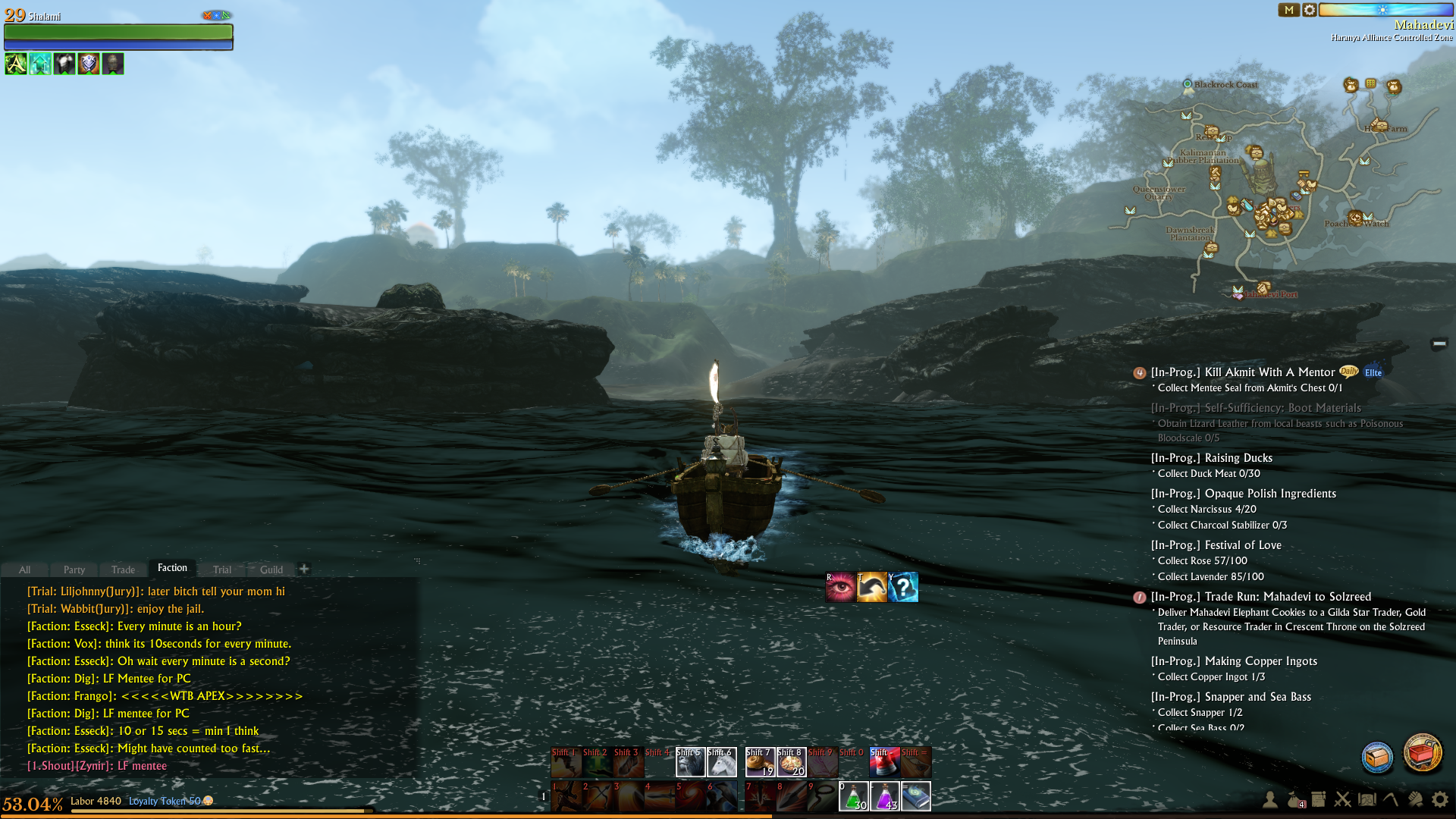
As you can see, my only means of transportation across the sea is in the basic rowboat obtained through an early quest. Travel speed: 4.5 meters per second. Likelihood of success: none.

ARCHEAGE 2014-10-10 11-41-57-05

No stowaways! Thankfully ArcheAge has aggro limits and the Seabug got bored a couple minutes later. Maybe it’s not too late to enlist one of those teleporting hackers.

ARCHEAGE 2014-10-10 11-45-43-16

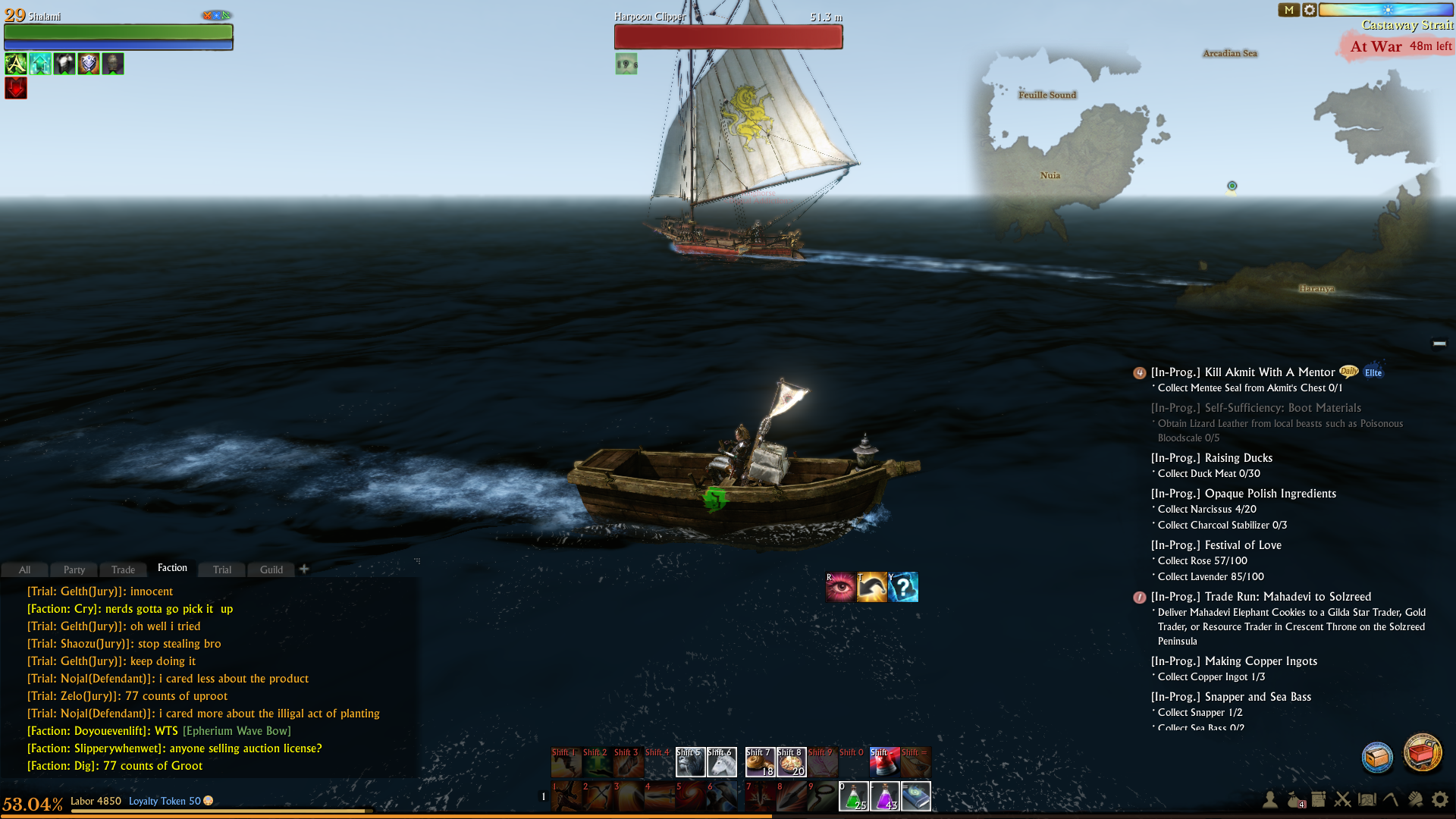
This guy wasn’t interested in what I was selling: A full load of being defenseless.

ARCHEAGE 2014-10-10 11-55-13-59

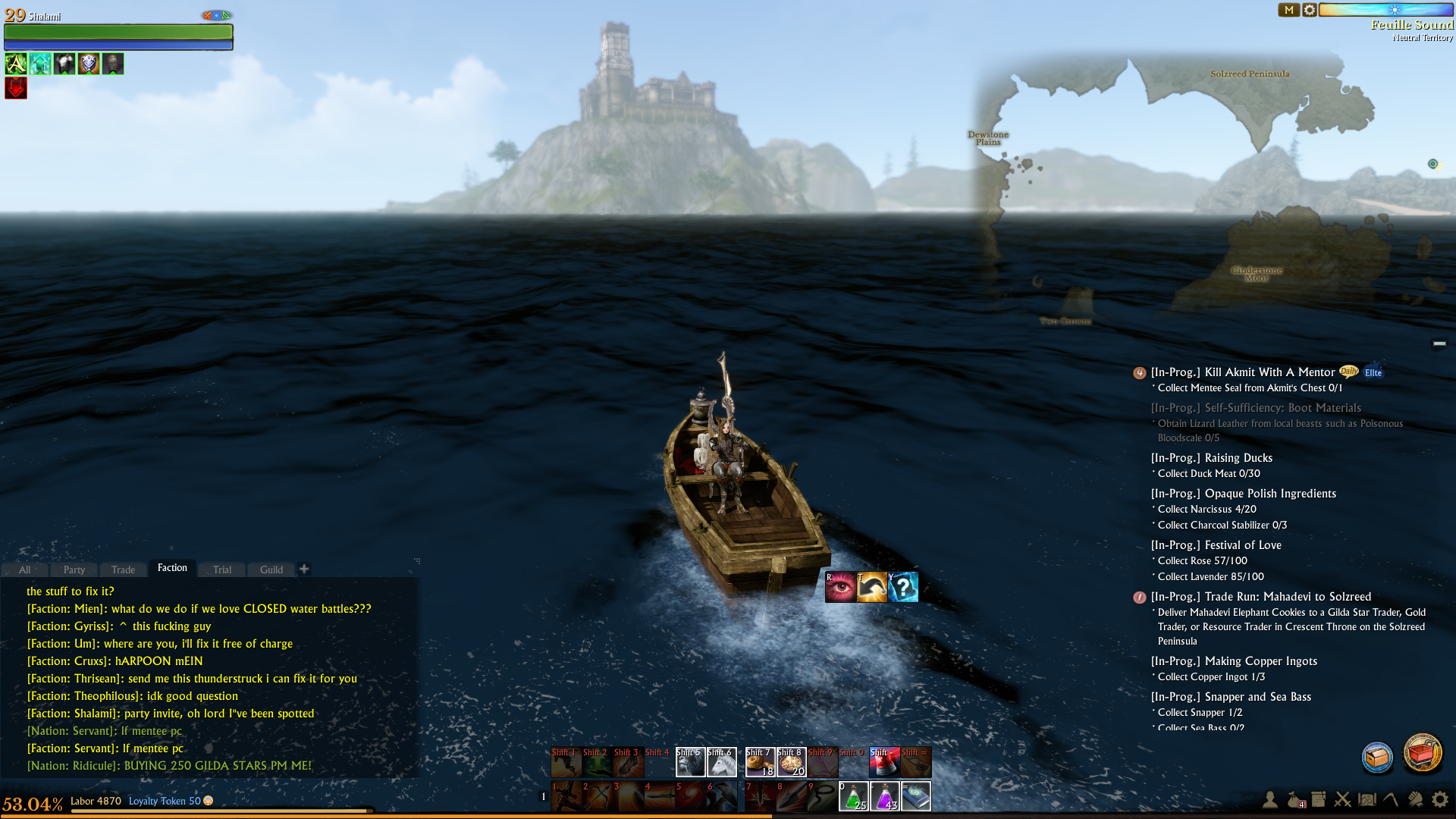
An hour later and I’m almost there! I can see the port in the distance.

ARCHEAGE 2014-10-10 12-02-23-78

The port is being blockaded by pirates. I’m dead, and the trade pack will probably be destroyed. Finished the quest.

MMOments: Destiny


10655179_10152733524359600_9149003542480043990_o

Have you heard of the black garden? The greatest threat to us all lies there. I wish I could tell you all about Destiny’s rich story and lore, I really do, but frankly there isn’t much that I can remember that isn’t tied to a basic storytelling trope. Basically the story is that a giant construct called The Traveler came to Earth where it ushered in a new era of technology and innovation, taking humanity to the stars. In space, naturally, we encountered aliens hell bent on killing us for no apparent reason other than that they are evil and we have god on our side. A traveler named The Traveler, bad guys called The Darkness, and the guardians of light are Guardians? I’m rather surprised that Bungie didn’t go full force and have you taking missions from Goody McGooderson, aided of course by his eventually-outed-as-evil assistant, Badguy McBackstabby.

It’s hard to remember much about Destiny with such groundbreaking writing like “the Vex are so evil that they despise other evil beings.” Most of this is narrated by a Peter Dinklage who sounds suspiciously like he found a copy of the Destiny script while bored at the doctor’s office and Bungie stealthily recorded him narrating it out loud. The rest is told through grimoire cards, but you’re going to have to go to Bungie.net in order to read what they are because there is no in-game lore book like in, well, every other RPG with some form of lore book. I mentioned my hope in the beta that this would be fully implemented on release, count that as a disappointment.

10697127_10152730652469600_3753579906584561296_o

It’s hard to not make comparisons to games like Borderlands, when the two are so similar. Destiny is a solid shooter and a fun time, and yet it will deserve every single one of the disappointed reviews that are currently making their way to press, and that is a shame because Destiny is a very fun game. When all is said and done, Bungie’s greatest sin in all of this will be that they gave too much hype to a generic game, like when McDonald’s would treat the return of the McRib as if it were a brand new discovery when it was the same sandwich we’d been having for years. We get it, Ronald, you put boneless rib on a sandwich and added some onion and a pickle. Twenty marketing campaigns later, and it’s the same sandwich.

10694267_10152730655174600_690763185510293652_o

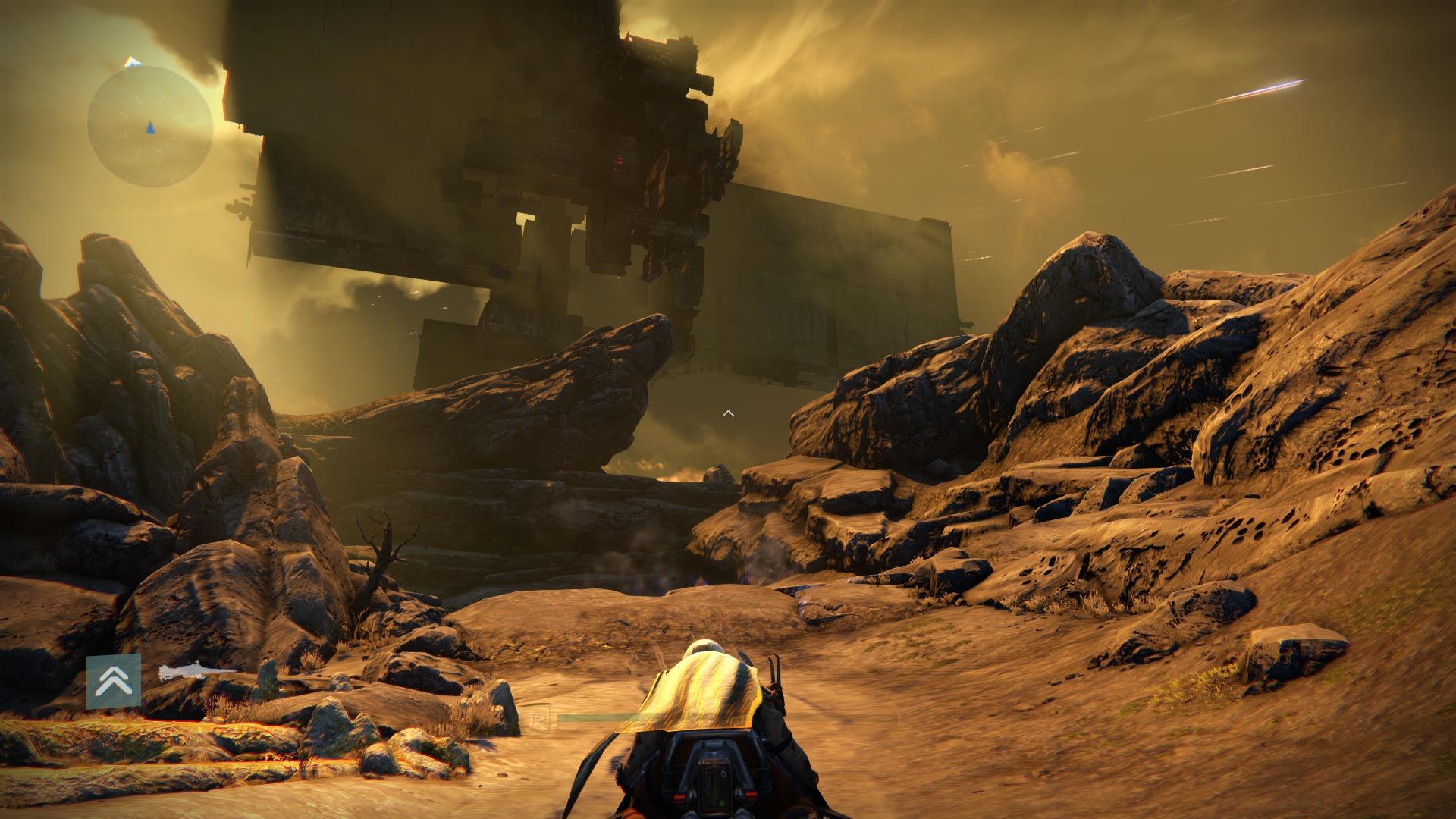
Make no mistake, Destiny is an impressive looking game both in the graphical department as well as taking relatively small environments and making them look gigantic. It is also a solid shooter with solid RPG mechanics and progression system with some loot on the side. As with games like Borderlands and Diablo before it, part of Destiny’s draw is the never-ending quest for more loot, higher levels, and progressively more powerful weapons and armor to shoot a lot of bad guys who have committed the crime of carrying your loot. The shooting, Destiny does well. Weapons feel like they have real weight and especially handcannons pack a punch that feels like it could knock the controller out of your hands.

Combat against the AI varies in nature, and as with Borderlands can eventually feel like a chore. Devoid of any intelligent AI, Bungie’s take on difficulty is to employ the same cheap tricks used in similar games, and use them in intolerable numbers and combinations that make me think Bungie missed a course on how combat is balanced in RPGs. You see, in standard mobs there is a balance between power, defense, and speed. You can have mobs that are invisible, mobs that have high health, and mobs that run incredibly fast in large numbers and deal heavy melee damage. Creating a creature that mobs in packs, has a lot of health and does heavy damage, and runs around invisible? Ridiculous. Snipers using invisibility is a pretty common trope in gaming, but snipers that remain invisible while they’re shooting you? That’s just sadistic.

Bosses carry the same poor AI, considering that they merely serve as walking tanks. They aren’t difficult as much as they are unfair, merely large hitboxes with a lot of health carrying a weapon with ridiculously high damage and splash radius, which makes them very easy to defeat if you can keep moving. I think I died by one boss so far, and it’s because his area had a constant stream of mid-tier creatures whose guns all had lock-on bullets. Oh yea, enemies have guns with bullets that change course and follow you through the air. Otherwise, I can guarantee that your death will almost always come when the game goes “screw it” and just throws so many mobs at you at once that there is no way to kill them fast enough and nowhere to use cover to regenerate.

10658690_10152733523964600_3692456607300919308_o

One problem Destiny faces is that Bungie’s take on sociability is, well, odd to say the least. On one hand, partying and getting into impromptu groups with random players and friends alike is seamless and enjoyable. I’ve taken on numerous boss dungeons where I suddenly found two other players by my side, and while none of them talked, everyone seemed to know what to do. Chat is handled through emoticons as well as through local voice chat if you can find anyone else with a headset plugged in.

On the other hand, the social aspect is essentially nonexistent outside of the off chance you manage to stumble upon one of the game’s exceedingly rare public events. The trade hub, the center for social contact, has little promise for social activity. Chat is nonexistent in both its vocal and keyboard form, there are no social mini-games, and trade doesn’t exist at all in Destiny so you can’t even go into town to sell off or give away your loot. Bungie’s official statement is that this is because they want every weapon to have a personal story behind it. This is a pretty heavy order, since it assumes that your combat moments will be memorable enough for players to actually remember how they got their weapons. I remember how I got each and every one of my weapons: I killed a bunch of unmemorable mobs until an orb popped out and then I picked that up.

PvP is a mess, and a real heavy step back considering we’re talking about the company that made Halo 2. The one thing Bungie did right was to consolidate stats in the Crucible, meaning you are no better than any other player just because you are a higher level or have better gear. Everyone is the same. Well, mostly. Maps are far too small and close-quartered, there is no segregation between competitive and noncompetitive players, you can’t vote on what map or mode you want to play next, there is no punishment for abandoning your team, no playlists, no private matches, and no matchmaking by pvp rank.

10658784_10152733791889600_647848678133423377_o

If there is one thing to be said about Destiny, it’s the knowledge that Bungie’s alleged dedication to the title means that all of these problems could be a thing of the past when you’re reading our updated review months from now. For now, though, what we’ve seen at launch is an incredibly forgettable story wrapped around a game that is, for all purposes, incredibly barebones and at the retail price of $60-150 despite missing a number of features. The social aspects are weak, if not mostly nonexistent, considering that this is apparently an MMO. Unless you are hell bent on getting the game immediately, give it a few months to go down in price.

Destiny falls somewhere in the realm of decent, and assuredly there are plenty of people who will find joy in it. Hopefully Bungie will work hard over the next couple of months to fix some of the game’s more glaring issues.