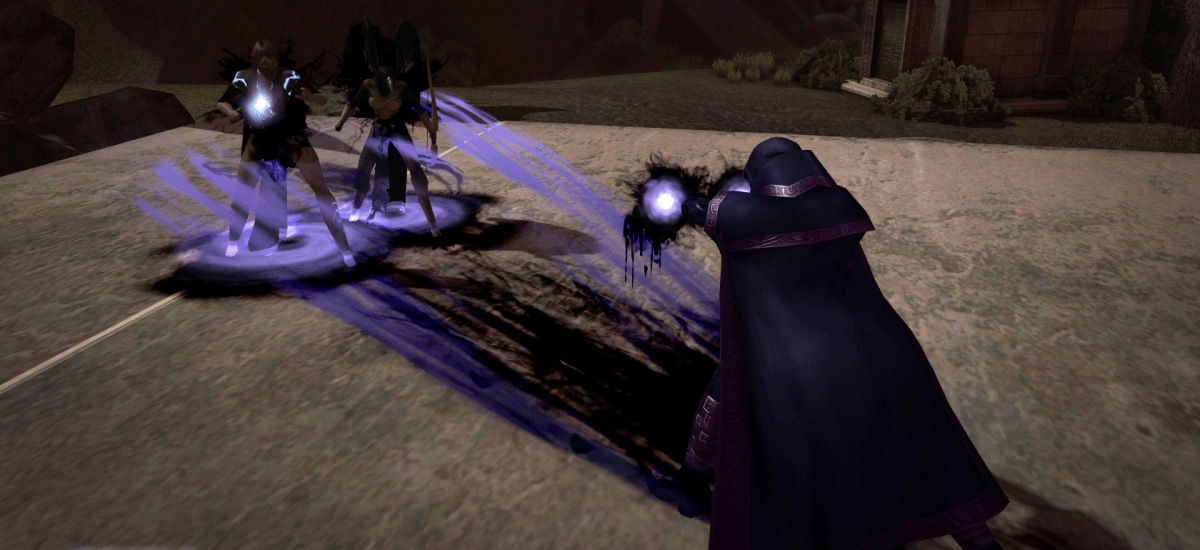
It’s been five months since City of Heroes shut down, and the more we hear about the events surrounding the closure of Paragon Studios, the less realistic that NCSoft’s explanation that they had “exhausted all options” seems to become. Gamasutra has published a very informative piece on the closing of Paragon Studios, detailing how Paragon Studios management attempted to buy out the studio, its employees, and its games. Due to a last minute roadblock, the deal fell through and we all know what happened next.
“It was very much a surprise. We all were really working as if things were going to work out. … It was business as usual right up until the last day.”
-Matt Miller, former lead designer at Paragon
You can read the rest of the three page article at the link below.
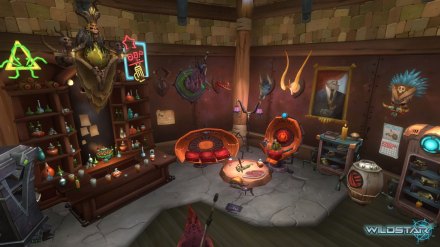
NCSoft released a decent number of screenshots and concept art for Wildstar today, and I’ve taken the liberty of posting one of the more interesting (in my opinion at least) of the player housing screenshots. Set for release in 2013, Wildstar comes to us from Carbine Studios and will be published by NCSoft.
MMOrning Shots is a (somewhat) daily line of screenshots from various MMOs. Most are taken by our in-house editors, but if you would like your screenshot featured, send it over to contact[at]mmofallout[dot]com with the subject “MMorning Shots.”
Mark this as a feature that all MMOs should adopt. For as long as online games have had gold farmers or abuse players, and ignore lists that are capped in how many people can be blocked, there has been the drudgery of spring cleaning said ignore list. Wouldn’t it just be easier for the game to automatically remove players who have been permanently banned, saving you the trouble of unblocking someone only to have them start harassing you again? NCSoft thinks so, and back in November Aion was treated to an update where the game now performs weekly sweeps of block lists, automatically removing any characters that have been removed from the game.
In the patch notes for March 13th’s server maintenance, Lineage II is following suit with its own implementation:
Block List Removal begins. Any characters that were banned since last week and were on your block list will be automatically removed during the maintenance. This will be a recurring process every week.
Just once I’d like to see a game receive a mature rating because the content is so hard hitting that it requires an adult mindset to digest. Until then, however, we’re going to have to deal with the fact that an MMO’s ESRB rating is generally directly proportional to the level of exposure of a certain part of the female anatomy. Of course I’m speaking of breasts, whether large, small, and of all shapes and sizes. In the past few years, we’ve seen a number of titles translated for the western audiences that end up being censored out of fear of either controversy or a bad rating by the ESRB/PEGI. These censors usually end up affecting classes/characters who could be misconstrued as underage, when they are simply small and petite.
A few gamers noted that a recent trailer for Blade & Soul that the game appears to have several alterations, adding some clothing where it didn’t exist in the Korean version. NCSoft released a press statement clarifying that they have only the utmost respect for Team Bloodlust, and that the censored models are solely for promotional purposes.
Due to ESRB guidelines, however, our marketing material must abide by a different set of considerations than the final product. This is why Blade & Soul‘s rating is listed as “pending.” It is NCSOFT West’s intention to accurately depict the game in its original, unaltered form, with only minor adjustments for gameplay considerations. In short: We are not planning to censor or alter the actual in-game content you have come to expect from an artist such as Hyung-Tae Kim and a studio such as Team Bloodlust. Rest assured that we love Blade & Soul as much as you do, and any modifications to the marketing material are not indicative of our plans for the final content.
No rest for NCSoft. Coming on the heels of Guild Wars 2’s success, and with the recent release of Blade & Soul over in Korea, and the upcoming releases of Wildstar and Lineage Eternal, you might fall under the pretense that the Korean publisher is up to their necks with work. You would be wrong, as NCSoft has inked a partnership with Epic Games to develop two new MMOs under the Unreal 4 Engine.
There are no confirmed titles in the works, and the two games are separate from NCSoft’s existing library. Rumors suggest that one or both may be either the long-delayed and thought to be cancelled Lineage III, and possibly Aion 2. Aion had recently stated a committal to existing IP.
Regardless, we won’t be seeing anything from these games for a long time. According to an NCSoft rep, not until after Lineage Eternal.
Talk about springing back. Strong sales in Lineage, Guild Wars 2, Blade & Soul, as well as mobile games, NCSoft has recorded historical high quarterly revenues for the fourth quarter of 2012. In the latest report, NCSoft marked a 56% increase in quarterly sales, a 208% increase in quarterly operating profit, 110% increase in pre-tax income, as well as a 116% quarterly increase in net income. The fourth quarter saw moderate to high increases in sales for Lineage, Lineage II, with the sales from Guild Wars 2 nearly tripling during the same period. Aion, as well as NCsoft’s latest title, Blade & Soul, saw marginal decreases over the same time period. Lineage II managed to reverse, at least for this quarter, a downward trend in sales that began in Q4 2011 while the original Lineage continues on an unpredictable, yet averaging upward, trend in sales despite its age.
Guild Wars 2 has already proven itself as NCSoft’s most successful product to date, breaking the record set by Aion during its peak sales by a long shot. NCsoft’s parent-company reports are, sadly, not as inspiring. While sales went up 15% quarterly, quarterly operating profit went down 1% with pre-tax income and net income both falling hard and ending up in the red for Q4.
And to wrap this up, we’ll look at everyone’s favorite part of NCSoft’s quarterly reports: Demographics. As expected from the launch of Guild Wars 2 and Blade & Soul, sales in Korea shot up with North America and Europe also taking a dramatic shift upward. Sales in Japan and Taiwan mostly remained the same while sales from royalties were boosted slightly.
Gold farming in Aion is a pretty major problem. Similar to NCSoft’s other big name title, Lineage II, Aion players have become accustomed over the years to logging in and going through the ritual of reporting and blocking the new set of bots spamming the multiple chat groups and sending them whispers of cheap gold, fast delivery, and poor English (as opposed to MMO Fallout’s gold farming service which carries high prices, no delivery, and a staff of folks who understand English very well, especially the more vulgar parts of it). NCSoft has put forward various efforts to improving the process, like automatically clearing ignore lists of banned accounts, all the way back to launch when NCSoft sent GM’s in-game to blow up gold spammers.
And now, NCSoft declared all-out war on gold farming by firing the first shot: Banning IPs. NCSoft will be blocking Chinese IPs from creating accounts on Aion, due to high RMT traffic coming from the country. As for proxies, they will be blocked too if they become a problem:
Please note that proxies have become an integral tool for illicit behavior in MMOs, and as a result we do target them when we undertake anti-RMT efforts. However, legitimate latency reduction services are recognized, and a proxy will not be banned unless it is confirmed to be part of unsanctioned behavior.
And what happens if the gold farmers leave China? NCSoft is willing to follow them. The post makes note that should the gold farming become a problem from another country, NCSoft may begin knocking out access from other countries on a case-by-case basis. This only applies to newly created accounts, it does not stop current accounts from using their game.
City of Heroes is undoubtedly the most surprising shut down of the year, not to mention the show of support for the game by its community during its last days.
You didn’t think that the drama surrounding City of Heroes was over just because the servers had shut down, did you? Well think again. MMORPG.com has posted an article today detailing exchanges between NCSoft and a former Paragon Studios employee over the fate of City of Heroes, and as usual the two pieces of information directly clash with one another. According to the source from Paragon Studios, City of Heroes had been profitable even before the transition to free to play, bringing in twelve million annually compared to four million in operating costs. NCSoft apparently wanted $80 million to sell City of Heroes to another developer, however they valued the game at $3 million for tax purposes. Ultimately, however, the game was shut down as while the game was profitable, the profits were not “what they needed to be,” and Paragon wound up the weak link in NCSoft’s restructuring.
MMORPG.com asked for a comment from NCSoft, and received the following note from Lincoln Davis, Director of Corporate Communications:
“It is disappointing that such inaccurate information was provided to MMORPG by an anonymous source and is being reported on as news. The operating cost, annual revenue figures and other financial information shared by this anonymous source are simply wrong. The studio was unprofitable before the shutdown. Both NCSOFT and Paragon Studios were incredibly proud of the transition of City of Heroes to a Free to Play business model, but unfortunately it wasn’t enough to support the studio’s needs. We made the difficult decision to close Paragon Studios and sunset City of Heroes because the franchise no longer aligned with the long term profitability goals for the company.
“While we looked to sell the franchise multiple times, we were unsuccessful in finding a suitable partner that we thought would support City of Heroes’ fans in a manner they were accustomed to for years to come. Closing a studio and sun setting a beloved franchise is never an easy thing to do for the publisher, the developer or the fans. This was not an easy decision to make. The Heroes and Villains have taken to the skies of City of Heroes for the last time, but the game and community will remain in our memories. We truly thank our fans for their years of support and we hope they understand the difficult position we were in when making the final decision.”
I’d like to look at one particular node: Paragon Studios. Now, the anonymous source claims that Paragon Studios had another game in the works, a Lost meets Minecraft game, which means that Paragon was eating far more money than simply keeping City of Heroes optional. Lincoln Davis doesn’t say that City of Heroes was unprofitable, and one can only imagine that such a game wouldn’t consume three million dollars a quarter in upkeep alone. Rather, Lincoln Davis specifically states that “the studio” was not profitable, referring to Paragon Studios itself. It is entirely possible that while City of Heroes was profitable, the second project that Paragon Studios was consuming the rest of its revenue and then some, leaving the studio as a whole as a burden on NCSoft’s finances.
I should point out that the source was anonymous by request, meaning MMORPG.com presumably knows who they are talking to and that person is a credible source in the company. It is also important to note that this is the first time someone from NCSoft has commented directly that Paragon Studios was not making a profit, a comment that should have been made several months ago when Paragon Studios was first shut down. Despite the comment by Lincoln Davis, the latest entry into the City of Heroes saga once again leaves us with more questions than answers.
Was City of Heroes itself profitable? How much was this second project by Paragon Studios costing them to develop? Why didn’t Paragon just shut down the project since it was apparently breaking the bank? What was going on with this second game Paragon Studios was making? If the cost that NCSoft was asking for City of Heroes was not $80 million, as Lincoln Davis claims the figures were “simply wrong,” then how much were they asking for? If Paragon Studios was unprofitable due to these other projects, what kind of money were they losing every quarter? Who decided that shutting the game down now would be better than putting it into maintenance mode and simply ceasing development (like Microsoft recently did with Age of Empires Online)?
We will probably never get a complete answer on exactly what was going on at NCSoft and Paragon Studios that lead up to the shut down, but the statement by Lincoln Davis paints a pretty clear picture that the performance of Paragon as a studio and its other projects, regardless of how City of Heroes itself had been running, played a major part in the studio being shut down. There is an answer somewhere, and it is likely much more complicated than any of us will be able to figure out.
City of Heroes is undoubtedly the most surprising shut down of the year, not to mention the show of support for the game by its community during its last days.
You didn’t think that the drama surrounding City of Heroes was over just because the servers had shut down, did you? Well think again. MMORPG.com has posted an article today detailing exchanges between NCSoft and a former Paragon Studios employee over the fate of City of Heroes, and as usual the two pieces of information directly clash with one another. According to the source from Paragon Studios, City of Heroes had been profitable even before the transition to free to play, bringing in twelve million annually compared to four million in operating costs. NCSoft apparently wanted $80 million to sell City of Heroes to another developer, however they valued the game at $3 million for tax purposes. Ultimately, however, the game was shut down as while the game was profitable, the profits were not “what they needed to be,” and Paragon wound up the weak link in NCSoft’s restructuring.
MMORPG.com asked for a comment from NCSoft, and received the following note from Lincoln Davis, Director of Corporate Communications:
“It is disappointing that such inaccurate information was provided to MMORPG by an anonymous source and is being reported on as news. The operating cost, annual revenue figures and other financial information shared by this anonymous source are simply wrong. The studio was unprofitable before the shutdown. Both NCSOFT and Paragon Studios were incredibly proud of the transition of City of Heroes to a Free to Play business model, but unfortunately it wasn’t enough to support the studio’s needs. We made the difficult decision to close Paragon Studios and sunset City of Heroes because the franchise no longer aligned with the long term profitability goals for the company.
“While we looked to sell the franchise multiple times, we were unsuccessful in finding a suitable partner that we thought would support City of Heroes’ fans in a manner they were accustomed to for years to come. Closing a studio and sun setting a beloved franchise is never an easy thing to do for the publisher, the developer or the fans. This was not an easy decision to make. The Heroes and Villains have taken to the skies of City of Heroes for the last time, but the game and community will remain in our memories. We truly thank our fans for their years of support and we hope they understand the difficult position we were in when making the final decision.”
I’d like to look at one particular node: Paragon Studios. Now, the anonymous source claims that Paragon Studios had another game in the works, a Lost meets Minecraft game, which means that Paragon was eating far more money than simply keeping City of Heroes optional. Lincoln Davis doesn’t say that City of Heroes was unprofitable, and one can only imagine that such a game wouldn’t consume three million dollars a quarter in upkeep alone. Rather, Lincoln Davis specifically states that “the studio” was not profitable, referring to Paragon Studios itself. It is entirely possible that while City of Heroes was profitable, the second project that Paragon Studios was consuming the rest of its revenue and then some, leaving the studio as a whole as a burden on NCSoft’s finances.
I should point out that the source was anonymous by request, meaning MMORPG.com presumably knows who they are talking to and that person is a credible source in the company. It is also important to note that this is the first time someone from NCSoft has commented directly that Paragon Studios was not making a profit, a comment that should have been made several months ago when Paragon Studios was first shut down. Despite the comment by Lincoln Davis, the latest entry into the City of Heroes saga once again leaves us with more questions than answers.
Was City of Heroes itself profitable? How much was this second project by Paragon Studios costing them to develop? Why didn’t Paragon just shut down the project since it was apparently breaking the bank? What was going on with this second game Paragon Studios was making? If the cost that NCSoft was asking for City of Heroes was not $80 million, as Lincoln Davis claims the figures were “simply wrong,” then how much were they asking for? If Paragon Studios was unprofitable due to these other projects, what kind of money were they losing every quarter? Who decided that shutting the game down now would be better than putting it into maintenance mode and simply ceasing development (like Microsoft recently did with Age of Empires Online)?
We will probably never get a complete answer on exactly what was going on at NCSoft and Paragon Studios that lead up to the shut down, but the statement by Lincoln Davis paints a pretty clear picture that the performance of Paragon as a studio and its other projects, regardless of how City of Heroes itself had been running, played a major part in the studio being shut down. There is an answer somewhere, and it is likely much more complicated than any of us will be able to figure out.