Blade & Soul Now F2P In Japan


cat

MMO Culture is reporting that Blade & Soul has officially gone free to play in Japan. Players are able to play for free with an optional VIP membership, with details for that coming later this month.

The article notes that players in Korea are upset at NCSoft now that Korea is apparently the last remaining pay-to-play region for Blade & Soul

(Source: MMO Culture)

Nexon Engaging Hostile Takeover Of NCSoft


WildStar64 2014-05-08 13-12-45-60

The relationship between Nexon and NCSoft has reportedly turned sour as the former has decided to take on a management role in the latter. Over two years ago Nexon purchased a majority stake in NCSoft, announcing at the time that it was purely for “investment” purposes. Relations between the two companies apparently soured when NCSoft appointed CEO Kim Taek-jin’s wife, Yoon Song-yee, to the role of President without notifying Nexon.

CEO Kim Taek-jin has vocally announced his displeasure with Nexon’s decision, stating:

“Nexon’s latest decision will damage the values of the NCSoft shareholders and weaken the competitiveness of the entire Korean game industry due to the (companies’) differing management philosophies and business models,”

NCSoft and Nexon have had a hard time getting along since the shareholder buyout, as differences in business perspective and management resulted in the failure of their first joint project: Mabinogi 2.

(Source: Korea Herald)

Guild Wars 2 Double Exp Weekend


guild-wars-2_83015

This weekend looks to be a big one for Guild Wars 2, and ArenaNet is kicking off with a double experience weekend and the biggest sale the game has seen yet. New players will be able to pick up Guild Wars 2 for $9.99, the cheapest the game has been in some time, while all players will be able to take advantage of double experience all weekend in-game.

On Saturday, ArenaNet will be broadcasting a special presentation titled “Beyond the Point of No Return,” featuring studio president Mike O’Brien and game director Colin Johanson. ArenaNet is expected to announce something large coming to Guild Wars 2.

(Source: NCSoft Press Release)

Reminder: Daewoo Is Not An Official Source


Tu3G4R2

Daewoo Securities, a financial investment group in Korea, have released an earnings forecast for NCSoft that is throwing some of the community into a ruckus. The whole thing stems from the prediction that in Q3 2015, Guild Wars 2 will see a massive rise in sales thanks to an upcoming expansion launch.

Here’s what you should know about the forecast: Daewoo is not an official source for any of NCSoft’s products. They are a third party investment firm that makes predictions based off of speculation and assumptions.

As of this publishing, NCSoft has not announced an expansion to Guild Wars 2, let alone one launching in 2015. For context, this is Daewoo’s full prediction regarding Guild Wars 2:


Also, in 2015, NCsoft is expected to roll out an expansion pack for Guild Wars 2, which has sold more than 3mn copies since its release in 2012 in the US and Europe. We assumed in our 2015 earnings estimates Guild Wars 2 expansion pack sales of around 2mn copies (US$50 per copy), and note that the expansion packs for Guild Wars 1 have sold almost as much as the original game in the year of their release.

A snippet of Daewoo’s disclaimer:

Information and opinions contained herein have been compiled from sources believed to be reliable and in good faith, but such information has not been independently verified and Daewoo makes no guarantee, representation or warranty, express or implied, as to the fairness, accuracy, completeness or correctness of the information and opinions contained herein or of any translation into English from the Korean language.

To inject some positivity into this, the rest of Daewoo’s predictions seem pretty solid. The firm predicts high sales from NCSoft’s numerous mobile games being released this year based off of trends from Activision Blizzard, Netease, Changyou, and Electronic Arts.

Arenanet will be hosting a panel at PAX South to discuss the future of Guild Wars 2 later this month.

(Source: Source)

Frequently Asked: NCSoft


ncsoftquarter

Frequently Asked is a new column relating to MMOs and common questions that I receive and see on other websites. If you have any questions of your own, feel free to drop a comment.

1. Why does NCSoft shut down everything?

Short answer: money. The longer answer is that NCSoft has made a lot of risky investments that didn’t work out and cost them a lot of money, due to poor management or design. Some of these were doomed to fail, while others simply found themselves in the wrong place at the wrong time. In order to properly understand each game, we need to look at them individually. This is going to be a long process.

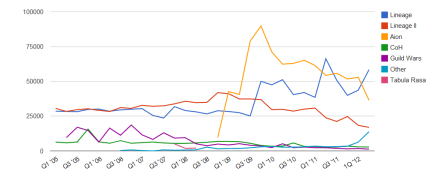
Lineage is the first game on the list, and a perfect example of the differences between the Korean and western gaming markets. South Koreans love their mmos, so much so that subscriptions for Lineage and other online games are actually included as perks to get people to sign rental leases. Imagine going apartment hunting and seeing a World of Warcraft subscription listed alongside utilities, laundry access, and parking. Despite its impact and obvious popularity, with revenue dwarfing and now exceeding the cumulative earnings of the rest of NCSoft’s catalog, the fact that Lineage was declared not financially viable in the west and subsequently shut down back in 2011 says a lot about the ability of NCSoft’s products to penetrate the foreign market.

Now let’s talk about their other games. Auto Assault launched in 2006 to sales that would later be tenderly described as “sluggish.” It was buggy, unfinished, and rushed to market with a fifty dollar price tag and a full subscription price. In fact, the game did so poorly that it was pegged as the primary culprit for the company posting a two hundred thousand dollar loss that quarter, thanks to a one-time write off of $13.1 million. Just two months later, NCSoft-Austin went through a restructuring, laying off seventy of its three hundred workers while the publisher’s stock tanked and lost roughly a third of its value over the same period. With Arenanet celebrating the tremendous launch of Guild Wars and City of Heroes remaining at a stable one hundred fifty thousand subscribers, it’s no wonder that NCSoft decided to axe Auto Assault.

Tabula Rasa is one of NCSoft’s biggest series of blunders to date, and a name that the executives would really like to forget. What we do know of Tabula Rasa’s development cycle is that it originally started as a heavily Asian influenced fantasy MMO aimed at the Chinese and Korean markets, with everything from player owned housing, music-based classes, and unicorns. When focus testing resulted in overwhelmingly negative feedback, Tabula Rasa was redesigned as the sci-fi shooter that we all know and a few of us even loved. Unfortunately for Richard Garriot and his team, this meant wasting two years of development and millions of dollars on a lost cause. As a result, Tabula Rasa saw increasing pressure to release a finished product and start making money, leading to the game’s poor state when the servers went live in 2007.

Having already wasted a lot of time and money, NCSoft evidently had no intention of investing any more when the game launched to a first quarter return of five million dollars, compared to its projected $50 million. In September 2008, similar to Auto Assault’s launch, NCSoft’s western operations went under yet another round of layoffs, this time in the UK offices. The company denied that Tabula Rasa was to blame, although they also denied that the game was shutting down just a couple months before announcing that Richard Garriot had left the building and the servers would be coming down in early 2009.

On top of the game’s losses, NCSoft was apparently so eager to get rid of Richard Garriot that they either didn’t properly consult their lawyers or didn’t care to, because they fired him and then penned a letter to the public by claiming that he had resigned. Garriot sued NCSoft for fraud and was awarded $28 million in damages and lost stock opportunities. Yea, NCSoft doesn’t like to talk about Tabula Rasa.

Exteel. Whenever people ask me where the name for MMO Fallout comes from, I tell them that it’s a nod to the radiating effect that success and failure in the industry has on other products. Tabula Rasa went down in such a blaze of glory that it actually caused direct collateral damage. Following Richard Garriot’s successful lawsuit and the loss of $28 million (plus the cost of lawyers and other fees) on top of what had already been a financial hole, NCSoft made the surprise decision and shut down Exteel. In the report detailing the shut down, NCSoft directly lays the blame on the game’s unstable income and makes reference to the losses sustained from the Garriot lawsuit, and while there is no way to know for sure (due to Exteel not being individually listed in NCSoft’s income), it is certainly possible that had the lawsuit never happened, Exteel might have remained running in relative obscurity at least for a little while longer.

Dungeon Runners. Speaking of running in obscurity, NCSoft’s other title Dungeon Runners was announced for closure just months after Exteel. As a game, Dungeon Runners was much beloved by its small and unprofitable community, but as a money making venture it was a tiny blip just barely making the radar of NCSoft. The publisher described it as an experiment in game design, one that they had gathered suitable data with. When the development team slowly dwindled down to three people with the game still not turning a profit, NCSoft made the decision to shut the servers down.

City of Heroes: City of Heroes is the only game on this list that was an undeniable success, and the fact that it is the only game that NCSoft has shown any interest in reviving says a lot about how they feel about the MMO. While the other games on this list were victims of profitability and restructuring following financial disaster, City of Heroes was the victim of NCSoft reorganizing its vision to encompass triple-a games and pretty much nothing else. City of Heroes had been coasting at a cool 2.5 to three million quarterly, and reports from NCSoft and ex-employees around the time of its demise seem to indicate that while the game was profitable in a vacuum, Paragon’s work on two other IPs at the time led to the studio itself being unprofitable. Given the already small part that City of Heroes played in NCSoft’s overall business and their new strategy of AAA gaming, it can be assumed that the publisher had no interest in working out a solution to Paragon Studios being unprofitable.

2. Why doesn’t NCSoft just sell their games?

Business deals are a closely guarded secret that, barring the revelations of an old CEO on his deathbed, we will never know the answer to. Next.

Oh right. We can assume a few reasons for why NCSoft doesn’t sell their failed MMOs, none of which are based off of anything other than mildly informed speculation. First, there are software issues. MMOs tend to use a lot of middleware software to deal with stuff like physics and the underlying engine, making it difficult if not impossible to transfer those rights to another company. Think of it like the EULA preventing you from selling your pc games, but on a corporate level. Secondly, while selling off a game and allowing another company to try and turn it into a viable product may seem like a win-win from a PR perspective, the idea of creating your own competition goes against every lesson in business school.

Third, there are investors and stockholders. Nothing could be more embarrassing and potentially damaging to a company’s reputation than to have them fail at developing a product only to hand that off to another company and have them do a better job. You’d be hard pressed to find a developer willing to shoot themselves in the foot and then proudly parade their inferiority to shareholders. Finally developers are creators, and if creators are anything, they are possessive. MMOs are a labor of love, encompassing years of a developer’s life to the detriment of family, friends, marriages, and often mental and physical health. Sometimes people don’t want to give that up.

3. Can I trust the NCSoft brand?

The answer to this is pretty subjective and complicated. If any lesson can be learned from NCSoft’s history it is that the company doesn’t have much patience for failure. That being said, the new company vision for AAA titles pretty much ensures that smaller games like Auto Assault or Tabula Rasa will never be approved, let alone launched and then shut down. NCSoft is only interested in games that have massive potential like Blade & Soul and Lineage Eternal, and while the corporate attitude may not protect, say, Carbine Studios from seeing the repercussions of Wildstar’s performance, at least we have the confidence that the game will likely go free to play rather than simply shutting down as with its predecessors.

So you can look at it either way, with NCSoft as a soulless corporation that puts profits over everything else, or that the digital graveyard that makes up NCSoft’s catalog is a relic of a bygone era that is no longer relevant to their current decision making. Regardless, you will not be dealing with a company like Sony Online Entertainment, who keep a lot of their games online long after they were no longer profitable.

NCSoft Third Quarter Finances


ncsoft3q

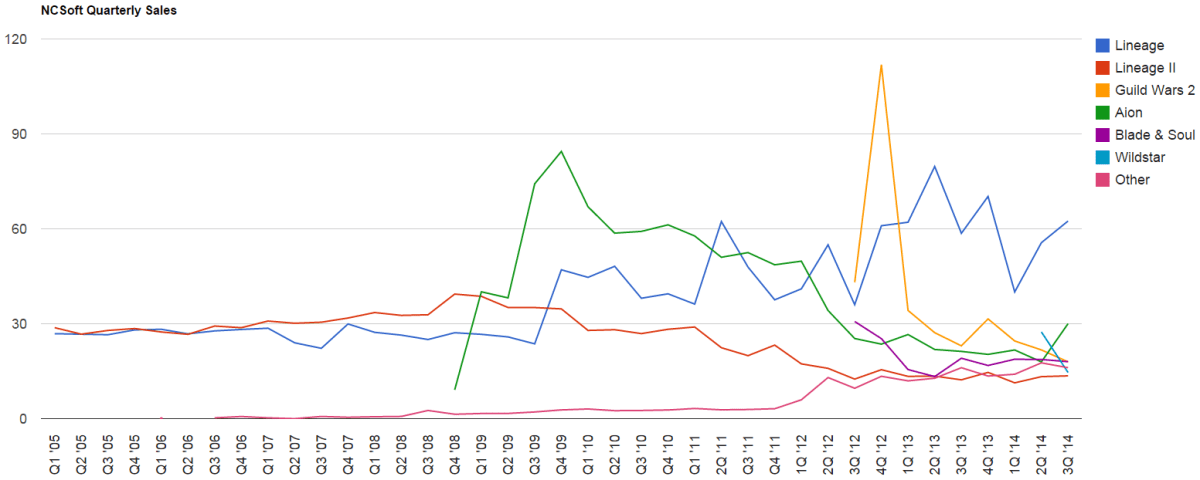
NCSoft has released their third quarter finances, and the news is good. While sales decreased 1% since last quarter, they amounted to approximately $195 million. Operating profit increased 25% quarter over quarter to $74.15 million, with pre-tax income up 33% and net income up 43% to $79 million and $69 million respectively.

Increased revenue was attributed to sales in Aion, Lineage, Lineage II, and Blade & Soul in Korea. Wildstar’s income dropped substantially, down to $14 million from $27 million during its launch quarter. Guild Wars 2, meanwhile, had its third straight quarter of falling revenue, down to $17.95 million from $21 million last quarter and $31 million of its previous peak in the fourth quarter of 2013. Korea once again made up the bulk of NCSoft’s sales, an increase over last quarter to 65%. The US and EU, which were combined into the same category, amounted to 18% of sales, with Japan at 5%, Taiwan at 1% and an addition 10% from royalties.

(Source: NCSoft)

NCWest Layoffs Inbound Across All Departments


WildStar64 2014-05-08 13-17-37-21

NCSoft has confirmed a round of layoffs at its western operations, affecting all of its studios outside of ArenaNet. The layoffs come as a result of “restructuring of key operations within NC West,” as the developer pushes towards mobile and tablet gaming, as well as emerging technologies. Polygon has cited an unnamed source stating that over sixty members of the Carbine Studios team were laid off.

The statement by NCSoft:

Today we announced a restructuring of key operations within NC West. As a result of this restructuring, we are implementing staff reductions across our Western operations with the exclusion of ArenaNet. While decisions like this are always hard, they are necessary as we begin the implementation of a new strategy designed to strengthen our footing as a leader in global entertainment.

Moving forward, we will continue to focus on our core development capabilities and the intellectual properties (WildStar, Aion, Lineage, and Guild Wars franchises) that have made NCSOFT what it is today. However, we are looking to move into new business segments like mobile and tablet games as well as explore emerging technologies.

Again, the decision to reduce staff was not an easy one, and we sincerely wish everyone well in their next endeavors.

(Source: Polygon)

[Editorial] Gem Store Update Poorly Introduced, Response Even Worse


gw089

The latest gem store update to Guild Wars 2 has had players up in arms, and it’s hard not to sympathize with their position. Previously, buying and selling gems was a process that involved deciding how much you wanted to buy/sell, setting an asking price, and waiting until your order was filled. If you wanted enough gems for a Black Lion chest key, you could get it. If you had 124 gems and wanted an item that cost 125 gems, you could buy that extra gem.

If you can figure out what is wrong with the new gem shop interface in the screenshot above, you probably don’t work for Arenanet. Given that the trade shop was built to be flexible and user-friendly, the change to a system that is entirely based on fixed, inflexible increments seems counterproductive and quite baffling in its logic, but so far Arenanet doesn’t seem to understand why players would be angry about being forced to buy 400 gems minimum.

As seems to be the popular excuse, Arenanet blamed the update on new players not understanding the system, a problem that apparently only exists in Arenanet’s customer support tickets. Communications team lead Gaile Gray has not helped the situation by going on the offensive against players in the forums. In her first response, Gray explained that “very few people bought gems at smaller denominations.” Following pages of complaints and suggestions, Gray made another post making no acknowledgement of the previous suggestions and instead decrying “most” of the posters as nonconstructive ranters.

Ok, guys. Some of you are unhappy about this change, I can see that. BUT… quite honestly, most of you are sort of (I hate to use the word) ranting (sorry!) instead of offering suggestions.

The comment on this update being geared towards new players is suspicious at best, considering that the lowest increment of gems now costs 75 gold. How many new players are going to have 75 gold to spend on the gem store? None. The only impact that this could conceivably have on new players is to remove their ability to purchase smaller amounts of gems and funnel them toward buying the gems with real money.

Guild Wars 2 has a habit of introducing updates which beg the question “who asked for this?” The answer is usually a lot of unseen people who submit support tickets and then apparently never feel the need to discuss the matter anywhere else, because if you searched the forums you wouldn’t come up with many, if any, results.

Arenanet has already confirmed that an update will allow player to use either system to their choosing, begging the question on why it wasn’t just included in the first place.

Wildstar Merger Nukes Low Level Inactive Characters


WildStar64 2014-05-08 13-17-37-21

Carbine Studios is set to launch the Wildstar megaservers this week, on Wednesday October 15th. Players will be grouped into one of four servers, based on their physical location (US and EU) and server type (PvE or PvP). Due to the complicated nature of the merger, Carbine Studios is expecting a downtime of twelve to twenty four hours, which will be compensated in the form of thirty Boom-Boxes and an extra day of game time. To avoid naming issues, players will be required to create unique surnames. Guilds with conflicting names will hand priority over to the oldest guild, with the newer one being forced to change its name.

As part of the update, characters under level 3 that are inactive (not logged in within 30 days of the merger) will be deleted.

(Source: Wildstar)

Wildstar State of the Game


WildStar64 2014-05-08 13-12-45-60

Carbine Studios has released the latest State of the Game address for Wildstar. After hitting some hurdles with population and having to drop their monthly update plan, Mike Donatelli posted a list of updates that are currently in the works for the next update. Players can look forward to new zones, new lore, and other content updates in addition to the tackling of long standing bugs in need of squashing.

  • Two new chapters of content, including solo, five-player, and 20-man events.
  • Fully voiced NPCs in new zones.
  • Option to skip the tutorial on alts.
  • Various improvements to low level zones.
  • Combat balances.
  • Bug fixes and long-demanded tweaks to UI, mechanics, and more.

(Source: Wildstar)